


Hair mesotherapy and PRP are both injection-based treatments for thinning hair, but they work differently. Mesotherapy delivers selected substances into your scalp, while PRP uses a concentrated part of your own blood.
Neither treatment is always better. PRP currently has a broader clinical evidence base for androgenetic alopecia, particularly for hair density, although studies remain heterogeneous and the certainty of evidence is limited. Mesotherapy results are even more formulation-dependent because different studies inject different active ingredients and use different protocols.
What Is Hair Mesotherapy?
Hair mesotherapy involves delivering small amounts of a selected formulation through multiple injections into the scalp. Injection depth, concentration, spacing and treatment schedule can vary according to the protocol. The aim is to deliver the chosen ingredient closer to your hair follicles rather than applying it only to the scalp surface.
Mesotherapy describes a delivery method rather than one specific medicine, so different clinics may use different formulations. Dutasteride is one of the more studied options for pattern hair loss, but you should ask exactly what will be injected and why it has been chosen for you.
What Is PRP Hair Treatment?
PRP stands for platelet-rich plasma and uses a sample of your own blood rather than a manufactured medication. Your blood is processed to concentrate the platelets, and the resulting plasma is injected into selected areas of your scalp.
PRP contains platelets and associated growth factors that are proposed to influence processes involved in follicular activity and hair growth. PRP is not completely standardised, as platelet concentrations, injection techniques and treatment schedules can vary between clinics.
What Is the Main Difference Between Mesotherapy and PRP?
The biggest difference is what gets injected into your scalp. Mesotherapy introduces an external active ingredient, while PRP uses a preparation made from your own blood, so the two treatments work through different biological pathways.
For example, dutasteride inhibits 5-alpha-reductase and is used in mesotherapy protocols intended to reduce androgen-related follicular miniaturisation, whereas PRP relies on an autologous platelet-rich preparation rather than a 5-alpha-reductase inhibitor. If you are comparing the two, the more useful question is whether PRP or a specific mesotherapy formulation is better suited to your diagnosis, treatment history and expectations.
Which Types of Hair Loss May Respond?
Most research on PRP and hair mesotherapy focuses on androgenetic alopecia, also known as male or female pattern hair loss. If you have this type of hair loss, PRP may improve hair density, while dutasteride-based mesotherapy has also shown potential, although the available evidence remains more limited.
You should not assume that either treatment will suit every type of hair loss. If you have sudden shedding, patchy hair loss, an inflamed scalp or signs of permanent follicular damage, you may need a different diagnosis and treatment approach before you consider injectable treatments.
Hair Mesotherapy vs PRP: How Do They Compare?
Both treatments involve scalp injections, but they differ substantially in what is injected, how well standardised the treatment is and the strength of the current evidence.
| Feature | Hair mesotherapy | PRP |
| What is injected? | A selected medicine or other formulation, depending on the protocol | Platelet-rich plasma prepared from your own blood |
| Standardisation | Low; ingredients, concentrations, depths and schedules vary | Also variable; platelet concentration, centrifugation and injection protocols differ |
| Main research area | Predominantly androgenetic alopecia | Predominantly androgenetic alopecia |
| Current evidence | Some formulations, including dutasteride, have reported favourable outcomes, but evidence is highly heterogeneous and cannot be generalised across all mesotherapy products. | Broader clinical evidence base for androgenetic alopecia, particularly hair density, but evidence quality remains limited by heterogeneous protocols and study quality |
| Medicine-specific risks | Depend on the substance injected in addition to injection-related risks | Does not introduce dutasteride, minoxidil or another external medicine, but injection-related risks remain |
| Treatment schedule | No universally accepted schedule | Courses of several treatments are common in studies, but no single protocol is universally established |
| Recovery | Temporary tenderness, redness, swelling or bruising may occur | Similar temporary injection-related scalp reactions may occur |
| Long-term results | Uncertain and formulation-dependent | Benefits may require review or further treatment; optimal maintenance is not standardised |
| Best candidate | Depends on diagnosis and evidence for the specific formulation | Most evidence relates to androgenetic alopecia |
| Main question to ask | “What exactly are you injecting and what evidence supports it?” | “How is your PRP prepared and what protocol do you use?” |
Recent systematic reviews support a broader evidence base for PRP in androgenetic alopecia, particularly for improving hair density, while continuing to highlight differences between PRP preparations and the need for further high-quality trials. The 2026 injectable-therapy review found potentially useful mesotherapy outcomes but concluded that more standardised randomised trials are needed.
What Does the Evidence Say About Hair Mesotherapy?

Hair mesotherapy has shown promising results, but you should know that studies use different medicines, doses and treatment schedules. Dutasteride mesotherapy has produced favourable results in some studies, but response rates vary and current evidence does not justify guaranteeing improvement.
You should also be cautious about clinics presenting one fixed treatment plan as proven for everyone. Your specific formulation, dosage and treatment frequency matter more than the general term “mesotherapy”, so you should discuss the evidence and expected results with your practitioner.
What Does the Evidence Say About PRP?
PRP has been studied more extensively than hair mesotherapy for androgenetic alopecia, with several reviews reporting improvements in hair density. You may see a benefit after a course of treatment, although studies use different PRP preparation methods and treatment schedules, so results can vary.
You should not treat research findings as a guarantee of a particular result. Recent reviews continue to describe PRP as promising, but you should remember that factors such as platelet concentration, preparation method and injection technique can affect your treatment outcome.
Important Safety and Licensing Note
Dutasteride mesotherapy is an off-label injectable approach for hair loss, and evidence on its effectiveness, safety and optimal treatment protocols remains limited. Dutasteride also has important reproductive safety considerations, particularly where pregnancy is possible or planned, so suitability should be assessed carefully before treatment.
PRP avoids exposure to an external medicine, but it is still an invasive procedure and treatment protocols are not fully standardised. For either treatment, ask what evidence supports the exact protocol, what adverse effects have been reported and what alternative treatments are available.
Is PRP More Effective Than Hair Mesotherapy?
There is not enough strong head-to-head evidence to say that PRP is always better than hair mesotherapy. You should remember that mesotherapy can involve different medicines and formulations, so the results can vary significantly depending on what is injected.
PRP has a broader evidence base for androgenetic alopecia, but that does not mean it will give you better results than every mesotherapy option. You should compare the evidence for the specific mesotherapy formulation being offered to you rather than judging the treatment by the general term “mesotherapy”.
What Results Can You Expect from Each Treatment?
With either treatment, you may notice reduced shedding, thicker-looking hair or improved visible density if your existing follicles respond well. PRP currently has a broader evidence base for improving hair density, while your mesotherapy results will depend largely on the active ingredient being injected.
You should not expect either treatment to completely restore advanced hair loss. If your follicles are severely miniaturised or permanently damaged, you may see more limited improvement because there is less healthy follicular tissue available to respond.
How Quickly Will You See Results?
Neither PRP nor hair mesotherapy produces immediate hair growth because your follicles need time to respond and move through their natural growth cycle. You may notice reduced shedding before you see clearer changes in hair thickness or visible density.
1. Early Changes: You may first notice less shedding before any obvious improvement in scalp coverage becomes visible.
2. Several Months: Changes in hair thickness and density are generally assessed over several months rather than a few days or weeks.
3. Individual Response: Your timeline can vary according to your diagnosis, follicle condition and the specific PRP or mesotherapy protocol used.
4. Track Your Progress: Consistent photographs taken under the same lighting, angle and hair conditions can help you judge whether treatment is working.
You should avoid deciding too early that either treatment has succeeded or failed. Regular reviews with your practitioner can help determine whether the improvement is meaningful enough to continue treatment.
How Many Sessions Might You Need?
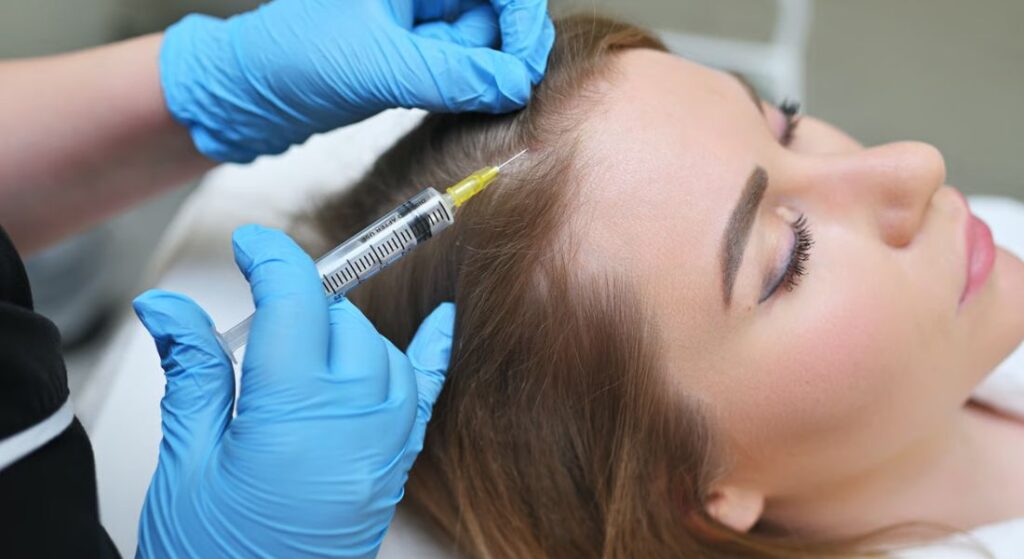
You may need a course of PRP treatments, with around three monthly sessions often studied, although schedules can vary. Hair mesotherapy is less standardised, so your recommended frequency will depend on the active ingredient, such as dutasteride, and the evidence supporting that particular protocol.
You should ask why your practitioner has recommended a specific number of sessions and how your progress will be assessed. If you see little or no measurable improvement after an appropriate period, continuing treatment indefinitely may add cost and inconvenience without providing meaningful benefit.
Which Treatment Is More Comfortable?
Both treatments involve multiple scalp injections, so you may feel pinching, stinging, pressure or brief burning during either procedure. PRP also involves drawing a small amount of your blood first, while mesotherapy usually does not require this additional step.
Your comfort can vary depending on the injection technique, the substance used and your individual sensitivity. You may experience temporary redness or soreness afterwards, but most reported reactions are mild and settle within a short period.
How Do Recovery and Aftercare Compare?
Both treatments usually involve less downtime than hair-transplant surgery, but you may still experience temporary scalp tenderness, redness, swelling or soreness after the injections. With PRP or mesotherapy, these effects are generally short-lived, although your recovery can vary depending on the technique and formulation used.
You should follow the aftercare instructions given for your specific treatment rather than assuming both procedures need exactly the same care. You should also ask when you can wash your hair, restart scalp products and return to strenuous exercise, as well as how to contact your clinic if your scalp becomes increasingly painful or irritated.
What Risks Should You Consider?
You may experience temporary pain, bruising, bleeding, swelling or infection after either treatment because both involve multiple scalp injections. PRP uses your own blood, which avoids some risks associated with external medicines, but you can still develop injection-related inflammation or infection.
Mesotherapy has additional risks that depend on the substance being injected, such as dutasteride or minoxidil. You should ask your practitioner about the specific product being used and seek assessment if you develop unusual reactions, including new localised areas of hair loss after treatment.
Which Treatment Offers Longer-Lasting Results?
You should not assume that either PRP or mesotherapy provides a permanent solution, as androgenetic alopecia can continue to progress over time. PRP studies have reported renewed hair loss in some patients after an initial improvement, suggesting that you may need maintenance treatment to support the results.
With mesotherapy, the duration of benefit depends largely on the active ingredient and how it affects the underlying cause of your hair loss. You should ask how long the expected results may last and whether you may need further sessions, as this can affect your overall cost and treatment commitment.
Myth vs Fact
| Myth | Fact |
| PRP and mesotherapy are basically the same treatment. | Both involve scalp injections, but PRP uses a preparation from your own blood while mesotherapy delivers another selected formulation. |
| PRP is scientifically proven to be better than every type of mesotherapy. | PRP has the broader evidence base, but there is not enough robust direct evidence to show that it is superior to every possible mesotherapy formulation. |
| All mesotherapy treatments contain dutasteride. | Mesotherapy formulations vary considerably and may contain medicines, vitamins, peptides, proteins or other preparations. |
| PRP is completely standardised because it uses your own blood. | PRP protocols vary in platelet concentration, centrifugation, preparation and injection technique. |
| Neither treatment has any risk because the injections are small. | Both can cause injection-related adverse effects, while mesotherapy can also carry risks related to the specific substance injected. |
| More treatment sessions always produce better hair growth. | Neither treatment has a universally established session schedule, and continuing without measurable benefit may simply increase cost and treatment burden. |
| PRP or mesotherapy can restore any completely bald area. | Injectable treatments cannot reliably recreate follicles that have been permanently destroyed. |
| Results from either treatment are permanent. | Androgenetic alopecia can continue progressing and long-term treatment requirements vary. |
How Do PRP and Mesotherapy Compare with Established Hair-Loss Treatments?
PRP and mesotherapy should not automatically replace established treatments for androgenetic alopecia. You may use PRP alongside treatments such as topical minoxidil, while mesotherapy can involve medicines that are also available through other routes.
You should ask whether injecting a particular medicine offers enough additional benefit to justify the discomfort, cost and procedural risks. A 2025 network meta-analysis of treatments for male androgenetic alopecia ranked oral dutasteride 0.5 mg/day higher than dutasteride mesotherapy. However, this was an indirect comparison across studies rather than a direct head-to-head trial, so the results should be interpreted accordingly.
How Can You Choose Between Hair Mesotherapy and PRP?

You should start with an accurate diagnosis rather than choosing a treatment based only on before-and-after photographs. Your practitioner should assess whether your hair loss is consistent with androgenetic alopecia or whether you have another condition that needs investigation or treatment.
You should then compare the specific PRP or mesotherapy approach being offered, including its evidence, expected results, risks and treatment schedule. Your medical history, previous treatments and personal expectations should also help you and your practitioner decide which option is more appropriate.
Key Takeaways
1. PRP and hair mesotherapy both involve scalp injections, but they inject very different substances.
2. PRP uses a platelet-rich preparation made from your own blood, whereas mesotherapy can use many different formulations.
3. Most research for both approaches relates to androgenetic or pattern hair loss.
4. PRP currently has a broader clinical evidence base, particularly for improving hair density.
5. Mesotherapy evidence depends heavily on the substance being injected, and results from one formulation cannot automatically be applied to another.
6. Neither PRP nor mesotherapy has a universally standardised preparation or treatment schedule.
7. There is not enough strong direct evidence to say that PRP is always better than every mesotherapy formulation.
8. Both treatments can cause pain, redness, bruising, swelling and other injection-related reactions.
9. Mesotherapy can also carry medicine-specific risks when drugs such as dutasteride or minoxidil are injected.
10. Neither treatment should be expected to recreate permanently destroyed follicles or guarantee permanent results.
11. An accurate diagnosis should come before choosing an injectable treatment.
12. Treatment should be reviewed objectively rather than continued indefinitely when there is little measurable improvement.
Frequently Asked Questions
1. What is the main difference between hair mesotherapy and PRP?
Hair mesotherapy involves injecting a selected medication or formulation into your scalp, while PRP uses a concentrated preparation made from your own blood. The active ingredients and proposed mechanisms are therefore different.
2. Is PRP better than hair mesotherapy for hair loss?
Neither treatment is universally better for everyone. PRP has a broader body of controlled research for androgenetic alopecia, while the effectiveness of mesotherapy depends heavily on the specific substance being injected.
3. Which types of hair loss can PRP and mesotherapy treat?
Both treatments have mainly been studied for androgenetic alopecia, also known as pattern hair loss. You should have the cause of your hair loss confirmed before considering either treatment, as other conditions may require different approaches.
4. How many sessions of PRP or mesotherapy will you need?
There is no universally agreed treatment schedule for either procedure. PRP is often given as an initial course of several sessions, while mesotherapy schedules vary according to the medication and formulation being used.
5. Are PRP and hair mesotherapy painful?
Both treatments involve multiple injections, so you may experience brief pinching, stinging, pressure or burning. Your level of discomfort can vary according to your individual sensitivity, injection technique and the substance being administered.
6. How quickly can you see results from PRP or mesotherapy?
Neither treatment produces immediate hair growth. Improvements are generally assessed over several months, and you may notice changes in shedding or hair thickness before a visible increase in overall scalp coverage.
7. Do PRP and mesotherapy have the same risks?
Both procedures can cause temporary pain, redness, swelling, bruising or infection because they involve scalp injections. Mesotherapy also carries risks associated with the specific medication being injected, whereas PRP uses a preparation made from your own blood.
8. Which treatment lasts longer, PRP or mesotherapy?
Neither treatment is guaranteed to provide permanent results. Pattern hair loss can continue to progress, so some people may require maintenance treatment regardless of whether they choose PRP or a particular mesotherapy formulation.
9. Can PRP and hair mesotherapy be combined with other hair-loss treatments?
They may sometimes be used alongside established hair-loss treatments, depending on your diagnosis and medical history. Your clinician can assess whether combining treatments is likely to provide additional benefit rather than simply increasing cost and treatment burden.
10. How can you decide between PRP and hair mesotherapy?
Your decision should start with an accurate diagnosis and an assessment of your treatment goals, rather than simply choosing the procedure with the most appealing before-and-after photographs. You should also ask what exactly will be injected, what evidence supports that specific treatment and what results, risks and maintenance requirements you can realistically expect.
Final Thoughts: Choosing Between Hair Mesotherapy and PRP
Choosing between hair mesotherapy and PRP is not simply about deciding which injection treatment sounds more effective. Your diagnosis, the specific substance being injected, the available evidence, your treatment goals and how comfortable you are with repeated sessions all need to be considered before you make a decision.
If you’re looking for hair mesotherapy treatment in London, you can contact our team at London Medical & Aesthetic Clinic to arrange a consultation.
References:
1. Beer, J., Boghosian, T., Mendez, H., Sayegh, M., Boghosian, N. and Tosti, A. (2026) ‘Injectable therapy for androgenetic alopecia: a systematic review’, Dermatologic Surgery, 52(7), pp. 659–665. Available at: https://pubmed.ncbi.nlm.nih.gov/41603616/
2. Kieling, L., Konzen, A.T., Zanella, R.K. and Valente, D.S. (2024) ‘Is autologous platelet-rich plasma capable of increasing hair density in patients with androgenic alopecia? A systematic review and meta-analysis of randomized clinical trials’, Anais Brasileiros de Dermatologia, 99(6), pp. 847–862. Available at: https://www.sciencedirect.com/science/article/pii/S0365059624001363
3. Gentile, P. and Garcovich, S. (2020) ‘Systematic review of platelet-rich plasma use in androgenetic alopecia compared with minoxidil, finasteride, and adult stem cell-based therapy’, International Journal of Molecular Sciences, 21(8), article 2702. Available at: https://www.mdpi.com/1422-0067/21/8/2702
4. Gupta, A.K., Bamimore, M.A., Williams, G. and Talukder, M. (2025) ‘Comparative efficacy of minoxidil and 5-alpha reductase inhibitors monotherapy for male pattern hair loss: network meta-analysis study of current empirical evidence’, Journal of Cosmetic Dermatology, 24(7), article e70320. Available at: https://pmc.ncbi.nlm.nih.gov/articles/PMC12207719/
5. Saceda-Corralo, D., Moustafa, F., Moreno-Arrones, Ó., Jaén-Olasolo, P., Vañó-Galván, S. and Camacho, F. (2022) ‘Mesotherapy with dutasteride for androgenetic alopecia: a retrospective study in real clinical practice’, Journal of Drugs in Dermatology, 21(7), pp. 742–747. Available at: https://pubmed.ncbi.nlm.nih.gov/35816059/