



Red stretch marks are usually newer and may appear pink, red, reddish-brown or purple. You may know these as striae rubrae, while older marks gradually fade to white or silvery and are called striae albae.
The stage of your stretch marks can influence which treatment is most appropriate, but it does not mean every treatment works better on newer marks. Some treatments may be particularly useful while marks are still red or purple, while mature white marks often require greater focus on collagen and texture remodelling.
What Are Red Stretch Marks?
Red stretch marks are newer stretch marks, medically known as striae rubrae. You may notice them as pink, red, reddish-brown or purple lines, depending on your skin tone, and they can look more noticeable because they contrast with your surrounding skin.
You may find that some red stretch marks feel slightly raised before becoming flatter over time. Because these marks are at an earlier and more vascular stage, certain treatments may be particularly relevant to them, but treatment response still depends on the method used, your skin and the characteristics of your marks. You should not expect any procedure to remove them completely.
What Are White Stretch Marks?
White stretch marks, known as striae albae, are mature marks that develop as earlier red or purple stretch marks fade. You may notice them as pale, silvery or lighter lines that can look slightly depressed, thinner or wrinkled compared with your surrounding skin.
You may find white stretch marks harder to treat because their structural changes are more established. Treatments such as fractional CO₂ laser, microneedling and radiofrequency microneedling can help you improve their texture and appearance, although your results will vary and complete removal cannot be guaranteed.
Why Do Red Stretch Marks Turn White?
Red stretch marks gradually change colour as they mature and the vascular activity within them becomes less noticeable. Over months to years, you may see them fade from red, purple or reddish-brown to pale, silvery or white.
1. Reduced Vascular Activity: As your stretch marks mature, the blood-vessel-related redness becomes less prominent.
2. Colour Fades: Your marks may gradually change from red or purple to a lighter white or silvery shade.
3. Structural Changes Remain: Changes in collagen and elastic fibres can persist even after the visible redness has faded.
4. Texture May Change: Mature stretch marks may become flatter, thinner or slightly depressed compared with the surrounding skin.
The fading of your stretch marks does not mean that the skin has completely returned to its original structure. Once the marks become white, treatment usually focuses more on collagen and texture remodelling than on reducing redness.
Why Do Stretch Marks Develop?
Stretch marks can develop when your skin is placed under rapid or prolonged tension, but stretching alone is not the only factor. You may be more likely to develop them during puberty, pregnancy or major changes in body size because hormonal changes, inflammation and your individual skin characteristics can also play a role.
Your dermis can undergo changes to collagen, elastin and other supporting structures, which is why stretch marks are more than a surface-level colour change. You may develop them even without major weight changes, and your genetics can influence how easily your skin forms stretch marks.
Clinical Note
Most stretch marks are harmless, but tell your clinician if you use steroid creams or tablets because some corticosteroids can contribute to their development. If you develop unusually large or widespread stretch marks without an obvious reason, particularly alongside changes such as a rounded face or increased fat around your chest, abdomen, neck or shoulders, speak to your GP before pursuing cosmetic treatment because stretch marks can rarely occur with conditions such as Cushing’s syndrome. Do not stop prescribed steroid treatment without medical advice.
Where Are Red and White Stretch Marks Most Common?
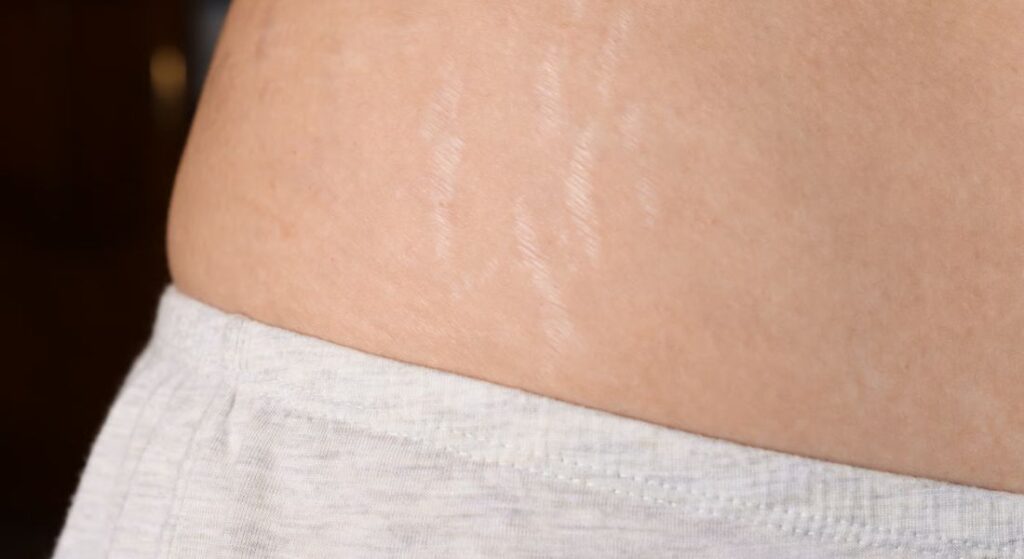
Stretch marks can appear on areas where your skin experiences rapid growth or stretching, including your abdomen, hips, thighs, buttocks, breasts and upper arms. You may develop them during pregnancy, puberty or changes in body size, depending on where your skin is affected.
You can also have red and white stretch marks on different parts of your body at the same time. Your clinician may therefore recommend different treatment approaches for you, depending on whether you have newer red marks or older white ones.
Are Red Stretch Marks Easier to Treat Than White Ones?
Sometimes, but not with every treatment. Red stretch marks are at an earlier stage and have a more prominent vascular component, so certain treatments may be more relevant while the marks are still red or purple. Mature white stretch marks have more established structural changes and usually require greater emphasis on collagen and texture remodelling.
Red marks can also fade naturally as they mature, which makes treatment results harder to separate from their normal colour change. Your clinician should therefore choose treatment according to the stage, colour and texture of your stretch marks rather than assuming that every newer mark will respond better.
Evidence Note
A 2026 systematic review evaluated 69 articles on stretch-mark treatment, including 20 studies of topical treatments, 35 of lasers and other energy-based devices and 14 of other therapies. Although several approaches showed improvement, the authors concluded that current evidence does not identify one consistently effective treatment, with some studies limited by small samples or lower-quality evidence. This means the stage of your stretch marks should guide treatment selection without assuming that one approach will work best for everyone.
Red vs White Stretch Marks at a Glance
| Feature | Red stretch marks | White stretch marks |
| Medical name | Striae rubrae | Striae albae |
| Stage | Earlier/newer | Mature/older |
| Typical colour | Pink, red, purple or reddish-brown | Pale, silvery or white |
| Vascular component | More prominent | Reduced |
| Texture | May initially be slightly raised | Often flatter, thinner or depressed |
| Natural progression | May fade naturally | Usually remain as mature marks |
| Treatment response | May respond particularly well to some early-stage or vascular treatments | Can improve, but treatment usually focuses more on structural remodelling |
| Main treatment focus | Redness plus collagen remodelling | Collagen and texture remodelling |
| Possible treatments | Vascular/light treatments, microneedling and selected procedures | Fractional laser, microneedling, RF microneedling |
| Complete removal | Cannot be guaranteed | Cannot be guaranteed |
Are White Stretch Marks Permanent?
Your white stretch marks are generally considered permanent changes in the skin, but that does not mean you cannot improve their appearance. You may see your marks become narrower, smoother and less noticeable with treatments that stimulate collagen remodelling.
You should be cautious of claims that promise complete stretch-mark removal. Even with treatments such as CO₂ laser, complete disappearance is uncommon, so you should aim for a visible improvement rather than skin that looks exactly as it did before the stretch marks developed.
Which Treatments Can Help Red Stretch Marks?
If you have red stretch marks, treatments that target visible redness may be considered because these marks still have a vascular component. You may also benefit from collagen-remodelling treatments such as microneedling, especially if you want to improve both colour and texture.
Your best option depends on what concerns you most about your stretch marks. If you mainly notice redness, you may discuss vascular or light-based treatments with your clinician, while you may need a collagen-focused approach if texture and depth are also concerns.
Which Treatments Can Help White Stretch Marks?
If you have white stretch marks, treatment usually focuses on improving their deeper structure because the earlier vascular stage has passed. You may consider options such as fractional CO₂ laser, microneedling, radiofrequency microneedling or non-ablative fractional laser to stimulate collagen remodelling.
You may achieve meaningful improvement, but no single treatment is best for everyone. Your choice may depend on your skin tone, the depth and age of your marks, your tolerance for downtime and how much improvement you want to achieve.
How Can CO₂ Laser Improve White Stretch Marks?
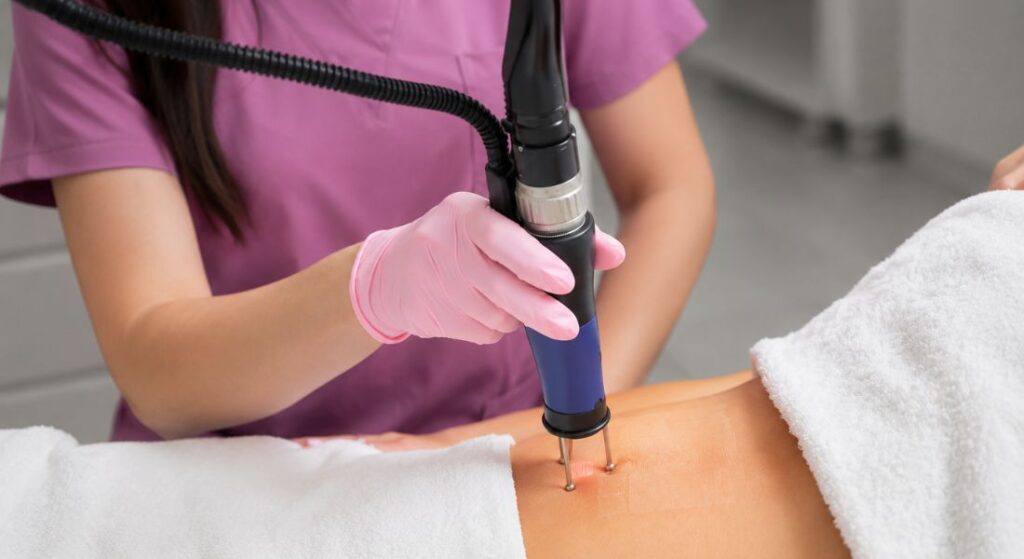
If you have white stretch marks, fractional CO₂ laser can target their altered texture by creating controlled microscopic injuries in your skin. You may gradually see your marks become narrower, smoother and less noticeable as your skin heals and remodels collagen.
You should know that CO₂ laser is not automatically the best option for you. You may achieve similar overall improvement with microneedling, while CO₂ laser can carry a higher risk of pigmentation, particularly if you have darker or pigment-prone skin.
Is Microneedling Useful for Both Red and White Stretch Marks?
Yes, you can use microneedling for both red and white stretch marks because it stimulates collagen rather than targeting colour alone. You may see gradual improvements in texture, width and overall visibility, although you may need several sessions.
Recent comparative evidence suggests that red marks may show greater improvement than white marks with microneedling specifically, although the available study was small. Mature white stretch marks can also improve, and your results will depend on their age, depth and how your skin responds to treatment.
Research Insight
A 2026 comparative study had 29 participants complete treatment across 15 red stretch-mark regions and 19 white stretch-mark regions, with four microneedling sessions spaced one month apart. At six months after the final treatment, Manchester Scar Scale scores had improved by approximately 48.9% for red marks and 41.6% for white marks. Because the study was relatively small, these figures should not be treated as a prediction of your individual result.
Do Creams Work Better on Red or White Stretch Marks?
Creams may be more useful for you when your stretch marks are newer and still red or purple. Tretinoin has shown some benefit in early stretch marks, but you may see little improvement if you have older white or silvery marks.
You can still use a moisturiser to keep your skin comfortable and reduce dryness, but it will not rebuild the deeper changes in your stretch marks. If you want a more noticeable change, you may need to discuss professional treatments with your clinician, particularly for mature white marks.
UK Guidance Note
NHS guidance advises that retinoid creams such as tretinoin should not be used during pregnancy. Medicines-safety guidance for topical retinoids also advises avoiding them when planning a pregnancy. If you are considering tretinoin for newer stretch marks, discuss whether it is appropriate for you with a suitably qualified healthcare professional.
Does Skin Tone Change How Red and White Stretch Marks Look?
Yes, your skin tone can change how your stretch marks appear. If you have darker skin, your newer marks may look purple, violet or reddish-brown rather than bright red, while older white marks may appear much lighter than your surrounding skin.
Your skin tone can also affect which treatment is safest for you. You may have a higher risk of pigmentation after some energy-based treatments if you have darker skin, so your clinician should consider your skin type, previous pigmentation and treatment settings rather than relying only on before-and-after photos.
Clinical Tip
Do not rely only on the words “red” and “white” when deciding which stage your stretch marks are at. Newer marks can appear purple, violet or reddish-brown on darker skin, while mature marks may look noticeably lighter than the surrounding skin. Colour should therefore be assessed alongside texture, age and your pigmentation history.
Can Red Stretch Marks Become Less Visible Without Treatment?
Yes, your red stretch marks can naturally fade as they mature, becoming paler or white over time. You may notice less redness even without treatment, but you can still see changes in texture, such as slight indentations or wrinkling.
You should therefore be careful when judging before-and-after photos of newer marks. Your stretch marks may look lighter naturally, so consistent photos and enough follow-up time can help you see whether treatment has genuinely improved their texture and overall appearance.
Can New Red Stretch Marks Develop When You Already Have White Ones?

Yes, you can develop new red or purple stretch marks even if you already have older white ones. Your existing white marks show that previous stretch marks have matured, but they do not prevent new marks from forming during pregnancy, growth or changes in body size.
You may therefore have both white and red stretch marks in the same area. Your clinician may recommend different approaches for you depending on the age, colour and texture of each mark, rather than treating every stretch mark in exactly the same way.
How Can You Choose Treatment for Red or White Stretch Marks?
You should first identify whether your stretch marks are newer red, pink or purple marks or older white and silvery ones. Your clinician should also consider your skin tone, the width and depth of your marks, their location and how your skin has reacted to inflammation in the past.
You do not automatically need CO₂ laser to improve your stretch marks. If you have red marks, you may consider treatments that target redness, while white marks may benefit more from collagen-remodelling treatments such as microneedling or laser, with your treatment chosen around your skin and goals.
Myth vs Fact
| Myth | Fact |
| All new stretch marks are bright red. | They may appear pink, purple, violet or reddish-brown depending on your skin tone. |
| Red and white stretch marks are different conditions. | They usually represent earlier and later stages of striae distensae. |
| White stretch marks cannot improve. | Mature marks can improve with collagen-remodelling treatments, although complete removal is unlikely. |
| CO₂ laser is always best for white stretch marks. | Research has not established CO₂ laser as universally superior to microneedling. |
| Microneedling only works on white stretch marks. | It has demonstrated improvement in both red and white marks. |
| When redness fades, the stretch mark has healed completely. | Colour can fade while structural changes remain. |
| Tretinoin works equally well on mature white marks. | Evidence is more favourable for relatively early stretch marks. |
| Every stretch mark in the same area needs identical treatment. | Mixed red and white marks may require different treatment priorities. |
Key Takeaways
1. Red and white stretch marks usually represent different stages of the same condition.
2. Red or purple striae rubrae are newer, while pale or silvery striae albae are more mature.
3. Red and white stretch marks can respond differently to treatment, and some treatments may produce greater improvement when marks are at the earlier red stage.
4. Both red and white marks can improve with microneedling, although a small 2026 comparative study found greater improvement in red marks than white marks after microneedling.
5. Treatments targeting vascular redness may be useful for some newer stretch marks.
6. Mature white marks generally require greater emphasis on collagen and texture remodelling.
7. Fractional CO₂ laser can improve white stretch marks but is not automatically better than microneedling.
8. Skin tone and your history of pigmentation should influence treatment selection.
9. No current treatment can guarantee complete removal.
Frequently Asked Questions
1. Are red stretch marks easier to treat than white stretch marks?
Not necessarily with every treatment. Red, pink or purple stretch marks are at an earlier stage, so some treatments may be particularly useful before the marks mature. However, recent evidence showing stronger improvement in red marks is treatment-specific, and mature white stretch marks can also improve with collagen-remodelling treatments such as microneedling or fractional laser.
2. Do red stretch marks always turn white?
Red stretch marks usually become paler as they mature, eventually appearing white or silvery. However, the exact colour change can vary depending on your skin tone and the individual characteristics of your stretch marks.
3. Can white stretch marks be removed completely?
No treatment can reliably guarantee complete removal of established white stretch marks. Treatments such as fractional CO₂ laser, microneedling and radiofrequency microneedling may make them narrower, smoother and less noticeable, but some evidence of the stretch mark may remain.
4. Is CO₂ laser better for white stretch marks?
Fractional CO₂ laser can be useful for mature white stretch marks because it stimulates collagen remodelling and improves skin texture. However, research has not established it as universally superior to alternatives such as microneedling, and it can carry a higher risk of post-inflammatory hyperpigmentation.
5. Can microneedling treat both red and white stretch marks?
Yes. Microneedling has been studied for both newer red stretch marks and mature white ones, with improvement reported at both stages. Red marks may respond more strongly, but mature white marks can also become less noticeable.
6. Can red stretch marks fade without treatment?
Yes. Red stretch marks naturally tend to lose their colour as they mature, so they may become less noticeable even without professional treatment. However, the underlying textural changes can remain after the redness fades.
7. Does your skin tone affect how stretch marks look?
Yes. On darker skin tones, newer stretch marks may appear purple, violet or reddish-brown rather than bright red, while mature marks can look noticeably lighter than the surrounding skin. Your skin tone should also be considered when choosing treatment because some procedures can increase the risk of pigmentation changes.
8. Do creams work better on red stretch marks?
Some topical treatments, particularly tretinoin, have shown more potential for relatively early stretch marks than established white ones. However, evidence for creams and oils remains limited, and moisturisers should not be expected to rebuild the altered collagen and elastic-fibre structure of mature stretch marks.
9. Can you have red and white stretch marks at the same time?
Yes. You can have mature white stretch marks from an earlier period of growth while developing newer red, pink or purple marks later. When different stages are present together, your clinician may need to consider different treatment priorities for each area.
10. How do you choose the best treatment for red or white stretch marks?
Your treatment should be based on the stage, colour, width, depth and texture of your stretch marks, as well as your skin tone and pigmentation history. Newer red marks may benefit from approaches that address vascular changes, while mature white marks generally require greater emphasis on collagen and dermal remodelling.
Final Thoughts: Understanding Your Red and White Stretch Marks
Knowing whether you have red or white stretch marks can help you understand how they may change naturally and what type of treatment may be appropriate. Newer striae rubrae have a more prominent vascular component, so some treatments may be particularly relevant at this stage, while mature striae albae often require greater emphasis on collagen and texture remodelling. With either type, you should have realistic expectations that some visible changes may remain.
If you are considering CO2 laser treatment for stretch marks in London, you can contact our team at the London Medical & Aesthetic Clinic to discuss whether the treatment may be suitable for you and explore your options.
References:
1. Algarra Sahuquillo, J. and Martín-Gorgojo, A. (2026) ‘Stretch marks: Systematic review of its therapeutic approach’, Actas Dermo-Sifiliográficas, 117(4), article 104553. Available at: https://www.sciencedirect.com/science/article/pii/S0001731025008294
2. Marin, S., Watterson, A., Alqam, M.L., Jones, B.C. and Hitchcock, T.M. (2026) ‘A comparative study to evaluate the safety and efficacy of microneedling as a stand-alone treatment for striae rubrae and albae’, Aesthetic Surgery Journal, 46(5), pp. 530–542. Available at: https://pmc.ncbi.nlm.nih.gov/articles/PMC13064658
3. Mustafa, A. et al. (2025) ‘Evaluating CO₂ laser and micro-needling therapies for striae distensae: A comprehensive meta-analysis and systematic review’, Lasers in Medical Science, 40(1), article 161. Available at: https://pubmed.ncbi.nlm.nih.gov/40131559
4. Aktoz, F. and Yilmaz, N. (2024) ‘Comparing fractional microneedle radiofrequency and fractional CO₂ laser for striae distensae treatment: A systematic review and meta-analysis’, Lasers in Medical Science, 39(1), article 271. Available at: https://pubmed.ncbi.nlm.nih.gov/39516426
5. Ud-Din, S., McGeorge, D. and Bayat, A. (2016) ‘Topical management of striae distensae (stretch marks): Prevention and therapy of striae rubrae and albae’, Journal of the European Academy of Dermatology and Venereology, 30(2), pp. 211–222. Available at: https://pmc.ncbi.nlm.nih.gov/articles/PMC5057295