


If you have darker skin and are considering CO₂ laser for stretch marks, you may be particularly concerned about whether treatment could leave you with new dark marks. Fractional CO₂ laser can improve some stretch marks, but darker or pigment-prone skin can have a greater risk of post-inflammatory hyperpigmentation (PIH).
That does not automatically mean CO₂ laser is unsuitable for you. Your pigmentation history, skin phototype, stretch-mark type and the treatment settings all matter, while alternatives such as microneedling or radiofrequency microneedling may offer a lower pigmentation risk in comparative research. Your clinician can help you weigh the potential improvement against these risks.
Why Does Skin Tone Matter with CO₂ Laser Treatment?
Your skin tone matters because fractional CO₂ laser creates controlled heat and inflammation to stimulate collagen remodelling. If your skin is darker or pigment-prone, this inflammatory response can increase your risk of post-inflammatory hyperpigmentation.
1. Pigment Response: Your skin may produce extra pigment after inflammation, causing temporary or persistent darker areas.
2. Previous Reactions: A history of dark marks after acne, cuts, waxing or previous treatments can suggest a greater tendency towards pigmentation.
3. Treatment Intensity: Your clinician may need to adjust the laser energy, density or number of passes according to how your skin is likely to respond.
4. Individual Assessment: Your visible skin tone should be considered alongside your pigmentation history, recent sun exposure and previous treatment reactions.
Having darker skin does not automatically mean that fractional CO₂ laser is unsuitable for you. A personalised assessment can help your clinician balance potential stretch-mark improvement against your individual pigmentation risk.
What Does “Darker Skin” Mean in Laser Treatment?
Clinicians often use the Fitzpatrick skin phototype system, which ranges from type I to VI and describes how your skin tends to respond to ultraviolet exposure. Higher phototypes are commonly included in darker-skin laser research, but your phototype does not define your ethnicity or predict your pigment response on its own.
Your ethnicity or visible skin colour alone should not determine your CO₂ laser settings. Your pigmentation history, recent sun exposure, previous treatments and how your skin responds to injury should all be considered when your treatment is planned.
Why Can Fractional CO₂ Laser Improve Stretch Marks?
Your stretch marks are structural changes in the deeper skin, so fractional CO₂ laser aims to stimulate collagen remodelling rather than simply treat the surface. The laser creates controlled microscopic areas of injury while leaving surrounding skin intact, encouraging your skin to repair and rebuild collagen.
You may gradually see your stretch marks become smoother, narrower and less noticeable as your skin remodels. Your results can vary depending on the age, depth and appearance of your marks, but CO₂ laser should be viewed as a treatment for improvement rather than complete removal.
Has CO₂ Laser Been Studied in Darker Skin with Stretch Marks?
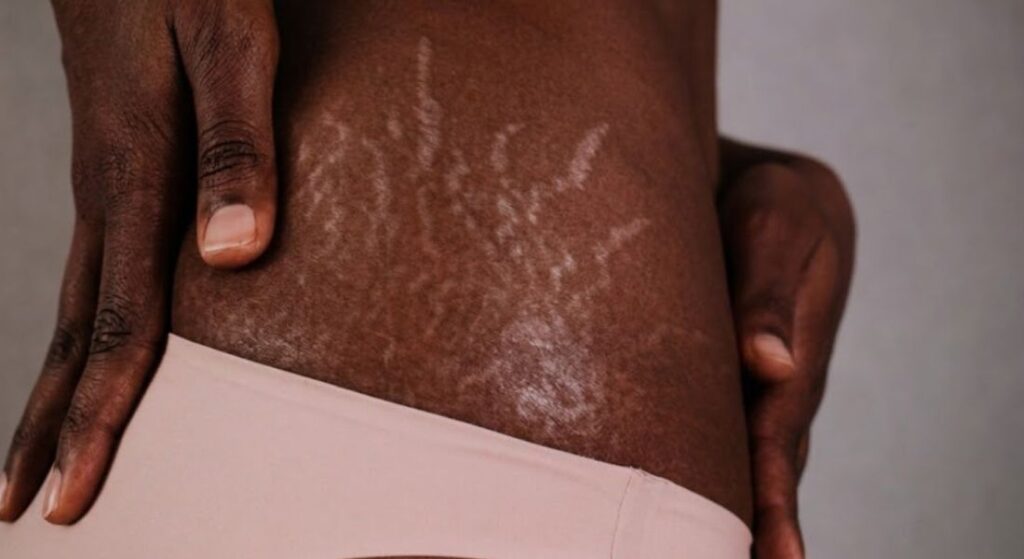
Yes, fractional CO₂ laser has been studied in people with medium to darker skin types, although the available research is still limited. You may see improvement in mature white stretch marks, but the results are not always dramatic or predictable.
You should therefore have realistic expectations if you have darker skin. CO₂ laser can improve your stretch marks, but your response can vary, so treatment should be carefully tailored to your skin type and pigmentation risk.
Evidence Note
A prospective study treated 30 people with striae alba and Fitzpatrick skin types III-IV with two fractional CO₂ laser sessions four weeks apart. At three months, 63.3% had minimal improvement, 16.7% had moderate improvement and 20% had no improvement. Burns and/or post-inflammatory hyperpigmentation were reported in 17% after the first session, while transient PIH occurred in 10% after the second session. These findings show that improvement is possible in darker phototypes, but the response may be modest and pigmentary reactions can still occur.
What Is Post-Inflammatory Hyperpigmentation?
Post-inflammatory hyperpigmentation (PIH) happens when your skin becomes darker after inflammation or injury. You may notice brown, dark brown or greyish areas, and the change can be more noticeable and longer-lasting if your skin naturally has more pigmentation.
Your PIH risk matters when you are considering fractional CO₂ laser because the treatment deliberately creates inflammation. Your stretch marks may improve while the treated skin temporarily becomes darker, so you should discuss your pigmentation history with your clinician before treatment.
How Common Is Pigmentation After CO₂ Laser for Stretch Marks?
There is no single percentage that applies to everyone because your risk of post-inflammatory hyperpigmentation (PIH) can vary with your skin type, treatment settings and laser device. Research comparing CO₂ laser with microneedling has found a higher risk of PIH after CO₂ laser, particularly when your skin is more prone to pigmentation.
You should not assume CO₂ laser will definitely cause pigmentation if you have darker skin. In the 30-patient Fitzpatrick III-IV striae-alba study, burns or PIH occurred in 17% after the first session and transient PIH occurred in 10% after the second session. These figures come from one small study using a particular protocol and should not be treated as your personal risk, because PIH rates vary considerably between studies, devices and treatment settings.
Why Do Laser Settings Matter So Much?
Your CO₂ laser settings can be adjusted to control how deeply and densely your skin is treated. Higher energy or greater treatment density may produce stronger resurfacing, but you may also experience more inflammation, downtime and pigmentation risk.
You should not assume that the strongest setting will give you the best result. If your skin is prone to pigmentation, your clinician may choose gentler settings and several sessions to balance improvement with your risk of complications.
Clinical Tip
Ask your clinician about more than the name of the laser. Energy, treatment density, number of passes, spacing between sessions and your previous pigmentary response can all influence recovery. A stronger setting should not be treated as automatically more effective, particularly when avoiding excessive inflammation is important.
Does More Redness Mean the Laser Will Work Better?
No. Your redness after fractional CO₂ laser shows that your skin has responded to the treatment, but more redness does not necessarily mean better collagen remodelling or greater improvement in your stretch marks.
You may increase your risk of prolonged redness, pigmentation and irritation if your treatment is unnecessarily aggressive. If you have darker or pigment-prone skin, your clinician may prefer controlled settings and several sessions rather than creating excessive inflammation in one treatment.
Can a Test Area Be Helpful Before Full Treatment?
A test area may be useful for you if you have a higher risk of pigmentation. Your clinician can treat a small section first to see how your skin responds to the device and settings before treating a larger area.
You should know that a test area cannot guarantee that your entire abdomen will respond in the same way. Your clinician should still consider your skin type, pigmentation history and treatment settings before deciding whether CO₂ laser is appropriate for you.
Is Microneedling Safer Than CO₂ Laser for Darker Skin?
Microneedling may offer a more favourable pigmentary risk profile than fractional CO₂ laser because it creates mechanical micro-injury without the same ablative thermal injury. Comparative research across striae distensae overall has found less post-inflammatory hyperpigmentation with microneedling than with CO₂ laser, although this evidence is not limited specifically to people with darker skin.
Pooled comparative research has found similar overall clinical improvement with microneedling and fractional CO₂ laser. You may need several sessions, so you should discuss both options with your clinician to decide which gives you the best balance of results, recovery and pigmentation risk.
What About Radiofrequency Microneedling?
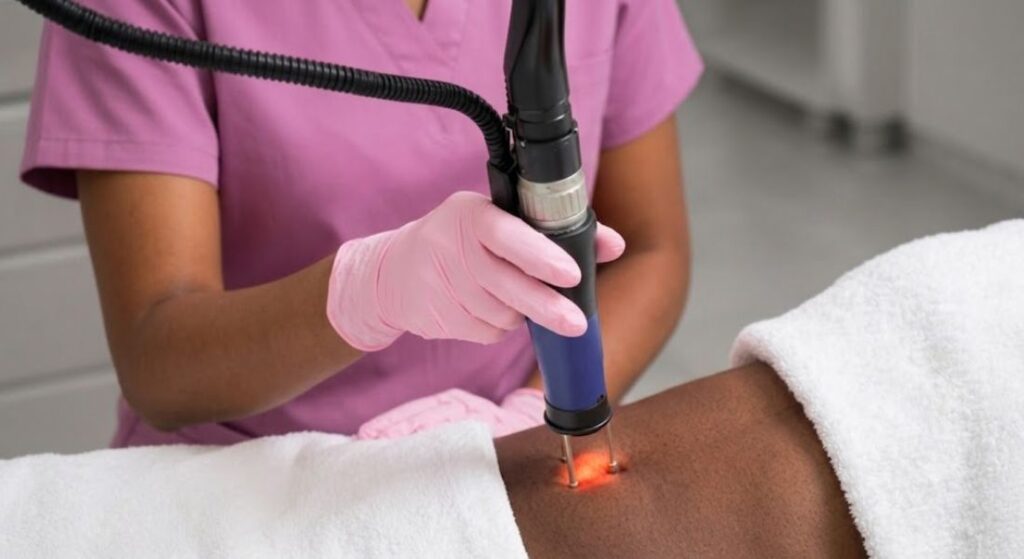
Radiofrequency microneedling combines fine needles with controlled radiofrequency heat to stimulate collagen remodelling at selected depths. You may consider it if you want collagen stimulation while reducing reliance on the surface ablation used with CO₂ laser.
You should not assume radiofrequency microneedling is completely risk-free for darker skin, as your treatment settings, needle depth and device can still affect pigmentation risk. Your clinician can assess your skin type and stretch marks to decide whether it offers you a suitable balance between improvement and risk.
A 2024 meta-analysis across striae distensae found no significant difference in improvement between fractional microneedle radiofrequency and fractional CO₂ laser, while PIH was significantly less frequent with radiofrequency microneedling. However, these pooled findings were not restricted to darker-skin patients.
Are Non-Ablative Fractional Lasers an Alternative?
Yes, non-ablative fractional lasers may be an alternative for you if pigmentation risk is a concern. They create controlled heat within your skin without removing the surface to the same extent as fractional CO₂ laser, so you may experience less surface injury.
You may still need several sessions to improve your stretch marks, and your results can vary depending on your skin type and treatment settings. Your clinician can compare non-ablative laser with CO₂ laser or microneedling to find the option that gives you the best balance of improvement and pigmentation risk. Evidence in darker phototypes supports the use of selected non-ablative fractional lasers, but safety still depends on the wavelength, energy, density and condition being treated rather than on the label “non-ablative” alone.
Are There Other Laser Options for Stretch Marks in Darker Skin?
Yes, you may have other laser options besides fractional CO₂ laser. In a study of 20 people with Fitzpatrick skin types IV-V and abdominal striae alba, four sessions of fractional 1064-nm picosecond Nd:YAG laser produced moderate-to-marked improvement in 90% of participants at six months, while 10% developed transient post-inflammatory hyperpigmentation. The study was small, so these results should not be treated as a guarantee of your response.
You should not assume that another laser will automatically be safer or more effective for you. Your clinician can compare the expected improvement, pigmentation risk, treatment settings and recovery time to decide whether CO₂ laser or another option is more suitable for your skin.
Stretch-Mark Treatment Options When Pigmentation Is a Concern
| Treatment | How it works | Pigmentary consideration | Evidence limitation |
| Fractional CO₂ laser | Ablative fractional resurfacing and collagen remodelling | PIH risk is an important concern | Results and PIH vary widely with protocol |
| Conventional microneedling | Mechanical collagen induction | Lower PIH rate than CO₂ in pooled striae-distensae evidence; not darker-skin-specific | Several sessions may be needed |
| RF microneedling | Needling with controlled RF energy | Lower PIH rate than CO₂ in pooled striae-distensae research; not darker-skin-specific | Device parameters vary considerably |
| Non-ablative fractional laser | Dermal heating without ablating the surface | May be better tolerated in some darker skin types | Not every wavelength has the same safety profile |
| Fractional picosecond 1064-nm laser | Fractional photoacoustic/laser effect | Has been studied specifically in Fitzpatrick skin types IV-V | Evidence still comes from relatively small clinical studies |
Can Preparation and Aftercare Reduce Pigmentation Risk?
Yes, careful preparation and aftercare may help reduce your risk of pigmentation after CO₂ laser, although they cannot guarantee that PIH will not occur. You should protect your treated skin from unnecessary sun exposure, as ultraviolet exposure can increase pigmentation during healing.
You should follow the aftercare plan your clinician gives you rather than starting strong acids, retinoids or bleaching products around your treatment without advice. Your skin needs time to heal, and unnecessary irritation can create more inflammation and potentially increase your pigmentation risk.
UK Guidance Note
If you are considering cosmetic laser treatment in the UK, ask about your practitioner’s training, experience treating darker skin and how they assess pigmentation risk before selecting your laser settings. You should also ask what aftercare you will need and how complications such as prolonged pigmentation would be managed if they occurred.
Who May Not Be a Good Candidate for Fractional CO₂ Laser?
You may need to postpone CO₂ laser if you have an active infection, significant dermatitis or inflammation on the treatment area. You should also tell your clinician if you have a history of prolonged pigmentation, recent tanning, abnormal scarring or previous reactions to laser treatments.
Your medical history and medications should be reviewed before treatment so your individual risks can be considered. If your pigmentation risk is high, you may be better suited to a less inflammatory treatment rather than proceeding with CO₂ laser despite a higher risk of pigmentary complications.
How Can You Decide Whether CO₂ Laser Is Safe for Your Stretch Marks?
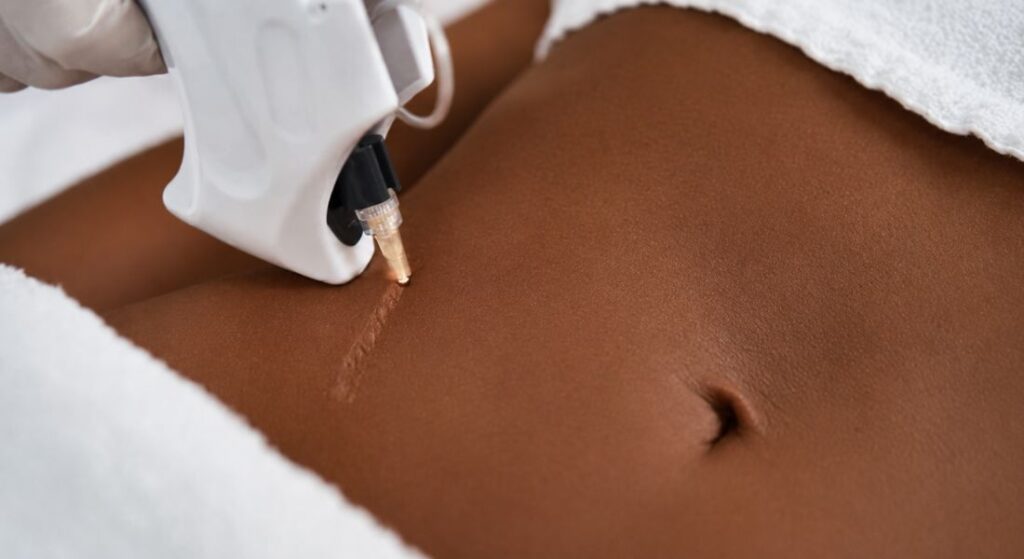
You should start by having your stretch marks and skin assessed, including their colour, depth and extent. Your clinician should also consider your history of pigmentation, previous laser reactions and whether the expected improvement is worth the risks of ablative treatment.
You should ask which settings are being considered for your skin type and why they are appropriate for you. If your skin is prone to long-lasting dark marks, you may find that a more conservative approach or an alternative treatment gives you a better balance between improving your stretch marks and avoiding new pigmentation.
Myth vs Fact
| Myth | Fact |
| Darker skin can never have fractional CO₂ laser. | Treatment may be possible for selected patients, but pigmentary risk requires careful assessment. |
| Fitzpatrick skin type alone tells you whether CO₂ laser is safe. | Phototype is only one part of assessment; pigmentation history and previous reactions also matter. |
| More powerful laser settings produce better stretch-mark results. | Greater intensity can also increase inflammation, downtime and pigmentary complications. |
| More redness means more collagen and a better result. | Excessive inflammation does not guarantee greater improvement. |
| A test patch guarantees the full treatment will be safe. | A test area can provide information but cannot predict every reaction over a larger area. |
| Microneedling cannot cause PIH. | PIH remains possible, although comparative studies show lower rates than with fractional CO₂. |
| RF microneedling is completely risk-free in darker skin. | It can still cause inflammatory and pigmentary changes, depending on settings and individual response. |
| Non-ablative lasers are always safe for darker skin. | Wavelength, settings and patient selection still matter. |
| CO₂ laser completely removes stretch marks. | The realistic aim is improvement in texture and visibility, not guaranteed removal. |
| PIH is the only possible laser complication. | Infection, prolonged redness, hypopigmentation and scarring can also occur. |
Key Takeaways
1. Fractional CO₂ laser may improve stretch marks in selected people with darker skin, but PIH risk needs careful assessment.
2. Fitzpatrick skin type alone should not determine whether CO₂ laser is suitable for you.
3. Your previous tendency to develop dark marks after inflammation or procedures can help assess pigmentation risk.
4. Microneedling and RF microneedling may offer similar improvement with a lower PIH risk than fractional CO₂ laser.
5. Treatment settings and intensity matter, and stronger treatment is not automatically better.
6. No current treatment can guarantee complete stretch-mark removal.
Frequently Asked Questions
1. Is CO₂ laser safe for stretch marks on darker skin?
Fractional CO₂ laser can be used on darker skin, but you may have a higher risk of post-inflammatory hyperpigmentation. Your skin tone, pigmentary history and the laser settings should be carefully assessed before treatment.
2. Why is CO₂ laser more likely to cause pigmentation on darker skin?
CO₂ laser creates controlled heat and inflammation to stimulate collagen remodelling. In darker skin, this inflammation can trigger a stronger pigment response, increasing the risk of post-inflammatory hyperpigmentation.
3. Can CO₂ laser improve white stretch marks on darker skin?
Yes, fractional CO₂ laser may improve the texture and appearance of mature white stretch marks. However, results vary, and you may need several sessions rather than expecting complete removal.
4. What skin types can have CO₂ laser for stretch marks?
Fractional CO₂ laser has been studied in people with Fitzpatrick skin types III-IV, but skin type alone cannot determine whether treatment is suitable for you. Your pigmentation history, recent sun exposure and previous reactions to skin injury should also be considered when your clinician assesses your individual risk.
5. Is microneedling safer than CO₂ laser for darker skin?
Microneedling may offer a more favourable pigmentary risk profile because it does not create the same ablative thermal injury as CO₂ laser. Comparative research across striae distensae overall has found similar clinical improvement with the two treatments and more post-inflammatory hyperpigmentation after fractional CO₂ laser. However, these pooled findings were not restricted specifically to darker-skin patients, so your individual pigmentary history still matters.
6. Can radiofrequency microneedling treat stretch marks on darker skin?
Radiofrequency microneedling can stimulate collagen remodelling and may be considered as an alternative to ablative CO₂ resurfacing. It can still cause pigmentation, so your practitioner needs to select the energy and needle depth carefully.
7. Can non-ablative lasers be used for darker skin?
Yes, non-ablative fractional lasers may be considered because they create controlled thermal injury without ablating the skin surface to the same extent as CO₂ laser. They may offer a lower pigmentary risk, although your suitability still depends on your individual skin and stretch marks.
8. Can you prevent pigmentation after CO₂ laser treatment?
You cannot completely prevent pigmentation, but careful treatment settings, appropriate aftercare and strict sun protection may reduce your risk. You should also avoid irritating products around treatment unless your clinician specifically recommends them.
9. Should you have a test patch before CO₂ laser?
A small test area may sometimes be considered if you have a higher risk of pigmentation or an uncertain response to treatment. However, a test area cannot guarantee that you will not develop pigmentation after treating a larger area.
10. Can CO₂ laser completely remove stretch marks on darker skin?
CO₂ laser cannot guarantee complete removal of stretch marks, regardless of your skin tone. The realistic aim is usually to make the marks less noticeable by improving their texture, depth and overall appearance.
Final Thoughts: CO₂ Laser for Stretch Marks on Darker Skin
Fractional CO₂ laser can improve stretch marks on darker skin, but you need a more careful approach because your risk of post-inflammatory hyperpigmentation may be higher. You can still achieve meaningful improvements in texture and visibility, but treatment settings, your history of pigmentation, skin tone and the maturity of your stretch marks all need to be considered before treatment.
If you are considering CO2 laser treatment for stretch marks in London, you can contact our team at the London Medical & Aesthetic Clinic to discuss whether the treatment may be suitable for you and explore your treatment options.
References:
1. Tehranchinia, Z., Mahboubianfar, A., Rahimi, H. and Saedi, N. (2018) ‘Fractionated CO₂ laser in the treatment of striae alba in darker skinned patients – a prospective study’, Journal of Lasers in Medical Sciences, 9(1), pp. 15-18. Available at: https://pmc.ncbi.nlm.nih.gov/articles/PMC5775949/
2. Chaudhury, H., Remmert, N., Chen, H. and Tarbox, M. (2026) ‘Advancements in treating stretch marks across all skin types: a comprehensive review of therapeutic modalities’, International Journal of Women’s Dermatology, 12(1), article e244. Available at: https://pmc.ncbi.nlm.nih.gov/articles/PMC12799299/
3. Mustafa, A. et al. (2025) ‘Evaluating CO₂ laser and micro-needling therapies for striae distensae: A comprehensive meta-analysis and systematic review’, Lasers in Medical Science, 40(1), article 161. Available at: https://pubmed.ncbi.nlm.nih.gov/40131559/
4. Aktoz, F. and Yilmaz, N. (2024) ‘Comparing fractional microneedle radiofrequency and fractional CO₂ laser for striae distensae treatment: A systematic review and meta-analysis’, Lasers in Medical Science, 39(1), article 271. Available at: https://pubmed.ncbi.nlm.nih.gov/39516426/
5. Kroma-Szal, A., Pawlaczyk, M., Urbańska, M., Cieślawska, J., Sobkowska, D., Pordąb, I. and Gornowicz-Porowska, J. (2025) ‘Medical Applications of Picosecond Lasers for Removal of Non-Tattoo Skin Lesions – A Comprehensive Review’, Applied Sciences, 15(9), article 4719. Available at: https://www.mdpi.com/2076-3417/15/9/4719