


If you are considering VASER liposuction for your midsection, you may notice that your abdomen and flanks affect the same overall waist shape. Treating these areas together can sometimes help you achieve a smoother transition from your abdomen around your waist and towards your back.
VASER uses ultrasound-assisted liposuction to target selected subcutaneous fat, the softer fat that sits beneath your skin, rather than providing general weight loss. It cannot remove visceral fat, which lies deeper around your abdominal organs, repair significant muscle separation or guarantee that loose skin will tighten afterwards.
Why Are the Abdomen and Flanks Often Treated Together?
Your abdomen and flanks form one continuous contour around your torso, so changes in one area can affect how you see your overall waist shape. If you reduce fat from your abdomen but leave fullness at your sides, you may still feel that your waist looks heavier or less defined.
Your combined treatment should not mean automatically treating every area. You may have more abdominal fat and very little flank fat, or the opposite, so your practitioner should assess your shape from the front, side and back before deciding which areas you actually need treated.
Abdomen, Flanks and Combined Midsection Planning
| Area | What may contribute to the contour | What VASER can address |
| Upper abdomen | Subcutaneous fat, skin quality, abdominal-wall shape | Selected subcutaneous fat |
| Lower abdomen | Subcutaneous fat, loose skin, previous pregnancy or surgery | Selected subcutaneous fat |
| Flanks | Localised subcutaneous fat and natural waist anatomy | Selected flank fat |
| Deeper abdomen | Visceral fat and abdominal-wall shape | Not treated by liposuction |
| Combined midsection | Several neighbouring contour areas | Can be planned together for smoother transitions where appropriate |
What Does VASER Actually Do?
VASER is a form of ultrasound-assisted liposuction. During the procedure, ultrasound energy helps loosen and break up selected fatty tissue before your surgeon removes it using thin suction tubes called cannulas.
Although VASER uses ultrasound energy, it is still a surgical liposuction procedure rather than a non-invasive ultrasound treatment. Your results and risks depend on your suitability, the areas being treated, the surgical plan and your surgeon’s technique.
What Fat Can VASER Remove from the Abdomen?
VASER liposuction targets subcutaneous fat, which sits beneath your skin and is usually the softer, pinchable fat around your abdomen. You may have this localised fat below your belly button, across your upper abdomen or in both areas despite having a relatively stable weight.
The procedure cannot remove visceral fat stored deeper inside your abdominal cavity. It also cannot correct abdominal fullness caused by muscle separation or other abdominal-wall changes, so the cause of your abdominal shape should be assessed before treatment is planned.
What Fat Is Treated Around the Flanks?
Your flanks are the areas around the sides of your waist and can extend towards your lower back. The way fat sits in this region can influence how defined your waist looks from several angles.
1. Subcutaneous flank fat: VASER can target selected fat beneath your skin that contributes to fullness around the sides of your waist.
2. Love handle fullness: Localised fat around your flanks may create a broader waist or less defined transition between your abdomen, hips and back.
3. Natural body structure: Your ribcage, pelvis and hip shape also influence your waist contour, so fat removal cannot completely change your underlying proportions.
4. Blending with nearby areas: Your surgeon should consider how the treated flanks transition into your abdomen, back and hips to reduce the risk of an uneven contour.
Your flank treatment should therefore be planned as part of your overall torso shape rather than as an isolated pocket of fat. The amount removed should depend on your anatomy and the balance your surgeon is trying to achieve.
What Is the Benefit of Planning the Abdomen and Flanks Together?
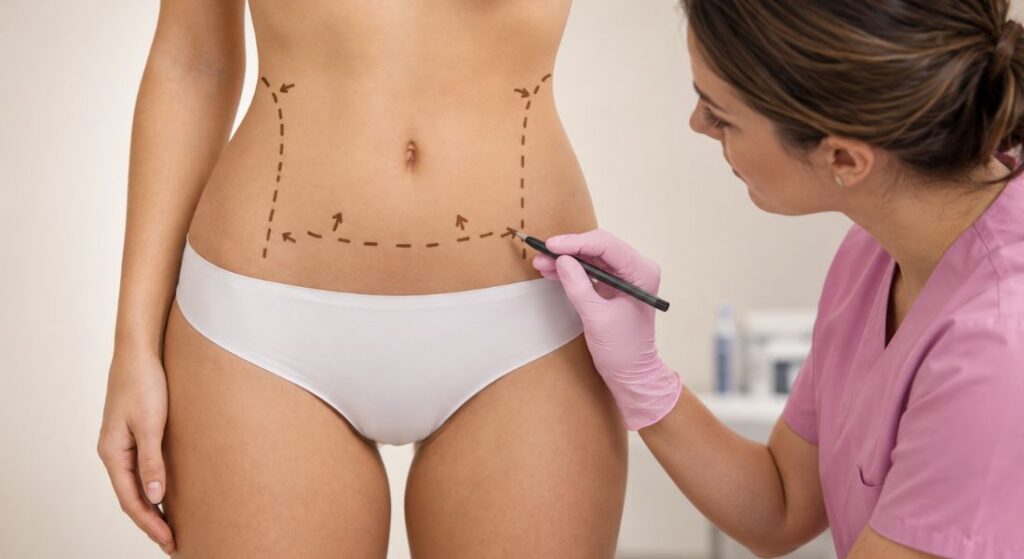
Your abdomen and flanks form one continuous contour, so planning them together can help your surgeon create a smoother transition around your waist. You may find that treating these areas as one three-dimensional shape gives you a more balanced result than treating each area separately.
Your surgeon does not need to remove equal amounts of fat from every area. Your lower abdomen may need more reduction while your upper abdomen or flanks need more subtle blending, so your treatment should be planned around your proportions and the shape you want to achieve.
Research Insight
A systematic review of 13 studies involving 1,280 male patients found that high-definition lipoplasty uses a range of techniques to emphasise natural muscular contours, with careful patient selection considered important. Only some of the included studies used VASER-assisted high-definition lipoplasty.
If greater definition is your goal, ask whether your surgeon is proposing general fat reduction or a high-definition approach, why it may be suitable for your anatomy and what additional limitations or risks may apply.
Who May Be Suitable for Combined VASER Treatment?
You may be suitable for combined VASER treatment if your weight is reasonably stable but you still have localised subcutaneous fat around your abdomen, flanks or both. VASER is designed for body contouring rather than substantial weight loss, so it is important to have realistic expectations about how much your shape can change.
Your surgeon should also consider your overall health, skin elasticity, smoking status, medicines, previous abdominal surgery and risk of blood clots. They should explain what treatment can realistically achieve for your anatomy rather than promising a particular waist size or body shape.
When Might VASER Not Be the Right Treatment?
VASER may not be the right treatment if the shape of your abdomen is mainly caused by visceral fat, significant loose skin or abdominal muscle separation. Liposuction can remove selected fat beneath the skin, but it cannot reach visceral fat, repair separated abdominal muscles or remove substantial excess skin.
It is also not a treatment for obesity or significant weight loss. Your surgeon should first identify what is contributing to your midsection shape so that any treatment considered matches the actual concern, whether that is localised fat, loose skin, muscle separation or a combination.
Clinical Tip
A prominent abdomen can reflect subcutaneous fat, deeper visceral fat, loose skin, abdominal-wall changes or a combination. These problems do not respond to the same treatment.
Liposuction can reduce selected subcutaneous fat, but it cannot remove visceral fat, repair significant muscle separation or remove substantial excess skin. Identifying the main cause of the contour is therefore more important than choosing a liposuction technique first.
How Important Is Skin Elasticity?
Your skin elasticity can affect how smoothly your skin settles after VASER treatment. Your age, previous pregnancies, major weight changes, genetics, sun exposure and how much your skin has stretched can all influence how well it retracts.
VASER may provide some skin contraction, but you should not expect it to remove significant loose skin. If your skin is very lax or stretched, your surgeon should explain whether fat removal alone is likely to give you the contour you want.
Evidence Note
One controlled study found greater measured skin retraction with VASER-assisted lipoplasty than with conventional suction-assisted lipoplasty. However, the study was relatively small, and greater measured contraction does not mean VASER can reliably correct substantial skin laxity.
If significant loose skin is the main concern, your surgeon should explain whether fat removal alone is likely to produce the contour you want.
Can VASER Create Abdominal Definition?
VASER may help create more abdominal definition if you have suitable anatomy and localised subcutaneous fat. Your results depend on factors such as your muscle shape, visceral fat, skin quality and the amount of fat that can be safely removed.
Your surgeon may use VASER for general fat reduction or more detailed liposculpture to emphasise your natural contours. You should focus on proportional definition that suits your body rather than expecting an artificially etched appearance or a specific shape that your anatomy cannot safely achieve.
How Is a Combined Abdomen-and-Flank Procedure Planned?
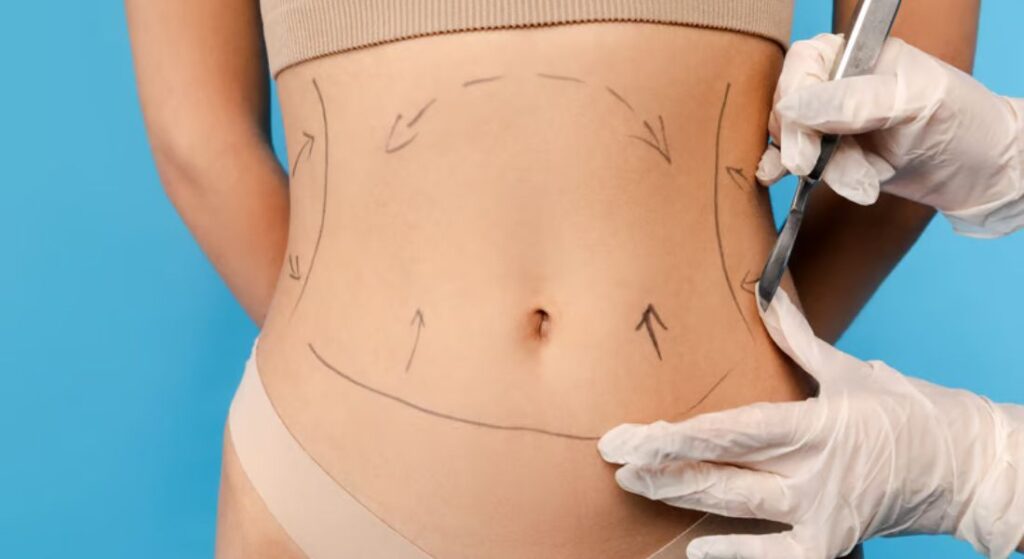
Planning starts with an assessment of your abdomen, waist, flanks and back while you are standing. Your surgeon will consider your natural proportions, fat distribution, skin elasticity and any previous scars before marking the areas that need treatment.
Your surgeon does not need to remove every area of pinchable fat, as preserving enough tissue helps maintain a smooth contour. If you have had previous abdominal surgery, a caesarean section or liposuction, your scar tissue may also affect your treatment plan and should be assessed beforehand.
What Happens During VASER Liposuction?
Your procedure usually begins with marking the treatment areas and introducing a fluid solution into the fatty tissue. Your surgeon then uses an ultrasound probe to break up selected subcutaneous fat before removing it through small incisions with liposuction cannulas.
Your abdomen-and-flank treatment covers a wider area than treating one isolated pocket, so your procedure time and fluid requirements can vary. Your surgeon should give you a treatment-specific estimate, as the duration depends on your anatomy, the areas being treated and the amount of fat being removed.
UK Guidance Note
Liposuction is a surgical procedure and should be carried out in an appropriately regulated clinical setting by a suitably trained and experienced surgeon.
Before deciding to proceed, you should meet the surgeon who will perform your procedure, ask about their training and experience, discuss the risks and expected recovery, and give yourself enough time after the consultation to consider your decision without feeling pressured.
What Is Recovery Like When Both Areas Are Treated?
Your recovery may feel more extensive because your abdomen and flanks are healing together. You may have swelling, bruising, soreness and temporary numbness.
Gentle walking can usually begin when advised by your surgeon, but you should wait before returning to strenuous exercise. Your final shape may take time to appear as the swelling settles.
When Can You Return to Work and Exercise?
Your return to work depends on your job and how much treatment you have had. You may return sooner to desk work, while lifting and physical jobs may require more time.
Your gentle walking can usually start early as advised by your surgeon, but you should gradually return to exercise. Your surgeon should confirm when you can safely resume strenuous activity.
What Risks Should You Understand?
VASER liposuction is still surgery, so you may experience swelling, bruising, soreness, numbness and small scars. Possible complications can also include contour irregularity, fluid collections, infection and changes in sensation.
More serious risks can include blood clots, pulmonary embolism and injury to internal structures, although these complications are less common. Your surgeon should discuss your individual risks with you, based on your health, treatment areas, anaesthesia and the amount of fat being removed.
When Should You Seek Medical Advice After VASER?
Contact your clinic promptly if you develop severe or worsening pain, increasing redness or swelling, pus from a wound, fever or other unexpected symptoms after your procedure.
Seek urgent medical advice if you develop new pain and swelling in one leg, as this can be a sign of a blood clot. Call 999 or go to A&E if you develop severe difficulty breathing, chest or upper-back pain, a very fast heartbeat or you collapse, as these can be signs of a pulmonary embolism or another serious condition.
What Results Can You Realistically Expect?

Your early results will be hidden by swelling, so your final contour may take several months to appear. You may notice your abdomen looking flatter and your flanks less prominent as your swelling settles.
Your results depend on your starting shape, skin quality and the amount of suitable fat you have. Your contour can change over time with weight gain, ageing or pregnancy, so keeping your weight relatively stable can help you maintain your results.
Myth vs Fact
| Myth | Fact |
| VASER removes all abdominal fat. | It targets selected subcutaneous fat and does not remove visceral fat. |
| Treating the abdomen and flanks means equal fat removal everywhere. | Each area should be treated according to anatomy and contour. |
| VASER automatically tightens loose abdominal skin. | Some contraction may occur, but significant excess skin may remain. |
| More fat removal creates better definition. | Excessive or poorly distributed removal can increase contour irregularity. |
| VASER is non-surgical because it uses ultrasound. | It is an ultrasound-assisted surgical liposuction procedure. |
Key Takeaways
1. Treating the abdomen and flanks together can allow the whole waist contour to be planned as one connected area.
2. VASER is ultrasound-assisted surgical liposuction and removes selected subcutaneous fat rather than visceral fat.
3. Combined treatment does not mean equal or maximal fat removal from every part of the torso.
4. Skin elasticity, abdominal-wall anatomy and previous surgery can affect the final contour.
5. VASER may produce some skin contraction, but it cannot reliably correct substantial loose skin.
6. Results develop gradually as swelling settles, and surgical risks and recovery should be discussed before treatment.
Frequently Asked Questions
1. Can you have VASER liposuction on your abdomen and flanks together?
Yes, both areas can sometimes be treated during the same procedure. Planning them together can help create a smoother, more balanced waist contour.
2. What does VASER liposuction do to abdominal fat?
VASER uses ultrasound energy to help loosen selected subcutaneous fat before it is removed with liposuction. It is a body-contouring procedure rather than a weight-loss treatment.
3. Can VASER remove visceral fat from your abdomen?
No. VASER can only target subcutaneous fat beneath the skin and cannot remove visceral fat around your abdominal organs.
4. Who may be suitable for combined abdomen and flank VASER?
You may be suitable if your weight is relatively stable and you have localised subcutaneous fat with reasonably good skin elasticity. Your overall health and expectations also need to be assessed.
5. Can VASER treat loose abdominal skin?
VASER removes fat but cannot remove significant excess skin. If skin laxity is substantial, a surgical procedure such as abdominoplasty may be more appropriate.
6. Can VASER create more abdominal definition?
It can potentially improve definition by reducing selected superficial fat. The result depends on your underlying anatomy, skin quality and the amount and distribution of subcutaneous fat.
7. How is combined abdomen and flank VASER planned?
Your surgeon should assess your torso from the front, sides and back while standing. They will consider your fat distribution, skin elasticity, previous surgery and overall proportions when marking the treatment areas.
8. What is recovery like after treating the abdomen and flanks together?
You can expect swelling, bruising, soreness and temporary numbness. Bending, twisting and getting in and out of bed may feel uncomfortable during the first few days.
9. When can you return to work and exercise after VASER?
Your timing depends on the extent of treatment and your type of work. Gentle movement is usually encouraged early, while strenuous exercise should be restarted gradually according to your surgeon’s advice.
10. When will you see the final VASER results?
Your initial contour may change relatively quickly, but swelling can take several months to settle. In some cases, it may take up to around six months for the treated area to settle fully.
Final Thoughts: VASER Abdomen and Flanks Together
Treating your abdomen and flanks together can help create a smoother, more balanced waist contour when localised subcutaneous fat is the main concern. However, VASER cannot remove visceral fat or significant loose skin.
If you’re looking for a Vaser lipo in London, you can get in touch with us at the London Medical & Aesthetic Clinic.
References:
1. Nagy, M.W. and Vanek, P.F. Jr (2012) ‘A multicenter, prospective, randomized, single-blind, controlled clinical trial comparing VASER-assisted lipoplasty and suction-assisted lipoplasty’, Plastic and Reconstructive Surgery, 129(4), pp. 681e–689e. Available at: https://pubmed.ncbi.nlm.nih.gov/22456382/
2. Wo, L.M. and Garcia, O. Jr (2024) ‘Ultrasound-assisted lipoplasty’, Clinics in Plastic Surgery, 51(1), pp. 13–28. Available at: https://pubmed.ncbi.nlm.nih.gov/37945069/
3. Aljerian, A., Abi-Rafeh, J., Hemmerling, T. and Gilardino, M.S. (2024) ‘Complications of aesthetic liposuction performed in isolation: a systematic literature review and meta-analysis’, Plastic Surgery, 32(1), pp. 19–32. Available at: https://pmc.ncbi.nlm.nih.gov/articles/PMC10902471/
4. Escandón, J.M., Vyas, K.S. and Manrique, O.J. (2022) ‘High-definition lipoplasty in male patients: a systematic review of surgical techniques and outcomes’, Aesthetic Surgery Journal, 42(1), pp. 68–85. Available at: https://academic.oup.com/asj/article-abstract/42/1/68/6328254
5. Lanzano, G., Napoli, F., Zannella, T., Colucci, R., Cantiello, I. and Scalera, G. (2024) ‘Correlation between BMI, amount of aspirated fat and post-operative complications in VASER liposuction: a single centre experience’, JPRAS Open, 42, pp. 170–177. Available at: https://www.sciencedirect.com/science/article/pii/S2352587824001293