

Wondering whether an LED mask could help your breakouts, redness or early fine lines? It’s sensible to ask what the treatment can realistically achieve before booking a course. Certain devices may improve mild acne or soften fine lines, but the results are not guaranteed.
The outcome depends on your skin concern, the device and the treatment schedule. Understanding where LED therapy may help, and where it falls short, can make the decision easier.
What Is LED Light Therapy and How Does It Work?
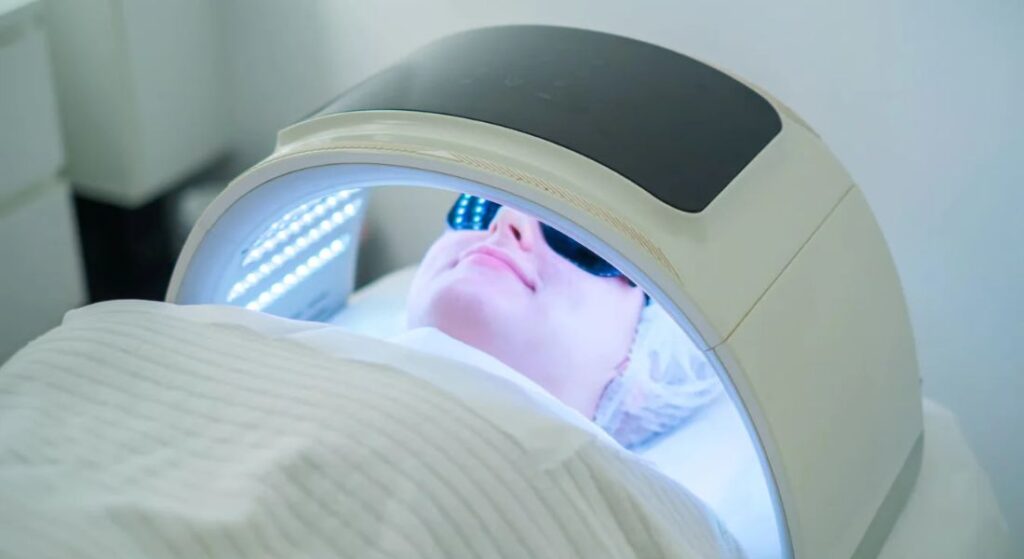
LED light therapy is a non-invasive treatment that uses specific wavelengths of visible or near-infrared light to influence activity within your skin cells. You may also hear it called photobiomodulation, particularly when red or near-infrared light is used to support skin rejuvenation.
Different wavelengths target different skin concerns, with blue light commonly used for acne and red or near-infrared light used in skin rejuvenation treatments. During your session, a practitioner positions an LED mask or panel close to your face to deliver light for a set period, usually with little discomfort.
What Do Red, Blue and Near-Infrared LED Lights Actually Do?
The light colour has a purpose. Blue wavelengths may act on acne-associated bacteria, while red and near-infrared light are being studied for effects on inflammation and skin repair. Results also depend on the device and dose, not colour alone.
Your practitioner may use a device that combines red, blue and near-infrared light to address your specific concerns. However, you shouldn’t assume that a mask with more colours will give you better results, so ask which wavelengths your treatment uses and why they’re suitable for your skin.
Can LED Light Therapy Help With Acne and Breakouts?
For mild to moderate inflammatory acne, some LED devices may help reduce spots after repeated treatment. Blue light acts on acne-associated bacteria, while red light is being studied for its effects on inflammation.
You may notice improvements after several weeks of regular treatment, although results vary. LED therapy won’t address every cause of acne, particularly hormonal influences, and you may still need established treatments such as benzoyl peroxide, topical retinoids or prescribed medication.
If you have painful nodules, cysts or acne that is beginning to leave scars, you should seek a GP or dermatologist assessment rather than relying on LED therapy alone.
Evidence Note
A 2025 systematic review and meta-analysis published in JAMA Dermatology examined six randomised trials involving 216 participants with mild-to-moderate acne. Researchers found improvements in inflammatory and non-inflammatory acne lesions with home-use red or blue LED devices, although this doesn’t guarantee that your clinic mask will produce the same results.
Because the trials used different devices, wavelengths and treatment schedules, you should be cautious about applying these findings to every LED mask. Some studies also had short follow-up periods, so LED therapy should be viewed as a possible additional option rather than a replacement for your usual acne treatment.
Can LED Light Therapy Reduce Skin Redness and Inflammation?
Redness can have several causes, and an LED mask isn’t always the right solution. Red light is being studied for its effects on inflammation, but evidence that standard LED masks reliably treat rosacea or eczema remains limited.
Frequent flushing, stinging or visible facial vessels may need GP assessment. Understanding what’s causing your redness is more useful than booking sessions without a diagnosis.
Can LED Light Therapy Improve Fine Lines and Skin Rejuvenation?
Noticing early fine lines or uneven skin texture? Red and near-infrared LED therapy may offer modest improvements after repeated sessions. Researchers are studying possible effects on cellular signalling and collagen-related processes, but visible results vary by device.
You may notice that fine lines appear less prominent after repeated sessions, although results vary between devices and individuals. LED therapy won’t lift sagging skin, restore lost facial volume or remove deeper wrinkles, so you may need another treatment if these are your main concerns.
Clinical Tip
Before starting LED treatment, identify the main skin concern you want to improve, such as inflammatory acne, early fine lines or general skin texture. Ask your practitioner which wavelengths the device uses and what level of improvement is realistic for your condition.
If you have persistent acne, melasma, rosacea or a history of light sensitivity, mention this during your consultation. Your practitioner should explain whether LED therapy is suitable as an additional treatment or whether you would benefit more from another clinical approach.
What Are the Benefits of Having LED Therapy at a Clinic?
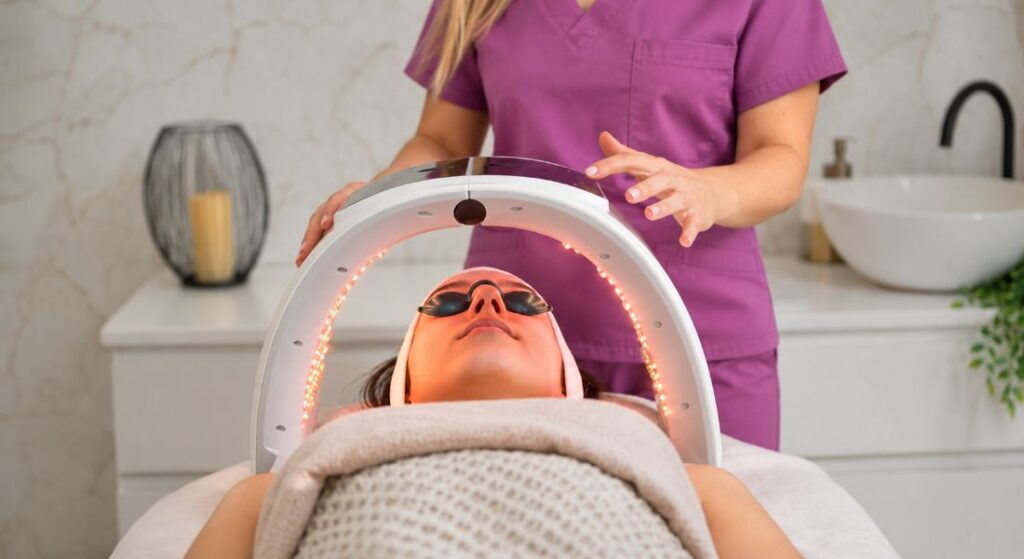
One advantage of LED therapy is that it doesn’t usually involve needles or significant downtime. Sessions are generally comfortable, and you can often return to your normal routine afterwards.
You also have the benefit of professional guidance before starting treatment. Your practitioner can assess your skin, help you choose appropriate wavelengths and advise whether LED therapy may work alongside your other skincare treatments.
What Are the Downsides of LED Light Therapy?
One limitation of LED light therapy is that you may see only modest improvements, even after several sessions. It also doesn’t address every skin concern, so reducing acne-associated bacteria won’t necessarily prevent hormonal breakouts, while stimulating collagen-related activity won’t restore lost facial volume or remove excess skin.
Evidence and results vary between devices. Repeated treatment may be needed, but there is no universal maintenance schedule. Be cautious of claims that LED masks permanently clear acne, remove scars or dramatically tighten skin.
Can LED Masks Remove Acne Scars, Pigmentation and Deep Wrinkles?
Established acne scars, dark patches and deep wrinkles often need more targeted care than an LED mask can provide. You may notice small changes in overall skin appearance, but these concerns are unlikely to disappear with LED sessions.
1. Depressed acne scars: LED therapy cannot reliably correct deep or indented scars.
2. Pigmentation: It isn’t a reliably established treatment for persistent melasma or dark patches, and some blue-light exposure may worsen pigmentation.
3. Deep wrinkles: Red LED may improve early fine lines but cannot restore lost facial volume or remove deep wrinkles.
4. Other treatment options: Depressed scars may be assessed for microneedling, laser treatment or subcision; pigmentation requires a different assessment.
Your practitioner should recommend treatment based on the specific condition you want to improve. You should also discuss the expected benefits, risks and recovery time of any alternative treatment before proceeding.
How Many LED Light Therapy Sessions Might You Need?
You will usually need several LED light therapy sessions rather than a single appointment to assess whether your skin is improving. Your treatment schedule depends on your skin concern, the device, the wavelengths used and the protocol recommended by your practitioner.
You shouldn’t assume that more frequent sessions will give you faster results. Your practitioner can review changes over time using measures such as acne lesion counts or photographs and advise whether you may benefit from further or maintenance sessions.
In studies of home-use LED devices for acne, you may find that improvements were generally reported after four to twelve weeks. However, you shouldn’t use this as a fixed schedule for professional treatment, because clinic devices and protocols can differ.
LED Light Therapy: Pros, Cons and Realistic Results
| Skin Concern | Possible Benefit | Important Limitation |
| Mild-to-moderate acne | May reduce some inflammatory and non-inflammatory lesions | May not adequately treat severe or scarring acne |
| General skin redness | Some wavelengths may influence inflammation | Not a proven replacement for rosacea or eczema treatment |
| Early fine lines | May modestly improve appearance and texture | Cannot remove deep wrinkles |
| Mild skin texture changes | Some studies suggest improved smoothness | Results vary and may be difficult to measure |
| Depressed acne scars | Limited role in correcting established scars | May require targeted scar treatment |
| Melasma or pigmentation | Benefits are not reliably established | Some blue-light exposure may worsen pigmentation |
| Loose or sagging skin | Cannot provide substantial lifting | Does not remove excess tissue |
| Lost facial volume | No established restorative effect | Cannot replace volume-restoring procedures |
Is a Professional Clinic LED Mask Better Than a Home-Use Mask?
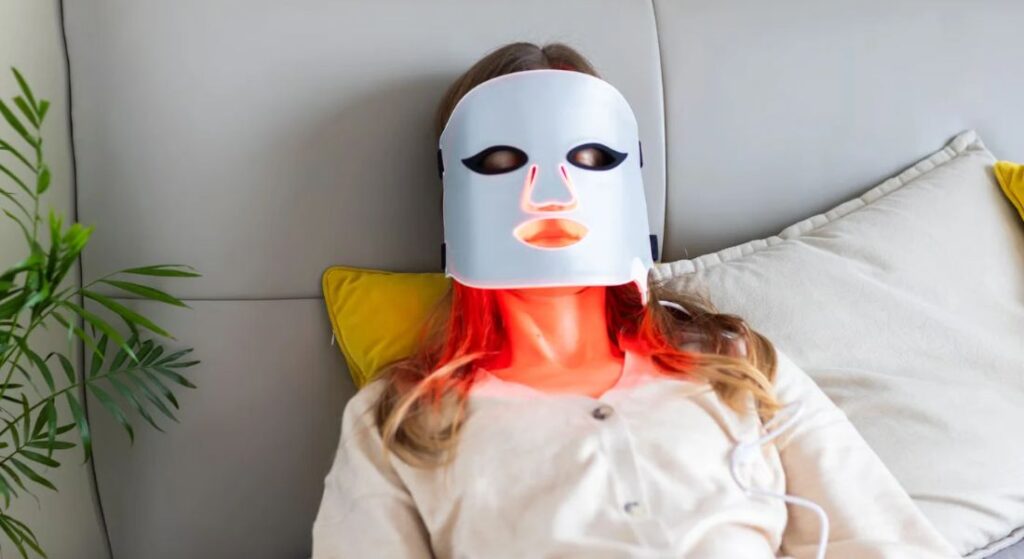
Professional LED masks and home-use devices can differ in wavelengths, light output and treatment controls. If you’re unsure which option suits your skin concern, a clinic assessment can help you choose an appropriate treatment.
A home-use mask may be more convenient, but a professional device isn’t automatically more effective. Compare safety testing, settings and clinical evidence for the specific device before choosing.
Research Insight
A 2007 controlled trial recruited 112 people, but only 76 completed the study. Improvements in wrinkle measurements and elasticity were reported among completers, so the findings shouldn’t be treated as a guarantee for every patient or device.
An October 2026 systematic review assessed eight studies involving 365 participants using home-use LED devices for facial rejuvenation. You may find its results encouraging, but researchers highlighted differences in devices, treatment schedules and the skin types represented, so the findings cannot prove that every clinic mask offers the same benefits.
Is LED Light Therapy the Same as Laser Treatment or Photodynamic Therapy?
If you’re considering LED light therapy, you should know that it differs from laser treatment. LEDs produce non-coherent light, while lasers use coherent light with different properties, so you should ask your clinic which technology your treatment involves.
You should also understand that photodynamic therapy requires a photosensitising substance before light exposure, unlike a standard LED session. If you’re comparing treatments, ask your practitioner which option is suitable for your skin concern and what results you can realistically expect.
Is LED Light Therapy Safe for Different Skin Tones?
Your skin tone doesn’t automatically rule out LED therapy, but your pigmentation history matters. Some blue-light exposure may worsen melasma or dark marks, while the risk from individual LED devices varies.
Tell your practitioner about any hyperpigmentation after acne or cosmetic treatments. Ask whether the device settings and eye protection are suitable for you, particularly as research involving darker skin tones remains limited.
UK Guidance Note
NICE guideline NG198 recommends established acne treatments and states that photodynamic therapy may be considered for some adults with moderate-to-severe acne when other treatments are ineffective, unsuitable or not tolerated. If you’re considering an LED mask, you should know that standard LED treatment isn’t the same as photodynamic therapy or an equivalent first-line acne treatment.
UK advertising rules expect strong evidence for claims about treating acne or reducing wrinkles. Claims that an LED device treats acne may also be classed as medicinal, so appropriate device registration and conformity requirements can apply. Ask whether the clinic has evidence for the exact device and results being promised.
What Side Effects and Safety Risks Should You Know About?
Temporary redness, dryness or discomfort can occur after LED treatment, although reactions are usually mild. Your clinic should follow the device’s eye-safety instructions and provide suitable protection when needed.
Before treatment, mention photosensitising medicines, lupus or eye conditions. Pregnancy or breastfeeding also warrants an individual discussion because evidence for cosmetic LED therapy in these circumstances is limited.
Tell your practitioner about any active facial infection or previous reaction to light treatment. New or changing skin lesions should be checked by your GP before cosmetic treatment. A session may need to be postponed, and any new eye pain or change in vision after treatment needs prompt medical assessment.
What Happens During a Professional LED Mask Treatment?
Your appointment should begin with a skin assessment, where your practitioner reviews your concerns, skincare routine, medicines and any history of light sensitivity. You should mention any previous reactions or treatments so they can decide whether LED therapy is suitable.
Your practitioner will cleanse your skin, position the LED mask or panel and provide eye protection if required. You can usually expect a comfortable session, followed by advice on aftercare and when to return for a review.
Is a Course of Clinic LED Therapy Worth the Cost?

LED therapy may appeal to you for mild acne or early fine lines, but changes can be subtle. It isn’t a reliable way to remove deep scars, marked pigmentation or loose skin.
Before paying for a course, ask for the total price, expected number of sessions and a progress review. Discuss other options when the concern you most want to treat is unlikely to respond.
Myth vs Fact
| Myth | Fact |
| LED therapy permanently cures acne. | It may improve some acne lesions, but recurrence is possible. |
| All LED mask colours have the same effects. | Different wavelengths are studied for different purposes. |
| More colours automatically give better results. | Effectiveness depends on the device, light dose and treatment protocol. |
| LED masks can remove deep acne scars. | They cannot reliably correct depressed or deeply scarred tissue. |
| Red LED light works like a surgical facelift. | It may improve some fine lines but cannot remove excess skin. |
| Clinic LED masks are always better than home masks. | The effectiveness of each device depends on its specifications and supporting evidence. |
| LED treatment has no side effects. | Irritation, discomfort and other adverse reactions are possible. |
| LED therapy is the same as photodynamic therapy. | Standard LED treatment does not involve the separate photosensitising step used in PDT. |
Key Takeaways
1. LED light therapy may help improve mild-to-moderate acne and some early signs of skin ageing.
2. Blue, red and near-infrared light are used for different purposes.
3. Results vary according to the device, treatment protocol and skin concern.
4. LED masks cannot remove deep scars, significant sagging or lost facial volume.
5. Eye safety, pigmentation risks and medical history should be assessed before treatment.
6. Professional LED therapy is not automatically more effective than a home-use device.
Frequently Asked Questions
1. What are the main benefits of LED light therapy for your skin?
LED therapy may reduce some acne lesions or soften early fine lines, usually with little downtime. Evidence for persistent redness is less certain and depends on the underlying condition.
2. Can LED light therapy help clear acne and breakouts?
Blue light may help reduce acne-associated bacteria, while red light can help manage inflammation. You may notice fewer breakouts after several weeks, although persistent or severe acne may require additional treatment.
3. Can LED light therapy tighten your skin and reduce wrinkles?
Red and near-infrared LED light may support collagen-related activity and help your early fine lines look less noticeable. However, you shouldn’t expect it to lift sagging skin, restore lost facial volume or remove deeper wrinkles.
4. What are the biggest disadvantages of LED light therapy?
Results are often modest, and you may need several sessions to notice an improvement. It also won’t treat every skin concern, and the evidence varies between devices and treatment protocols.
5. Can LED light therapy remove acne scars and pigmentation?
No, LED therapy cannot reliably remove depressed acne scars or clear persistent melasma and other dark patches. Your practitioner may recommend more targeted treatments, such as microneedling or subcision for selected acne scars, or a different approach for pigmentation based on your skin assessment.
6. How many LED light therapy sessions do you need to see results?
You’ll usually need several sessions to assess whether your skin is improving. The recommended schedule depends on your skin concern, device, wavelengths and your practitioner’s treatment plan.
7. Is professional LED light therapy better than using a home LED mask?
Professional and home-use masks can differ in wavelengths, light output and treatment controls. A clinic assessment can help you choose a suitable device, but professional treatment isn’t automatically more effective.
8. Is LED light therapy safe for darker skin tones?
LED therapy may be suitable for different skin tones, but certain wavelengths, particularly blue light, may worsen pigmentation in people prone to melasma or dark marks. Tell your practitioner about previous pigmentation changes before starting treatment.
9. What side effects can you experience after LED light therapy?
You may notice temporary redness, dryness, irritation or discomfort, although these effects are generally mild. Tell your practitioner if you take photosensitising medication or have lupus or an eye condition before treatment.
10. Is LED light therapy worth it for your skin concerns?
It may be worthwhile if you have mild acne or early signs of ageing and want a gentle, non-invasive option. Before booking, ask which wavelengths will be used, how many sessions you may need and whether another treatment would better address your concerns.
Final Thoughts: LED Light Therapy Pros and Cons
The best starting point is to decide what change you want to see, then ask whether the clinic’s LED device has evidence for that goal. Small improvements in acne or early fine lines may be possible, but deep scars, marked pigmentation and loose skin usually need a different approach. Reviewing your progress can help you decide whether more sessions are worthwhile.
If you’re looking for LED Light Therapy in London, you can speak with the team at the London Medical & Aesthetic Clinic about your skin concerns, the results you can expect and which treatment options may suit you.
References:
1.Ershadi, S. and Barbieri, J.S. (2025) ‘At-Home LED Devices for the Treatment of Acne Vulgaris: A Systematic Review and Meta-Analysis’, JAMA Dermatology, 161(5), pp. 552–555. Available at: https://pubmed.ncbi.nlm.nih.gov/40042878/
2. Lee, S.Y., Park, K.H., Choi, J.W. et al. (2007) ‘A prospective, randomized, placebo-controlled, double-blinded, and split-face clinical study on LED phototherapy for skin rejuvenation: clinical, profilometric, histologic, ultrastructural, and biochemical evaluations and comparison of three different treatment settings’, Journal of Photochemistry and Photobiology B: Biology, 88(1), pp. 51–67. Available at: https://www.sciencedirect.com/science/article/pii/S1011134407000632
3. Das, R.K., Thayer, W.P., Kubiak, C.A. et al. (2026) ‘Efficacy and Safety of At-Home Light-Emitting Diode Photobiomodulation for Facial Rejuvenation: A Systematic Review’, Aesthetic Plastic Surgery. Published online 14 October 2026. Available at: https://pubmed.ncbi.nlm.nih.gov/42875609/
4. Gan, C. and Rodrigues, M. (2024) ‘An Update on New and Existing Treatments for the Management of Melasma’, American Journal of Clinical Dermatology, 25(5), pp. 717–733. Available at: https://pmc.ncbi.nlm.nih.gov/articles/PMC11358250/
5. Hernández-Bule, M.L., Naharro-Rodríguez, J., Bacci, S. and Fernández-Guarino, M. (2024) ‘Unlocking the Power of Light on the Skin: A Comprehensive Review on Photobiomodulation’, International Journal of Molecular Sciences, 25(8), article 4483. Available at: https://www.mdpi.com/1422-0067/25/8/4483