


You may consider fractional CO₂ laser if your neck has fine lines, rough texture, selected sun-related pigmentary changes or crepey skin. It resurfaces your skin and encourages natural repair, which may improve its overall quality.
You shouldn’t expect CO₂ laser to remove significant loose skin or replace a neck lift. Your skin type and main concern should guide whether laser is suitable for you, as your neck needs careful treatment.
What Is CO₂ Laser Neck Rejuvenation?
CO₂ laser neck rejuvenation can be used to target selected ageing changes in your neck skin. Fractional CO₂ laser creates tiny areas of controlled injury, encouraging your skin to heal and remodel collagen.
You may consider it for fine wrinkles, crepey texture, uneven skin or sun damage. However, CO₂ laser improves your skin quality rather than physically removing significant loose skin.
Why Does the Neck Show Signs of Ageing?
Your neck can show ageing as collagen and elastic fibres gradually change. You may notice thinner, less firm skin, fine lines, crepey texture or pigmentation over time.
Your neck also folds and moves constantly, while regular sun exposure can add further skin damage. CO₂ laser may improve some of these skin-quality changes, but you shouldn’t expect it to reverse every sign of ageing.
How Does Fractional CO₂ Laser Work?
Fractional CO₂ laser can create tiny, controlled areas of thermal injury in your skin while leaving surrounding tissue intact. Your skin then begins a repair process that encourages collagen remodelling and new skin formation.
Your practitioner may use more conservative or stronger settings depending on your treatment goals and skin characteristics. Because your neck skin is thinner, more aggressive treatment isn’t automatically better.
What Skin Concerns Can CO₂ Laser Improve?
You may consider fractional CO₂ laser if you want to improve fine wrinkles, crepey texture, sun damage or uneven skin. By resurfacing your skin and encouraging collagen remodelling, it may help your neck look smoother.
Your results depend on how much skin ageing and laxity you have. CO₂ laser mainly improves skin quality, so it won’t replace treatments designed to lift or remove significant loose skin.
What Can CO₂ Laser Improve on the Neck?
| Main concern | How fractional CO₂ laser may help | Important limitation |
| Fine wrinkles | Resurfacing and collagen remodelling may soften superficial lines | Deeper anatomical creases may remain visible |
| Crepey texture | May improve surface texture and skin quality | Cannot remove significant excess skin |
| Sun damage | May improve selected pigmentary and textural changes | Pigmentation risk must also be considered |
| Uneven texture | Fractional resurfacing may create a smoother appearance | Results depend on treatment intensity and skin response |
| Mild laxity | Collagen remodelling may produce some improvement in firmness | It does not provide the same structural lift as surgery |
| Significant loose skin | CO₂ laser has a limited role | Surgical assessment may be more appropriate |
Can CO₂ Laser Improve Crepey Neck Skin?
You may improve crepey neck skin with fractional CO₂ laser by encouraging collagen remodelling and improving your skin’s texture and firmness. You may see better results when your main concern is thin, finely wrinkled skin rather than significant loose skin.
Your neck can be more sensitive to laser treatment than your face. A conservative approach may therefore be more suitable for you, particularly if you are prone to redness, irritation or pigmentation changes.
Clinical Tip
Crepey skin and loose skin can occur together, but they are different concerns. Fine wrinkling and rough texture mainly involve skin quality, while laxity describes skin that has lost support and sits further from the underlying contour.
Fractional CO₂ laser may be more useful when surface texture and fine wrinkles are the main concerns. If significant excess skin is responsible for the appearance, resurfacing alone is unlikely to produce a major lifting effect.
Can CO₂ Laser Treat Neck Wrinkles?
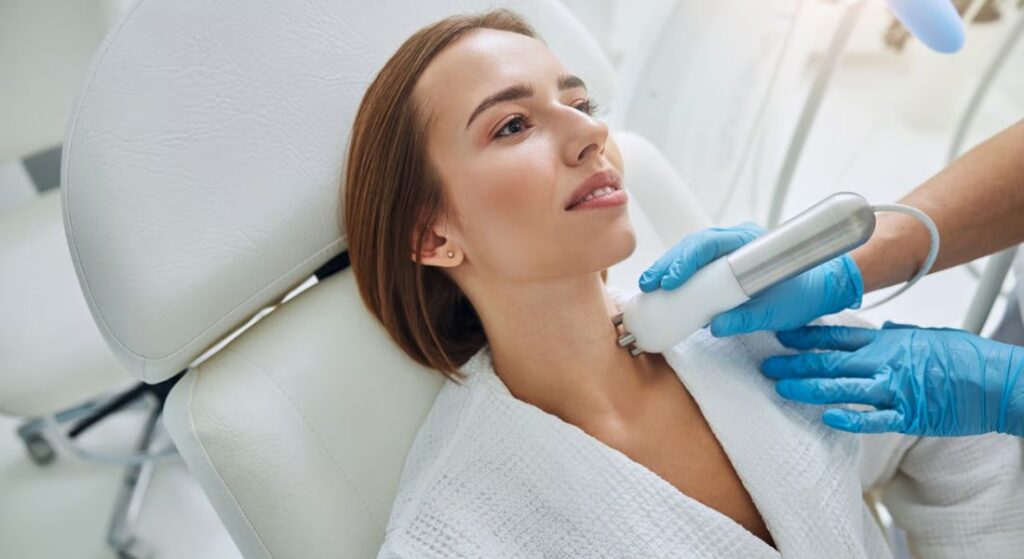
You may soften fine neck wrinkles with CO₂ laser, especially when they are linked to sun damage or reduced skin quality. The treatment improves your skin texture rather than physically filling a crease.
Deeper horizontal lines may have an anatomical or movement-related cause. Your practitioner should assess whether your wrinkles are mainly superficial before recommending laser treatment.
Evidence Note
A small neck-specific study followed 20 women after fractional CO₂ laser treatment and reported improvements in horizontal neck lines, laxity and other measures at both one month and one year. However, the study did not include an untreated comparator group, so its findings should be interpreted cautiously rather than treated as a guaranteed result for every patient.
An earlier prospective study involving 10 patients also reported improvements in neck texture, wrinkles and laxity after fractional ablative CO₂ treatment, but its small sample size again limits how widely the results can be applied.
Does CO₂ Laser Encourage Collagen Remodelling?
Fractional CO₂ laser creates controlled thermal injury that triggers a wound-healing response within the treated skin. This process can lead to collagen remodelling and changes in the skin’s structure over time.
You shouldn’t expect the final result immediately because remodelling develops gradually after treatment. The degree of improvement depends on factors such as your skin, treatment parameters and starting concern, and laser resurfacing cannot remove significant excess skin.
Is CO₂ Laser Suitable for Everyone?
You may be suitable for CO₂ laser depending on your skin type, pigmentation risk, skin thickness, medical history and treatment goals. If your skin is prone to post-inflammatory pigmentation or you have previously developed dark marks after irritation or cosmetic procedures, you may need additional caution and an individual assessment of pigment risk.
You should also consider whether your main concern is skin texture or significant laxity, neck bands or loss of contour. A consultation can help you decide whether laser addresses the reason your neck looks older.
Research Insight
Post-inflammatory hyperpigmentation is a recognised concern after CO₂ laser treatment. A 2023 review of 14 studies found that reported PIH rates varied substantially between studies and treatment approaches. The review did not find a clear relationship between Fitzpatrick skin type and PIH risk, although the authors noted that stronger evidence is still needed.
This is why your pigmentation history, skin characteristics, recent sun exposure and treatment settings should all be considered rather than choosing laser intensity using skin tone alone.
What Is Recovery Like After CO₂ Laser?
You may experience redness, swelling, warmth, sensitivity, dryness or peeling after CO₂ laser. Your neck may take time to settle because the skin is delicate and constantly moving.
You should follow your practitioner’s skincare and sun-protection advice while your skin heals. Your recovery time depends on how strongly you are treated, so you should avoid scheduling it just before an important event.
What Are the Risks of CO₂ Laser on the Neck?

You may experience redness, irritation, infection, scarring, pigmentation changes or delayed healing after CO₂ laser. Your neck needs particular care because its skin can respond differently from thicker facial skin.
You may reduce avoidable risks by choosing an appropriately trained practitioner who has experience with fractional CO₂ laser treatment of the neck. You should ask about the laser, downtime, possible complications and aftercare before you proceed.
How Does CO₂ Laser Compare with Other Neck Treatments?
You may consider CO₂ laser when your main concerns are wrinkles, crepey texture or sun damage. You may consider radiofrequency or ultrasound for mild laxity, while selected injectables can target certain lines or skin-quality concerns.
If you have significant loose skin or deeper structural changes, surgery may offer a different type of correction. You should choose your treatment based on what you want to improve, as no single option addresses every neck concern.
Can CO₂ Laser Be Combined with Other Treatments?
You may consider a combination of CO₂ laser and other treatments when several different changes are affecting your neck. Each treatment should have a clear purpose rather than simply adding more procedures.
1. Skin texture and wrinkles: CO₂ laser may improve fine lines, roughness and crepey texture by resurfacing the skin and encouraging remodelling.
2. Mild skin laxity: Radiofrequency or ultrasound may sometimes be considered alongside resurfacing when firmness is also a concern.
3. Specific neck lines: Selected injectable treatments may be used for particular creases that laser resurfacing alone may not fully improve.
4. Treatment timing: Procedures may need to be spaced apart so your skin can heal properly and your response to each treatment can be assessed.
Combining treatments does not automatically produce better results. Your practitioner should recommend a staged plan based on the specific concerns you want to improve.
How Long Do CO₂ Laser Results Last?
You may see improvements in your neck skin for some time after CO₂ laser, but your skin will continue to age naturally. How long your results last can depend on your age, sun exposure, skincare, genetics and treatment intensity.
You can help maintain your results by protecting your skin from the sun and following a sensible skincare routine. You should view CO₂ laser as rejuvenation rather than a permanent reversal of ageing.
Can CO₂ Laser Replace a Neck Lift?
You may consider CO₂ laser if your main concerns are crepey texture, fine lines, uneven skin or sun damage. It improves your skin quality but doesn’t remove significant loose skin.
If you have pronounced sagging or excess skin, you may need a surgical approach such as a neck lift. You may also benefit from combining treatments if you have both skin-quality and structural concerns.
How Should You Prepare for CO₂ Laser Neck Treatment?
You should discuss your skincare, medications, previous treatments and pigmentation history with your practitioner before CO₂ laser. You may also need to pause certain active skincare products and minimise sun exposure beforehand.
You should understand your expected redness, peeling and recovery time so you can plan properly. You should also explain exactly what you want to improve, whether that’s smoother skin or a firmer-looking neck.
How Do You Choose the Right CO₂ Laser Practitioner?

You should choose a practitioner who is appropriately trained and regularly performs laser treatments, particularly on the neck. Your practitioner should understand laser settings, healing and complications, as your thinner neck skin may need a more cautious approach than your face.
You should feel comfortable asking about realistic results, treatment sessions, downtime and risks for your skin type. A proper consultation can help you understand whether CO₂ laser is suitable for you and what to expect during recovery.
Myth vs Fact
| Myth | Fact |
| CO₂ laser can replace a neck lift. | CO₂ laser primarily improves skin quality and cannot remove substantial excess skin in the way surgery can. |
| Stronger laser settings always give better results. | More aggressive treatment can increase downtime and complications, particularly on the neck. |
| CO₂ laser only treats wrinkles. | Fractional resurfacing may also improve texture and selected sun-related changes in appropriate patients. |
| One treatment gives the same result for everyone. | Results depend on skin characteristics, treatment settings, severity of ageing and individual healing response. |
| CO₂ laser permanently stops neck ageing. | Treatment may improve existing skin changes, but natural ageing and future UV exposure continue over time. |
Key Takeaways
1. Fractional CO₂ laser may improve fine wrinkles, crepey texture, uneven skin and selected signs of sun damage by resurfacing the skin and encouraging collagen remodelling.
2. CO₂ laser mainly targets skin quality, so it should not be expected to remove significant excess skin or reproduce the structural results of a surgical neck lift.
3. Neck treatment generally needs careful laser settings because aggressive energy or treatment density can increase recovery time and the risk of complications.
4. Pigmentation risk should be assessed individually, particularly if your skin has previously developed dark marks after inflammation or cosmetic procedures.
5. Improvements usually develop gradually as the skin heals and remodels, and the duration of results varies rather than following one fixed timeline.
6. Choosing treatment should depend on your main concern, skin characteristics, expected downtime and individual risk rather than simply selecting the strongest available laser treatment.
Frequently Asked Questions
1. What is CO₂ laser neck rejuvenation?
CO₂ laser neck rejuvenation uses laser energy to improve the quality of your neck skin. It creates controlled microscopic injuries that encourage healing and collagen remodelling. This can improve wrinkles, texture and sun damage.
2. What can CO₂ laser improve on your neck?
CO₂ laser may improve fine wrinkles, crepey skin, uneven texture and some sun damage. It mainly targets skin quality. It cannot remove significant loose or hanging skin.
3. Can CO₂ laser treat crepey neck skin?
Yes, CO₂ laser may improve crepey skin by encouraging collagen remodelling. This can make your neck look smoother and firmer. Results depend on your skin condition and treatment intensity.
4. Can CO₂ laser reduce neck wrinkles?
CO₂ laser can soften certain fine surface wrinkles. However, deeper horizontal lines may have anatomical or folding factors that laser cannot fully correct. Your practitioner should assess the cause of your wrinkles before treatment.
5. Does CO₂ laser stimulate collagen?
Yes, controlled laser injury triggers your skin’s natural repair response. This encourages collagen-related remodelling within the treated area. Improvements usually develop gradually rather than appearing immediately.
6. Is CO₂ laser suitable for everyone?
No, CO₂ laser is not suitable for every person or every type of neck ageing. Your skin type, pigmentation risk, skin thickness and medical history should be considered. Particular caution may be needed if your skin is prone to post-inflammatory pigmentation or you have previously developed dark marks after irritation or cosmetic procedures.
7. What is recovery like after CO₂ laser?
You may experience redness, swelling, sensitivity, dryness and peeling after treatment. Recovery depends on how intensive your treatment is. Your practitioner will advise you on skincare and sun protection during healing.
8. What are the risks of CO₂ laser on the neck?
Possible risks include prolonged redness, irritation, infection, scarring, pigmentation changes and delayed healing. Neck skin can be particularly delicate. Choosing an experienced practitioner can help reduce unnecessary risks.
9. Can CO₂ laser be combined with other neck treatments?
Yes, combination treatments may be considered when you have several concerns, such as wrinkles, sun damage and mild laxity. However, combining procedures does not automatically mean better results. Your practitioner may recommend treating concerns in stages.
10. Can CO₂ laser replace a neck lift?
No, CO₂ laser and a neck lift treat different concerns. Laser improves skin quality, while surgery can remove excess skin and address deeper structural changes. If you have significant sagging, a neck lift may be more appropriate.
Final ThoughtsCO₂ Laser for Neck Rejuvenation
CO₂ laser can be a useful option when your main concerns are fine wrinkles, crepey texture, uneven skin tone or sun damage. By creating controlled treatment zones, it can support skin remodelling and gradually improve texture and firmness, although results depend on your skin and treatment approach.
CO₂ laser does not remove significant loose skin or correct every type of neck ageing. A consultation with an experienced practitioner can help determine whether laser resurfacing suits your concerns, skin type and expectations, while also considering recovery time and potential risks.
References:
1. Oram, Y. and Akkaya, A.D. (2014) ‘Neck rejuvenation with fractional CO₂ laser: long-term results’, Journal of Clinical and Aesthetic Dermatology, 7(8), pp. 23–29. Available at: https://pmc.ncbi.nlm.nih.gov/articles/PMC4142817/
2. Tierney, E.P. and Hanke, C.W. (2009) ‘Ablative fractionated CO₂ laser resurfacing for the neck: prospective study and review of the literature’, Journal of Drugs in Dermatology, 8(8), pp. 723–731. Available at: https://pubmed.ncbi.nlm.nih.gov/19663109/
3. Bin Dakhil, A., Shadid, A. and Altalhab, S. (2023) ‘Post-inflammatory hyperpigmentation after carbon dioxide laser: review of prevention and risk factors’, Dermatology Reports, 15(4), article 9703. Available at: https://pmc.ncbi.nlm.nih.gov/articles/PMC10777097/
4. Clementi, A. et al. (2025) ‘Sequential fractional CO₂ and 1540/1570 nm lasers: a narrative review of preclinical and clinical evidence’, Journal of Clinical Medicine, 14(11), article 3867. Available at: https://www.mdpi.com/2077-0383/14/11/3867
5. Vanaman, M., Fabi, S.G. and Cox, S.E. (2016) ‘Neck rejuvenation using a combination approach: our experience and a review of the literature’, Dermatologic Surgery, 42(Suppl 2), pp. S94–S100. https://pubmed.ncbi.nlm.nih.gov/27128251/