


Eyelid surgery, or blepharoplasty, may create a noticeable change around your eyes while aiming to preserve a natural eyelid appearance. You may see less excess upper-eyelid skin, reduced under-eye bags or a less heavy appearance, depending on your anatomy and the type of surgery you have.
Your early appearance will not show the final result because swelling, bruising, redness and temporary asymmetry can take time to settle. Before-and-after photographs should also be viewed realistically, as blepharoplasty can improve selected eyelid concerns but cannot automatically correct low eyebrows, true eyelid ptosis, pigmentation, every fine line or all types of under-eye hollows.
What Is Blepharoplasty Designed to Change?
Blepharoplasty is designed to improve selected changes around your eyelids, such as excess upper-eyelid skin or prominent under-eye bags. You may have upper surgery, lower surgery or both, depending on your anatomy and the concerns you want to address.
Your surgeon may remove or reposition carefully selected amounts of skin, fat or other tissue rather than simply removing as much as possible. The aim is to improve your appearance while maintaining healthy eyelid position, closure and function, so the exact technique will be tailored to you.
What Might Your Eyes Look Like Before Surgery?
Before upper blepharoplasty, you may notice excess skin folding over your natural eyelid crease, making your eyes look hooded or heavy. In some cases, this skin can also affect your upper or peripheral vision, making surgery partly functional as well as cosmetic.
Before lower blepharoplasty, you may notice persistent under-eye bags, excess skin, fine lines or hollows beneath your eyes. These concerns can occur together, but they may require different approaches, so your surgeon should assess your individual anatomy before deciding what can realistically be improved.
How Can Upper Eyelid Surgery Change Your Appearance?
After upper blepharoplasty, you may notice less excess skin above your eyelid crease, making your eyes look more open and less hooded. Your eyes are not actually made larger; removing skin that was covering part of your natural eyelid simply makes more of the eyelid visible.
The aim is usually to reduce excess skin while maintaining an eyelid shape that is appropriate for your existing anatomy and features. Studies have reported improvements in patient-reported aesthetic satisfaction and selected functional outcomes after upper blepharoplasty, although results vary between individuals.
How Can Lower Eyelid Surgery Change Under-Eye Bags?
Lower blepharoplasty can reduce your under-eye bags when they are mainly caused by prominent or displaced fat. Your surgeon may reposition selected fat rather than simply removing it, which may help create a smoother transition between your lower eyelid and cheek in suitable patients.
You may look less tired when the bags were caused by structural changes rather than lack of sleep. However, if your main concern is pigmentation or a deep tear trough, lower blepharoplasty alone may not give you the result you expect, so your surgeon should identify the underlying cause first.
Can Blepharoplasty Make You Look Less Tired?

Blepharoplasty may make your eyes appear less tired when excess upper-eyelid skin or prominent under-eye bags are contributing to a heavy appearance. By changing these structural features, your eyes may appear more open and less heavy.
However, you may still have dark circles, hollows, low eyebrows or facial volume changes after surgery. Your results are more likely to meet your expectations when the main cause of your tired-looking appearance has been identified and treated appropriately.
Can Upper Eyelid Surgery Improve Your Field of Vision?
Upper blepharoplasty may improve your visual field when excess upper-eyelid tissue is genuinely obstructing peripheral vision. You may notice better peripheral vision and improved ease with everyday activities when the obstruction is significant.
However, blepharoplasty does not correct your glasses prescription or improve eyesight affected by short-sightedness or long-sightedness. The visual benefit comes specifically from removing excess tissue that was obstructing your natural field of view.
Research Insight
A systematic review of 28 studies examining functional outcomes after upper blepharoplasty found favourable changes including enlargement of the visual field and improvements in some quality-of-life measures. However, not every measured outcome changed consistently between studies, reinforcing the importance of selecting patients whose symptoms genuinely relate to eyelid anatomy.
More recent 2025 evidence reviewing validated patient-reported outcomes also supports improvements in visual function and quality-of-life measures after appropriately selected upper-eyelid surgery. This does not mean that every cosmetic blepharoplasty will improve vision, because functional improvement depends on whether tissue was actually obstructing the visual field beforehand.
What Will Eyelid Surgery Not Change?
Blepharoplasty can improve specific eyelid concerns, but it will not correct every feature around your eyes. You may still have low eyebrows, true eyelid ptosis, dark circles, pigmentation or under-eye hollows because these concerns can have different underlying causes.
Crow’s feet and fine lines beside your eyes may also remain after surgery. Your surgeon should explain which changes blepharoplasty can realistically improve for you, so you can compare your before-and-after results with realistic expectations rather than expecting every sign of ageing to disappear.
Which Eye-Area Concerns Can Blepharoplasty Improve?
| Concern | Can blepharoplasty help? | Important consideration |
| Excess upper-eyelid skin | Often | Upper blepharoplasty can remove carefully selected excess skin and reduce hooding |
| Prominent under-eye bags | Often | Lower blepharoplasty can remove or reposition prominent fat |
| Heavy-looking upper eyelids | May help | Improvement depends on whether excess eyelid skin is the main cause |
| Low eyebrows | Usually not directly | A separate brow assessment or treatment may be required |
| True eyelid ptosis | Not with standard blepharoplasty alone | Ptosis may require a different or additional procedure |
| Dark under-eye pigmentation | Usually limited | Pigmentation has different causes and may remain after surgery |
| Deep tear-trough hollows | May improve in selected cases | The result depends on the underlying anatomy and whether fat repositioning or another treatment is appropriate. |
| Crow’s feet | Limited | Blepharoplasty does not directly treat lines beside the eyes |
| Obstructed peripheral vision | May improve | Benefit is possible when excess upper-eyelid tissue genuinely obstructs vision |
| Natural eyelid asymmetry | May improve in selected cases | Some pre-existing asymmetry usually remains and perfect symmetry cannot be guaranteed. |
Where Will the Scars Be After Surgery?
Your upper blepharoplasty scar is usually placed within the natural eyelid crease, where it can become less noticeable as it heals. Initially, you may find the scar looks pink, firm or more visible than expected and it will often soften and become less noticeable as healing and scar maturation progress over the following months.
For lower eyelid surgery, your surgeon may place the incision close to your lash line or, for selected procedures, inside your lower eyelid so there is no visible external scar. The final appearance of your scars depends on factors such as your healing response, genetics, surgical technique and aftercare.
What Will You Look Like Immediately After Eyelid Surgery?
Immediately after eyelid surgery, your eyes will likely look swollen and bruised rather than refreshed, and one side may appear more swollen than the other. You may also experience watering, irritation, temporary blurred vision or difficulty fully closing your eyes while the swelling settles.
You may have visible stitches if non-dissolving sutures are used. Your surgical team will tell you when they should be removed, as the timing depends on the technique and your individual recovery. You should not judge your final appearance from the first few days, as early photographs mainly show your recovery rather than the result you will see once the swelling has settled.
How Does the Appearance Change During the First Few Weeks?
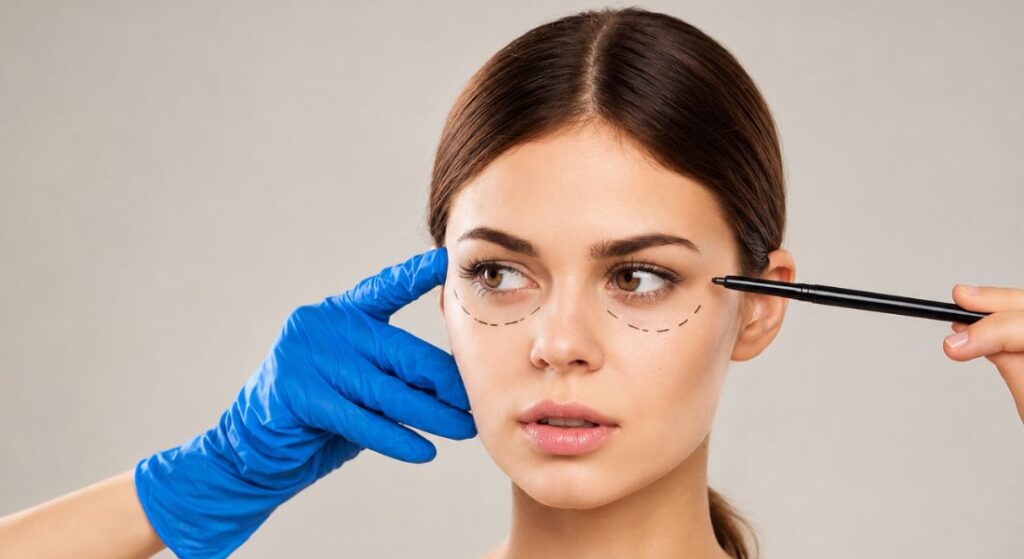
During the first few weeks, your swelling and bruising should gradually reduce rather than disappear overnight. Many people take around two weeks away from work after eyelid surgery, although the time you need depends on your job, the extent of surgery and your recovery.
Your eyelids will continue settling even after you start feeling better. Before-and-after photographs taken during the first one or two weeks should therefore not be treated as your final result, as your skin, scars and eyelid contours are still changing.
When Will You See Your Final Result?
You may notice the main improvement once most of your bruising and swelling has settled, but your eyelids can continue changing for several months. Your scars will also gradually become softer, flatter and less noticeable as they mature.
Lower-eyelid swelling can sometimes take longer to resolve. In some patients, swelling of the conjunctiva, known as chemosis, can also occur and may temporarily affect the appearance of the lower eyelid. You should therefore avoid judging your final result from an early photograph and allow enough time for your tissues and scars to settle properly.
How Long Can Eyelid Surgery Results Last?
Blepharoplasty can provide long-lasting improvement because the excess skin or fat adjusted during surgery does not simply return immediately. However, your eyelids and surrounding facial tissues will continue to change naturally as you age.
1. Long-Lasting Improvement: You may continue to notice the benefits of eyelid surgery for many years after your procedure.
2. Natural Ageing Continues: Your skin, eyebrows and surrounding facial tissues can gradually change even after successful surgery.
3. Lifestyle Factors Matter: Smoking, sun exposure and general skin quality may influence how your eyelid area changes over time.
4. Further Treatment: Some people may eventually consider additional treatment if new hooding, bags or other age-related changes develop.
You should therefore think of blepharoplasty as a long-lasting improvement rather than a permanent way to stop ageing. How long you remain satisfied with your result will depend on your anatomy, healing and the way your facial tissues change over time.
Will Both Eyes Look Perfectly Symmetrical Afterwards?
You should not expect your eyelids to become perfectly identical because natural facial asymmetry is common. One eyebrow, eyelid crease or side of your face may already differ slightly before surgery, and these differences can remain afterwards.
Your swelling may also develop unevenly during recovery, making one eyelid temporarily look higher, lower or more swollen. The aim of surgery is usually to create better overall balance for you while maintaining a natural appearance, rather than achieving mathematical symmetry.
Can Dry Eyes or Eyelid Position Affect Your Result?
Yes, your eye comfort and eyelid position can affect both your recovery and final result. Temporary dry-eye symptoms are possible after blepharoplasty, while lower eyelid surgery can occasionally affect how the lid sits or closes, depending on factors such as your existing eyelid support, the surgical technique and how the tissues heal.
You should tell your surgeon about any existing dry eyes, previous eye surgery or difficulty closing your eyes fully. Protecting your eyes and maintaining normal eyelid function should remain a priority alongside achieving the cosmetic improvement you want.
Evidence Note
A 2025 systematic review of lower blepharoplasty found a generally favourable safety profile, but outcomes and complication rates varied between techniques and studies. This matters because lower-eyelid surgery involves more than simply removing a bag or excess skin: eyelid support, fat position, tissue laxity and how much skin is adjusted can influence the final contour and function.
Careful patient selection and conservative planning can therefore be particularly important when assessing a lower-eyelid before-and-after result. An aesthetically smoother lower lid is not a successful result if normal eyelid position, closure or ocular comfort has been compromised.
What Complications Can Change the Before-and-After Result?
Bruising and swelling are normal parts of your early recovery, but complications such as infection, delayed healing, noticeable scarring or persistent asymmetry can affect your final appearance. Lower eyelid surgery can also occasionally cause changes in eyelid position or contour that may require further treatment.
You should seek urgent medical assessment if you develop severe or increasing eye pain, sudden deterioration in your vision or rapidly worsening swelling after surgery. Understanding these potential problems can help you judge before-and-after results realistically, rather than focusing only on the best possible outcome.
How Should You Judge Eyelid Surgery Before-and-After Photos?

Before-and-after photographs can help you understand potential results, but only when the images provide a fair comparison. You should look for similar lighting, camera angles and facial expressions, as changes in eyebrow position or lighting can make your eyes appear more or less hooded.
You should also check how long after surgery the final photograph was taken, as early swelling can affect the appearance of your eyelids. Photographs of patients with anatomy and concerns similar to yours may provide a more useful comparison than focusing only on particularly dramatic results.
Myth vs Fact
| Myth | Fact |
| Your final improvement should be obvious immediately after surgery. | Early swelling and bruising can temporarily make your eyelids look more swollen or uneven, so the final result cannot be judged immediately. |
| Blepharoplasty makes the eyeballs larger. | It can reveal more of the natural eyelid by reducing excess skin; it does not enlarge the eyes themselves. |
| Upper blepharoplasty automatically lifts a low eyebrow. | Standard blepharoplasty does not directly lift the eyebrow. |
| Eyelid surgery always corrects true ptosis. | True eyelid ptosis may require a different or additional procedure. |
| Lower blepharoplasty removes every dark circle. | Pigmentation, thin skin, vascular show and deep hollows can remain. |
| Both eyes should become perfectly identical. | Natural facial and eyelid asymmetry normally remains to some degree. |
| A two-week photograph shows the final result. | Scars and tissues can continue settling for several months. |
| Removed eyelid skin can never appear hooded again. | Ageing and brow descent can change the eyelid appearance over time. |
| Dry eye has nothing to do with cosmetic results. | Ocular-surface health and eyelid closure can affect comfort and recovery. |
| Severe increasing eye pain or sudden deterioration in vision is a normal part of recovery. | These are warning symptoms that require urgent medical assessment. |
Key Takeaways
1. Upper blepharoplasty may reduce excess upper-eyelid skin and hooding.
2. Lower blepharoplasty may reduce or reposition prominent under-eye fat in suitable patients.
3. Blepharoplasty does not automatically correct brow descent, true ptosis, pigmentation or every under-eye hollow.
4. Functional upper blepharoplasty may improve a visual field genuinely obstructed by excess eyelid tissue.
5. Swelling, bruising and temporary asymmetry during early recovery do not represent the final result.
6. Scars and eyelid contours can continue to change for several months.
7. Dry-eye symptoms and eyelid closure should be assessed before surgery.
8. Results can be long-lasting, but natural ageing and brow changes continue.
9. Severe increasing eye pain or sudden deterioration in vision after surgery requires urgent assessment.
Frequently Asked Questions
1. Can eyelid surgery improve excess upper-eyelid skin?
Yes, upper blepharoplasty can reduce excess skin that makes your upper eyelids look hooded or heavy. By removing a carefully planned amount of skin, your natural eyelid crease may become more visible and your eyes can appear more open while maintaining their natural shape.
2. Can lower eyelid surgery reduce under-eye bags?
Yes, lower blepharoplasty can improve prominent under-eye bags when they are caused by excess or displaced fat. However, if your main concern is pigmentation, hollowing or thin skin, eyelid surgery may not completely address the appearance.
3. Will my eyes look different immediately after eyelid surgery?
Your eyes are likely to look swollen and bruised immediately after surgery rather than refreshed. Temporary asymmetry, redness and irritation are also common during early recovery, so your appearance during the first few days should not be considered your final result.
4. How long does it take for swelling and bruising to settle?
Most swelling and bruising gradually improve over the first few weeks rather than disappearing immediately. Many people take around two weeks away from work, although residual swelling, redness and other healing changes can continue for longer.
5. When will you see the final results of blepharoplasty?
You may notice the general improvement once the initial swelling and bruising have reduced, but your eyelids continue to settle for several months. Scars can also become softer, flatter and less noticeable as they mature.
6. Will eyelid surgery leave visible scars?
Upper-eyelid scars are usually placed within the natural eyelid crease, while an external lower-eyelid incision is generally positioned close to the lash line. Scars can initially appear pink or firm but usually become less noticeable as they heal.
7. Can eyelid surgery improve your field of vision?
Yes, upper blepharoplasty can improve your peripheral visual field when excess eyelid skin physically obstructs your vision. However, it does not correct short-sightedness, long-sightedness or other refractive problems that require glasses or contact lenses.
8. Will both eyes look perfectly symmetrical after surgery?
Perfect symmetry cannot be guaranteed because natural facial asymmetry is common. Swelling can also affect each eyelid differently during recovery, so temporary differences do not necessarily indicate a problem with your final result.
9. Can dry eyes affect the results of eyelid surgery?
Yes, dry-eye symptoms can occur temporarily after blepharoplasty, particularly while your eyelids are healing and your blinking or closure is affected by swelling. Your surgeon should assess your existing eye health and dry-eye symptoms before surgery to help minimise potential problems.
10. How should you judge eyelid surgery before-and-after photographs?
You should compare photographs taken with similar lighting, facial expressions, camera angles and eyebrow positions. It is also important to check how long after surgery the photographs were taken, because early images may still show swelling and do not necessarily represent the final result.
Final Thoughts: Understanding Your Eyelid Surgery Before-and-After Results
Eyelid surgery can refresh the appearance of your eyes by addressing specific concerns such as excess upper-eyelid skin or prominent under-eye bags, but your results will depend on your individual anatomy and what is causing your concerns. You should also remember that swelling, bruising and scar changes can affect your appearance for several weeks or months, so your early result is not necessarily your final one.
If you are considering eyelid surgery in London, you can contact us at the London Medical & Aesthetic Clinic to discuss your suitability and treatment options.
References:
1. Fineide, F.A., Khan, A.Z., Boberg-Ans, L.C., Allen, R.C., Bohman, E., Tønseth, K.A. and Utheim, T.P. (2025) ‘Minimizing postoperative scars in upper eyelid blepharoplasty: A concise review’, Surgeries, 6(4), article 93. Available at: https://www.mdpi.com/2673-4095/6/4/93
2. Zhang, S.Y., Yan, Y. and Fu, Y. (2020) ‘Cosmetic blepharoplasty and dry eye disease: A review of the incidence, clinical manifestations, mechanisms and prevention’, International Journal of Ophthalmology, 13(3), pp. 488–492. Available at: https://pmc.ncbi.nlm.nih.gov/articles/PMC7154208/
3. Gimenez, A.R. et al. (2025) ‘Safety and complications in lower eyelid blepharoplasty: A systematic review’, Plastic and Reconstructive Surgery – Global Open, 13(9), article e7102. Available at: https://pmc.ncbi.nlm.nih.gov/articles/PMC12456572/
4. Vagefi, M.R. et al. (2025) ‘Health-related quality-of-life outcomes for upper blepharoplasty and blepharoptosis surgery: A report by the American Academy of Ophthalmology’, Ophthalmology, 132(12), pp. 1445–1456. Available at: https://pubmed.ncbi.nlm.nih.gov/40913605/
5. Hollander, M.H.J., Contini, M., Pott, J.W., Vissink, A., Schepers, R.H. and Jansma, J. (2019) ‘Functional outcomes of upper eyelid blepharoplasty: A systematic review’, Journal of Plastic, Reconstructive & Aesthetic Surgery, 72(2), pp. 294–309. Available at: https://www.sciencedirect.com/science/article/abs/pii/S1748681518304200