


The most appropriate laser for thread vein treatment depends on the diameter, depth, colour and location of the visible vessels, as well as your skin characteristics. PDL or KTP laser may be considered for selected superficial facial vessels, while long-pulsed Nd:YAG may be considered for deeper or larger vessels because its 1,064 nm wavelength penetrates further into the skin. IPL can also be suitable for widespread facial redness and multiple fine vessels.
There is no single laser that is right for everyone. You should have your thread veins assessed by an experienced practitioner, who can discuss which treatment offers an appropriate balance of expected improvement, recovery, limitations and risk for your particular vessels and skin.
What Are Thread Veins?
Thread veins, also called telangiectasias, are small, persistently dilated blood vessels visible near the skin’s surface. They may appear as fine red, blue or purple lines and commonly affect the face and legs.
Most thread veins are harmless and are treated for cosmetic reasons rather than medical necessity. Their causes vary according to location. Facial telangiectasias may be associated with ageing, cumulative sun exposure, inherited susceptibility or rosacea, while leg thread veins may also occur in association with pregnancy, family history or wider venous changes. Before you consider treatment, your practitioner should confirm that the visible mark is a thread vein, as some other skin conditions can look similar and may require a different approach.
Why Is There No Single “Best” Laser?
There is no single laser that works best for every thread vein because different lasers target different types of blood vessels. The size, depth and colour of your thread veins, as well as your skin tone, all influence which wavelength and treatment approach may be appropriate. A tiny superficial red vessel requires a different approach from a larger blue vein beneath the skin.
How Do Vascular Lasers Treat Thread Veins?
Vascular lasers deliver wavelengths that are absorbed by haemoglobin or oxyhaemoglobin within blood vessels. The absorbed light is converted into heat, producing controlled thermal injury that may cause coagulation and closure of the targeted vessel while aiming to limit unnecessary heating of the surrounding skin. The vessel may then become less visible over time.
Your practitioner will adjust the laser settings according to the size and depth of your thread veins and may use a cooling system to protect your skin and improve comfort. You may notice the vessel becoming lighter, darker or temporarily more visible after treatment, but using higher energy is not always better, as it can increase the risk of burns, pigmentation changes and scarring.
When May Pulsed Dye Laser Be Used for Facial Thread Veins?
Pulsed dye laser (PDL) is one of the most established treatments for small, superficial facial thread veins and persistent redness. It targets haemoglobin within the blood vessels while helping to protect the surrounding skin, making it a popular option if you have facial telangiectasia or vascular rosacea. During treatment, you may feel a brief snapping sensation, and temporary redness or bruising can occur depending on the settings used.
Although PDL is highly effective, it is not always the best choice for every patient. You may need several sessions to achieve your desired result, and your practitioner may recommend KTP, Nd:YAG laser or another treatment if your thread veins are deeper, larger or better suited to a different wavelength.
When Is KTP Laser a Good Choice?
KTP laser is often a good choice if you have small, superficial red thread veins, particularly around your nose and cheeks. Its wavelength is absorbed effectively by haemoglobin, allowing it to target fine facial vessels with a high level of precision. Temporary redness and swelling can occur, and the response and side-effect profile can vary according to the treatment settings used.
KTP is not suitable for every type of thread vein. If your vessels are deeper, larger or blue in colour, your practitioner may recommend another treatment, such as Nd:YAG laser. Your skin tone should also be considered, as KTP can interact with melanin and may require more cautious settings in darker or recently tanned skin.
When Is Nd:YAG Laser the Better Option?
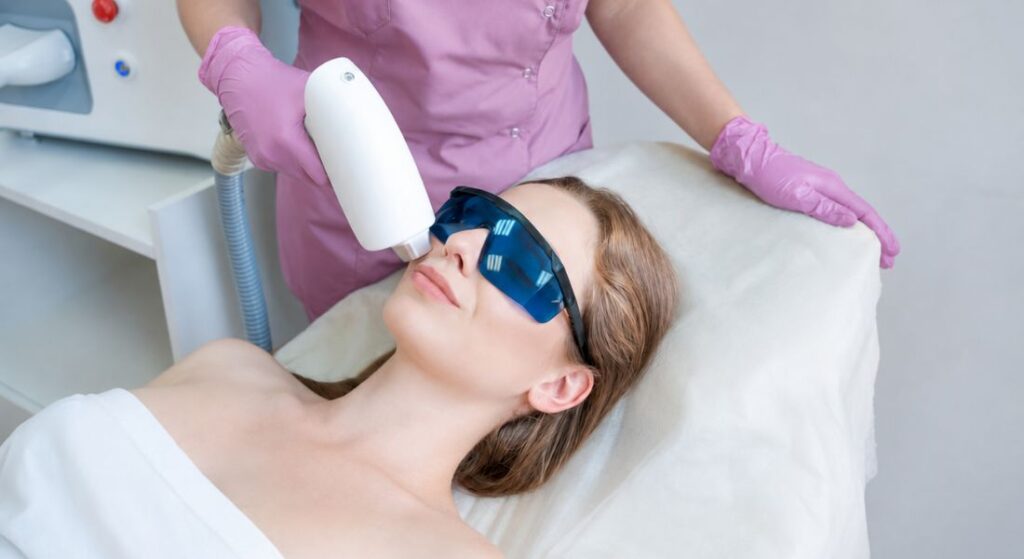
Nd:YAG laser is often the better choice when your thread veins are larger, deeper or blue-purple in colour. Its longer wavelength allows it to reach blood vessels beneath the skin more effectively than PDL or KTP, making it particularly useful for selected facial veins and many leg thread veins. During treatment, you may feel a deeper warming or stinging sensation because the laser is targeting vessels at greater depth.
Although Nd:YAG is highly effective for deeper veins, it is not always the best option for tiny superficial facial capillaries. Your practitioner should assess the size, depth and location of your thread veins before deciding whether Nd:YAG or another vascular laser is more appropriate.
Evidence Note
A systematic review of 26 studies involving 1,991 patients found that long-pulsed 1,064 nm Nd:YAG laser can be an effective option for leg telangiectasias and reticular veins measuring up to approximately 3 mm. Studies comparing Nd:YAG with sclerotherapy generally reported similar clearance, although sclerotherapy tended to cause less discomfort and produce faster visible improvement.
This does not mean Nd:YAG is automatically the best treatment for every leg vein. Vessel size, depth, skin type and the presence of underlying venous disease should all be considered before treatment.
Is IPL as Effective as a Laser?
Intense pulsed light (IPL) is not a laser, but it can be an effective treatment for thread veins and facial redness. Unlike lasers, IPL uses a broad range of light wavelengths, making it particularly suitable if you have multiple fine vessels, diffuse redness or pigmentation across a larger area. You may benefit from IPL when your concern is widespread rather than a single visible thread vein.
The results you achieve with IPL depend on the device being used, your skin tone and the experience of your practitioner. While IPL can provide excellent improvement for some people, a dedicated vascular laser such as PDL, KTP or Nd:YAG may offer greater precision if you have individual, well-defined thread veins.
How Do PDL, KTP, Nd:YAG and IPL Compare?
The different technologies target blood vessels in different ways, so the most suitable option depends on the depth, colour and size of the vessel as well as your skin tone.
| Treatment | Typical wavelength | May suit | Important considerations |
| Pulsed dye laser (PDL) | Around 595 nm | Superficial red facial vessels, persistent facial redness and rosacea-associated telangiectasia | Well-established vascular laser; temporary redness, swelling or purpura can occur |
| KTP laser | 532 nm | Fine, superficial red facial thread veins | Highly precise for superficial vessels; greater interaction with melanin means skin tone and tanning require careful assessment |
| Long-pulsed Nd:YAG | 1,064 nm | Deeper, larger or blue-purple vessels and selected leg veins | Penetrates more deeply; treatment may feel more uncomfortable and correct settings are important to avoid thermal injury |
| IPL | Broad filtered spectrum | Diffuse facial redness and multiple fine vessels | Not technically a laser; performance depends substantially on the device, filter and operator |
| CO₂ laser | Around 10,600 nm | Not normally first-line for uncomplicated thread veins | Primarily targets water rather than haemoglobin; specialised techniques have been studied but evidence is more limited |
Comparative evidence shows that both KTP and PDL can improve facial telangiectasia. In a randomised split-face study comparing PDL with IPL, both treatments were effective, but PDL produced greater overall clearance.
What Is Usually Best for Thread Veins on the Face?
For small, superficial facial thread veins, PDL and KTP laser are usually among the best treatment options because they target haemoglobin within the blood vessels with a high degree of precision. If you have deeper or larger facial veins, your practitioner may recommend Nd:YAG laser instead, while IPL can be a good choice if you have widespread redness and multiple fine vessels.
What Is Best for Thread Veins Associated with Rosacea?
If your thread veins are associated with rosacea, PDL is often one of the most established treatment options because it can reduce persistent redness and visible blood vessels without resurfacing the skin. KTP laser is another effective choice for superficial facial vessels, while IPL may be recommended if you have widespread redness rather than a few individual thread veins.
Laser treatment can improve the visible blood vessels, but it does not cure rosacea. You should continue following your prescribed rosacea treatment, use gentle skincare and protect your skin from the sun, as ongoing management is important to help reduce future flare-ups and the development of new thread veins.
What Is Usually Best for Leg Thread Veins?
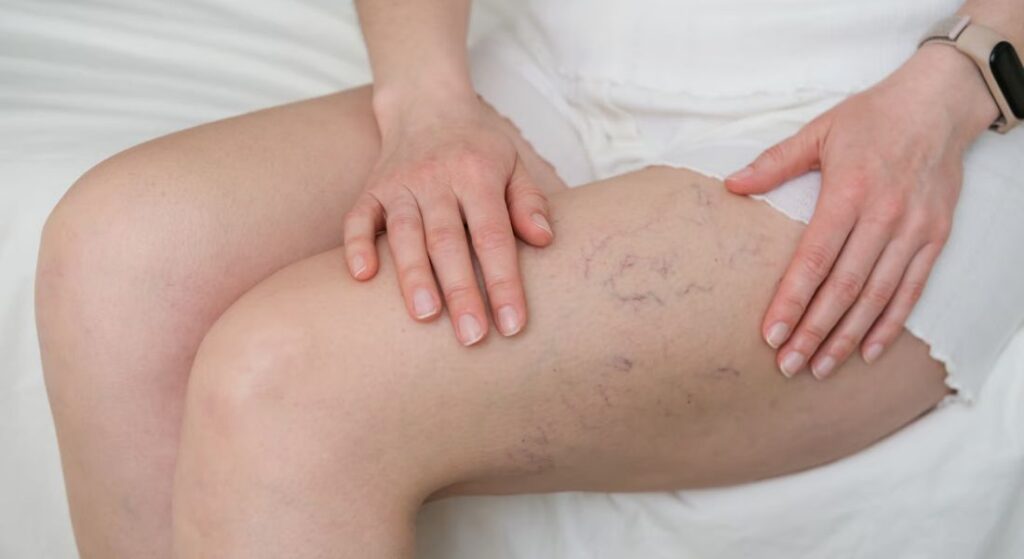
Leg thread veins often require a different approach from facial thread veins because they may be linked to deeper veins or underlying venous disease. Long-pulsed Nd:YAG laser may be used for selected leg telangiectasias, while sclerotherapy is another commonly used treatment for many leg thread veins.
The best treatment depends on the size and pattern of your veins, as well as whether an underlying circulation problem is present. If you have aching, swelling, varicose veins or skin changes, you should have a vascular assessment before deciding on laser treatment alone.
UK Guidance Note
Small thread veins without other symptoms are often a cosmetic concern, but visible leg veins can sometimes occur alongside clinically significant venous disease. If you have persistent aching, heaviness, swelling, itching, skin pigmentation, eczema, a hard painful vein or a leg ulcer, you should have an appropriate medical or vascular assessment rather than relying on cosmetic laser treatment alone.
NICE recommends referral to a vascular service for symptomatic varicose veins and for complications such as venous skin changes, superficial vein thrombosis or venous ulceration. Bleeding varicose veins require immediate referral.
Does Vessel Size and Colour Affect the Best Laser?
Yes, the size and colour of your thread veins play an important role in choosing the most suitable laser. Fine, bright-red vessels are usually closer to the skin surface and often respond well to PDL or KTP laser, while larger, purple or blue veins tend to lie deeper and may be better suited to Nd:YAG laser.
Does Your Skin Tone Affect Which Laser Is Best?
Yes, your skin tone is an important factor when choosing the most appropriate laser for thread veins. Some laser wavelengths are absorbed not only by blood vessels but also by melanin, which can increase the risk of burns or pigment changes in darker or recently tanned skin. For this reason, your practitioner may recommend different settings or a different laser depending on your skin type.
You should also tell your practitioner if your skin tends to develop dark or pale marks after cuts, burns or previous cosmetic treatments. Avoid tanning before your appointment, as this can affect both the safety and effectiveness of vascular laser treatment.
Where Does CO₂ Laser Fit into Thread Vein Treatment?
CO₂ laser is not usually the first choice for ordinary thread veins because it targets water in the skin rather than haemoglobin inside blood vessels. If you are looking to treat visible thread veins, vascular lasers such as PDL, KTP or Nd:YAG are generally more suitable because they are designed to target blood vessels more selectively.
A specialised CO₂ pinhole technique has shown some potential for selected facial telangiectasia, but it is different from standard CO₂ resurfacing and has more limited evidence. You should discuss why CO₂ has been recommended and whether a dedicated vascular treatment may be a more established or appropriate option for your concern.
What Happens During Thread Vein Laser Treatment?
Before treatment, your practitioner will assess your thread veins, review your medical history and confirm that laser treatment is suitable for you. They should also explain the expected results, possible side effects and aftercare so you know what to expect.
1. Skin Assessment: Your practitioner will examine the size, colour, depth and location of your vessels before choosing suitable laser settings.
2. Eye Protection: You will wear appropriate protective eyewear throughout the procedure to protect your eyes from laser energy.
3. Treatment Sensations: You may feel brief heat, stinging or a snapping sensation as the laser pulses target the visible blood vessels.
4. Immediate Skin Changes: The treated vessels may temporarily darken, swell or become more noticeable before gradually fading as your skin recovers.
After treatment, you should follow your practitioner’s advice on gentle skincare and sun protection while the area heals. Contact your clinic if you develop worsening pain, blistering or other unexpected changes rather than waiting for them to settle on their own.
How Many Sessions and What Results Can You Expect?
Some thread veins may improve after a single session, but many people need multiple treatments to achieve better clearance. The number of sessions depends on the size, depth and number of vessels, along with the type of laser used and how your skin responds.
New thread veins can develop in the future, so maintenance treatment may sometimes be considered.
How Can You Choose the Right Laser and Practitioner?

You should discuss your skin tone, pigmentation history, expected results, number of sessions, recovery and possible risks before treatment. A skilled practitioner will recommend the option that best matches your needs, even if that means suggesting an alternative treatment or advising that laser is not the right choice for you.
Myth vs Fact
| Myth | Fact |
| One laser is best for every thread vein. | Different vessels require different wavelengths depending on their colour, diameter, depth, location and your skin tone. |
| The most powerful laser always gives the best result. | Excess energy can increase the risk of burns, pigmentation changes and scarring without necessarily improving vessel clearance. |
| PDL is always better than KTP for facial thread veins. | Both PDL and KTP can improve superficial facial vessels, and studies show that the most suitable choice depends on the vessel and treatment settings. |
| Nd:YAG is only used for leg veins. | Nd:YAG may also be considered for selected deeper or larger facial vessels because its wavelength penetrates further into the skin. |
| IPL is another type of laser. | IPL uses a broad filtered spectrum of light rather than a single laser wavelength. |
| CO₂ laser is the standard treatment for thread veins. | CO₂ primarily targets water in tissue and is not normally the first choice for uncomplicated thread veins. |
| Successfully treating thread veins means they can never appear again. | Treated vessels may remain closed or less visible, but new vessels can develop later because underlying contributing factors may remain. |
Key Takeaways
1. There is no single laser that is best for every thread vein.
2. PDL and KTP are established options for many superficial red facial vessels.
3. Long-pulsed 1,064 nm Nd:YAG penetrates more deeply and may be suitable for selected larger, deeper or leg vessels.
4. IPL can help with diffuse facial redness and multiple fine vessels, although it is a light-based treatment rather than a laser.
5. CO₂ laser is not normally the first choice for uncomplicated thread veins because it primarily targets water rather than haemoglobin.
6. Vessel colour, diameter, depth, location and skin tone all affect which treatment may be most appropriate.
7. Symptomatic leg veins or veins associated with swelling, skin changes or varicose veins may need vascular assessment before cosmetic treatment.
8. Successful treatment cannot prevent new thread veins from developing in the future.
Frequently Asked Questions
1. Which laser is considered the best for thread vein removal?
There is no single laser that is best for every thread vein. The most suitable option depends on the size, depth, colour and location of the vessel, as well as your skin tone. Pulsed dye laser (PDL) and KTP laser are commonly used for superficial facial thread veins, while long-pulsed Nd:YAG laser may be more appropriate for deeper or leg veins.
2. Is pulsed dye laser (PDL) better than KTP laser?
Pulsed dye laser (PDL) and KTP laser are both effective treatments for superficial facial thread veins. PDL is often chosen for persistent redness and rosacea-related vessels, whereas KTP laser can provide excellent results for small, well-defined red facial veins. The best choice depends on your individual vascular pattern.
3. Can long-pulsed Nd:YAG laser treat leg thread veins?
Yes. Long-pulsed Nd:YAG laser is commonly recommended for deeper, larger or blue-purple thread veins, particularly on the legs. Its longer wavelength allows it to reach vessels that are beyond the depth typically treated by PDL or KTP lasers.
4. Is intense pulsed light (IPL) the same as laser treatment?
No. Intense pulsed light (IPL) is not a laser because it emits a broad spectrum of filtered light rather than a single wavelength. It can be an effective option for widespread facial redness and multiple fine thread veins but works differently from vascular lasers.
5. Can CO₂ laser remove thread veins?
CO₂ laser is not usually the first choice for ordinary thread veins because it targets water within the skin rather than haemoglobin in blood vessels. Although specialised pinhole CO₂ laser techniques have shown promising results in selected cases, dedicated vascular lasers such as PDL, KTP or Nd:YAG are generally more appropriate for uncomplicated facial thread veins, while leg veins may require a different approach.
6. How many laser sessions are usually needed for thread vein removal?
Many people require more than one treatment session. The number of sessions depends on the size, number and location of the thread veins, as well as how your skin responds. Your practitioner will review your progress before deciding whether further treatment is necessary.
7. Does laser treatment permanently remove thread veins?
Laser treatment can close or reduce the visibility of successfully treated vessels, but results are not guaranteed to be permanent. New thread veins can develop in the future, and some treated vessels may become visible again over time.
8. Does skin tone affect which laser is recommended?
Yes. Skin tone is an important factor because melanin absorbs some laser energy. Your practitioner may recommend different wavelengths or adjust the treatment settings to reduce the risk of burns, pigmentation changes or other complications while maintaining effectiveness.
9. Is laser treatment for thread veins painful?
Most people describe laser treatment as causing a brief snapping, stinging or hot sensation. Modern devices usually include cooling systems to improve comfort, and any discomfort is generally short-lived.
10. How do you know which laser is right for your thread veins?
A thorough consultation is the best way to determine the most appropriate treatment. Your practitioner should assess the colour, depth, diameter and location of your thread veins, review your skin type and medical history, and explain why a particular laser or alternative treatment is recommended.
Final Thoughts: Choosing the Best Laser for Thread Vein Removal
The best laser for thread vein removal depends on your individual skin and the characteristics of the vessels being treated rather than one technology being better than all the others. A thorough assessment can help identify whether PDL, KTP, Nd:YAG, IPL or another approach is most appropriate, giving you the best chance of achieving a safe and effective result.
If you’re considering C02 laser treatment in London, contact London Medical & Aesthetic Clinic to arrange an assessment and discuss whether CO₂ laser or another treatment may be more suitable for your thread veins.
References:
1. Uebelhoer, N.S., Bogle, M.A., Stewart, B., Arndt, K.A. and Dover, J.S. (2007) ‘A split-face comparison study of pulsed 532-nm KTP laser and 595-nm pulsed dye laser in the treatment of facial telangiectasias and diffuse telangiectatic facial erythema’, Dermatologic Surgery, 33(4), pp. 441–448. Available at: https://pubmed.ncbi.nlm.nih.gov/17430378/
2. Nymann, P., Hedelund, L. and Haedersdal, M. (2010) ‘Long-pulsed dye laser vs. intense pulsed light for the treatment of facial telangiectasias: a randomized controlled trial’, Journal of the European Academy of Dermatology and Venereology, 24(2), pp. 143–146. Available at: https://pubmed.ncbi.nlm.nih.gov/20205349/
3. Baldaia, L., Dias-Neto, M. and Almeida Pinto, J. (2025) ‘Long-pulsed 1064nm Nd:YAG laser in the treatment of leg veins: systematic review’, Vascular, 33(1), pp. 151–166. Available at: https://pubmed.ncbi.nlm.nih.gov/38413049/
4. Woo, S.S., Gwak, H., Han, S.S., Suh, I.S. and Kim, S.H. (2023) ‘Evaluation of the pinhole method using carbon dioxide laser on facial telangiectasia’, Journal of Clinical Medicine, 12(8), article 2849. Available at: https://pubmed.ncbi.nlm.nih.gov/37109186/
5. National Institute for Health and Care Excellence (2013) ‘Varicose veins: diagnosis and management’. NICE guideline CG168. Published 24 July 2013. Available at: https://www.nice.org.uk/guidance/cg168