


Thread vein removal can make visible red, purple or blue blood vessels much less noticeable, but the improvement is not always immediate. You may initially notice redness, swelling, bruising or temporary darkening before the treated vessels gradually fade. Your final result will depend on the size, depth, location and type of vessel being treated.
You should not expect every thread vein to clear completely after one session. Some vessels may only partially respond, while larger networks or resistant vessels may require further treatment. Your skin tone, rosacea, sun exposure and underlying venous factors can also influence the result and the development of new vessels. Before-and-after photographs taken under consistent lighting can help you judge the improvement more accurately.
What Do Thread Veins Look Like Before Treatment?
Before treatment, thread veins may appear as fine red lines, branching patterns or small groups of purple and blue vessels visible through your skin. Facial thread veins are common around the nose, cheeks and chin, while leg thread veins may form spider-like networks and may sometimes occur alongside reticular veins, varicose veins or wider venous disease.
Vessel colour can provide some information about the type of vessel, but colour alone cannot reliably determine depth. Diameter, location, blood flow, skin thickness and clinical examination are also important when selecting treatment. Before treatment, your practitioner should confirm that the mark is a thread vein. If a lesion is changing, bleeding or looks unusual, it should be medically assessed before cosmetic laser treatment.
What Should Happen Before Your First Treatment?
Before your first thread vein treatment, your practitioner should assess the vessels carefully rather than choosing a laser automatically. Your skin tone, medical history, previous treatments and expectations should also be reviewed so the treatment plan is suitable for you.
1. Vessel Assessment: Your practitioner should examine the colour, size, depth, pattern and location of your thread veins before recommending treatment.
2. Skin and Medical Review: You should discuss your skin tone, recent sun exposure, medicines, rosacea and any history of pigmentation changes.
3. Standardised Photographs: Standardised photographs may be useful for documenting baseline appearance and treatment response when they are taken with consistent lighting, camera position and skin preparation.
4. Realistic Expectations: Your practitioner should explain the likely improvement, possible need for repeat sessions, recovery, risks and available alternatives.
A thorough consultation can help ensure that the treatment is matched to your individual vessels and skin. Understanding the expected results and recovery beforehand can also help you judge your before-and-after improvement more realistically.
How Does Laser Treatment Change a Thread Vein?
Vascular laser treatment uses light that is absorbed by haemoglobin inside the blood vessel, converting the energy into heat that produces controlled thermal injury and coagulation within the targeted vessel. After treatment, you may notice the vein contract, darken or temporarily become more visible before your body gradually clears it over the following weeks.
Different lasers penetrate to different depths, so your practitioner will choose the wavelength, pulse duration and energy according to the size and colour of your thread vein. Increasing the energy does not necessarily give you a better result, as too much heat can cause unnecessary swelling, blistering, pigmentation changes or scarring.
What Will Your Skin Look Like Immediately Afterwards?
Your treated area may look redder, swollen or more noticeable immediately after vascular laser treatment because the skin and blood vessels have been exposed to heat. You may also see individual veins become darker or temporarily more prominent. Some PDL settings can produce purpura, causing temporary purple bruising.
These changes are usually temporary and do not represent your final result. Nd:YAG treatment may cause temporary redness, swelling, tenderness, bruising or, less commonly, blistering or pigment change.
What Results Can You Expect from Facial Thread Vein Removal?

Facial thread veins may become less visible when an appropriate vascular device is selected according to vessel diameter, depth, location and skin characteristics. You may notice fine red veins around your nose or cheeks becoming much less visible, although any background redness caused by rosacea may remain.
Your complexion may look more even once the individual vessels have faded, but you may need more than one session before the treatment response can be fully assessed. Before-and-after photographs should be taken from consistent angles without make-up, as this gives you a more accurate idea of how much the treatment has actually changed your skin.
What Results Can You Expect Around the Nose and Cheeks?
Thread veins around your nose and cheeks may become less visible after vascular treatment, although the response varies between vessels. Fine red vessels may respond well to PDL or KTP, while broader areas of redness may sometimes benefit from PDL or IPL alongside targeted treatment of individual veins.
You should not expect vascular laser treatment to change the shape or texture of your nose, as it is designed to target blood vessels rather than resurface the skin. Your result may also change over time if you have rosacea or ongoing sun exposure, as these factors can contribute to new visible vessels developing.
What Before-and-After Results Can PDL Produce?
PDL may reduce selected superficial facial telangiectasias and vascular erythema. Individual vessels may show substantial, partial or limited improvement depending on the vessel and treatment settings.
You may need a course of treatments if you have widespread redness or several visible vessels rather than a few isolated veins. PDL can also cause temporary purple bruising, so you should wait until this has settled before judging your before-and-after result or comparing photographs.
Evidence Note
Clinical studies show that both PDL and KTP can significantly reduce facial telangiectasia, although results vary with the vessel pattern and treatment settings. In one split-face study involving 15 patients, average clearance after three treatments was approximately 85% with 532 nm KTP and 75% with 595 nm PDL. Both treatments were effective, but the study was small and these percentages should not be presented as guaranteed results for an individual patient.
What Results Can You Expect from KTP Laser?
KTP laser can make superficial red thread veins around your nose and cheeks significantly less visible when the vessels are suitable for treatment. You may notice substantial clearance after treatment, but your individual result will depend on the vessel characteristics, treatment settings and number of sessions.
Your skin may look red or swollen immediately afterwards, which can temporarily make the result difficult to judge. You should wait for this inflammation to settle before assessing your improvement, after which your practitioner can decide whether any remaining vessels would benefit from another session.
What Results Can You Expect from Nd:YAG Laser?
Nd:YAG laser can make deeper or larger thread veins less visible because its 1,064 nm wavelength penetrates further into the skin than PDL or KTP. You may initially notice redness, mild swelling or temporary darkening, followed by gradual fading as your body clears the treated vessel.
You may need more than one session, particularly when you have deeper vessels or leg thread veins. Your practitioner should assess your individual vessels before treatment, as results from leg veins cannot automatically be applied to facial thread veins.
What Results Can You Expect from Leg Thread Vein Treatment?
Leg thread veins can be more complicated than facial vessels because they may be connected to deeper reticular veins or venous reflux. You may therefore need an assessment for symptoms such as aching, swelling, varicose veins or skin changes before deciding whether laser treatment is appropriate.
Nd:YAG laser and sclerotherapy can both be used for selected leg thread veins. The most suitable option depends on the vessel characteristics, skin type, underlying venous factors and individual treatment assessment. You may notice temporary redness or pigmentation after treatment, so you should allow enough time for these changes to settle before judging your final before-and-after result.
UK Guidance Note
Small leg thread veins without symptoms are often primarily a cosmetic concern. However, if visible veins are associated with persistent aching, heaviness, swelling, itching, skin pigmentation, eczema, a hard painful vein or a leg ulcer, you may need a medical or vascular assessment before cosmetic treatment.
NICE recommends referral to a vascular service for symptomatic varicose veins and venous complications such as skin changes, superficial vein thrombosis and venous ulceration. Bleeding varicose veins require immediate referral.
How Many Treatment Sessions Might You Need?
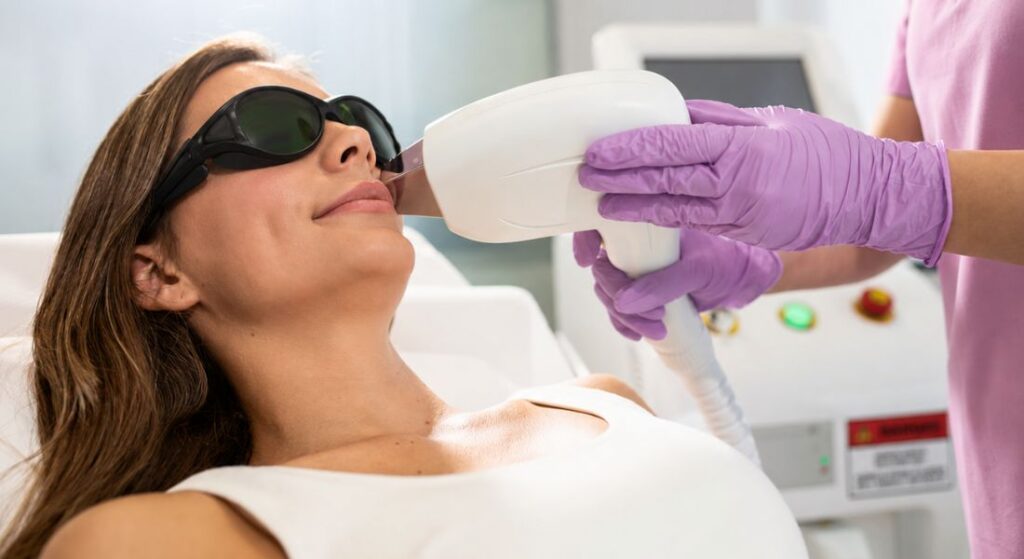
The number of sessions you need will depend on the number, size, depth and type of thread veins being treated. You may see a strong improvement after one session if you have a single small facial vessel, while larger networks or more resistant veins may require several appointments.
Your practitioner should reassess your skin after each treatment rather than following a fixed schedule. If you still have visible vessels, you may need another session or a different laser wavelength, but treating too soon can cause unnecessary irritation before you have had time to see the full result.
How Long Before You See the Final Result?
Your improvement after vascular laser treatment is usually gradual because your body needs time to clear or remodel the treated blood vessel. You may initially notice swelling, bruising or temporary darkening, which can make the area look different before the actual improvement becomes clear.
You should allow several weeks before judging your final result, particularly when deeper vessels have been treated. The exact timeline will depend on your laser, the type of vessel and the treatment area, so your clinic should advise you when it is appropriate to take your final before-and-after photographs.
What Changes Can You Expect After Thread Vein Treatment?
The appearance of the treated area can change during recovery, so an early photograph should not be mistaken for the final result. The exact timeline depends on the laser, vessel and individual skin response.
| Stage | What you may notice | What it means |
| Before treatment | Red, purple or blue visible vessels | Your practitioner assesses the vessel size, colour, depth and surrounding skin |
| Immediately afterwards | Redness, warmth, swelling or temporary darkening | A common short-term response to vascular laser treatment |
| First few days | Continued redness or swelling; some PDL settings may cause purple bruising | The skin and treated vessels are recovering |
| Following weeks | Treated vessels may gradually become less visible | Your body is clearing or remodelling the treated vessels |
| After recovery | Partial or substantial reduction in visible vessels | The degree of clearance varies between people and vessels |
| Longer term | New vessels may appear in the same general area | Treatment does not remove underlying tendencies such as rosacea, sun damage or venous pressure |
What Is Normal During Recovery?
You may experience mild redness, warmth, swelling or tenderness after vascular laser treatment, and the area can feel similar to a mild sunburn for a short time. PDL may cause purple bruising that can last around one to two weeks. KTP and Nd:YAG more commonly cause temporary redness and swelling, although soreness, minor crusting, blistering or pigment changes can occasionally occur depending on the device and treatment settings.
Your practitioner may ask you to avoid intense heat, strenuous exercise and certain skincare products while your skin settles. You should avoid scratching or picking the treated area and protect your skin from the sun, as unnecessary irritation and UV exposure can increase the risk of pigmentation changes or scarring.
What Side Effects Can Affect Your Before-and-After Appearance?
Temporary redness, swelling and bruising can make your skin look worse immediately after treatment, particularly when PDL causes temporary purple bruising (purpura).
Pigmentation changes can be more noticeable if your skin tends to darken after inflammation, while leg-vein treatment can sometimes cause longer-lasting pigmentation or small areas of new fine vessels. You should contact your practitioner if you develop increasing pain, blistering, significant skin breakdown, spreading redness or other signs that your recovery is not progressing normally.
Can Thread Veins Return After Successful Treatment?

A successfully treated thread vein may remain significantly reduced, but you can still develop new visible vessels over time. Facial thread veins may recur or new ones may appear with rosacea, sun exposure and ageing, while leg veins can be influenced by venous pressure or underlying vein problems.
You may therefore need maintenance treatment if new vessels become noticeable, and this does not necessarily mean your original treatment failed. Sun protection, appropriate rosacea management and assessment of underlying venous problems may help reduce factors that contribute to new visible vessels.
Myth vs Fact
| Myth | Fact |
| Thread veins should disappear immediately after laser treatment. | Redness, swelling, bruising or temporary darkening can occur first, and the improvement may become clearer gradually. |
| Every thread vein disappears completely after one session. | Some isolated vessels respond well to one treatment, while larger networks or resistant vessels may need additional sessions. |
| A darker-looking vein immediately after treatment means the laser has failed. | Treated vessels can temporarily darken or become more noticeable before they fade. |
| Using stronger laser settings always gives better clearance. | Excessive energy can increase the risk of burns, blistering, pigmentation changes and scarring without necessarily improving the result. |
| Once thread veins have been treated, they can never appear again. | Successfully treated vessels may remain reduced, but new vessels can develop because factors such as ageing, rosacea, sun exposure or venous pressure remain. |
| All facial and leg thread veins respond in the same way. | Facial and leg vessels differ in depth, size and underlying causes, so they may require different treatments and have different recovery patterns. |
| Before-and-after photographs always show the true result. | Lighting, camera angle, make-up, swelling and bruising can substantially change how the result appears in photographs. |
How Should You Judge Your Before-and-After Result?
You should compare your before-and-after photographs using the same lighting, camera position, distance and skin condition, ideally without make-up that changes the appearance of redness. Wait until your full recovery period has passed, as swelling or bruising can temporarily make the result look better or worse than it really is.
Look at the whole treatment area rather than focusing on one successfully cleared vessel, as some veins may fade more than others. If you still have visible vessels, your practitioner may consider a different vascular wavelength rather than simply increasing the treatment strength, as vessels can vary in colour, size and depth.
Key Takeaways
1. Thread vein removal results are usually gradual rather than immediate.
2. Redness, swelling, bruising or temporary darkening can occur before the treated area begins to look clearer.
3. Some isolated vessels may respond well to one treatment, while larger networks or deeper vessels may need additional sessions.
4. PDL and KTP are commonly used for superficial facial vessels, while Nd:YAG can be considered for selected deeper or leg vessels.
5. Leg thread veins may require assessment for underlying venous disease when symptoms such as aching, swelling, varicose veins or skin changes are present.
6. Before-and-after photographs should be taken using consistent lighting, camera position and skin preparation.
7. Complete clearance cannot be guaranteed, and new vessels can develop even after successful treatment.
8. The safest approach is to judge results only after the expected recovery period and have remaining vessels reassessed before further treatment.
Frequently Asked Questions
1. How long does it take to see results after thread vein removal?
The results of thread vein removal are usually gradual rather than immediate. You may notice some improvement within the first few weeks, but the final outcome often becomes clearer after your skin has had time to heal and your body has cleared the treated vessels.
2. Do thread veins disappear completely after laser treatment?
Some thread veins may disappear completely, particularly small superficial facial vessels. However, complete clearance cannot be guaranteed for every vessel, as larger veins, deeper vessels and extensive networks may only fade partially or require additional sessions.
3. What will thread veins look like immediately after laser treatment?
Immediately after treatment, the area may appear red, swollen or darker than before. Some vessels may turn purple or become more noticeable temporarily, especially after pulsed dye laser treatment. These changes are usually part of the normal healing process.
4. How many sessions are needed for thread vein removal?
The number of sessions depends on the size, depth and number of vessels being treated. Some isolated facial thread veins may improve after one session, while larger networks, deeper vessels or selected leg veins may require more than one treatment.
5. Are facial thread veins easier to treat than leg thread veins?
Not necessarily. Many facial thread veins are small and superficial and may respond well to vascular lasers, while leg thread veins can be more complex because they may be associated with reticular veins or underlying venous disease. Treatment choice and response depend on the individual vessels.
6. Which laser gives the best before-and-after results for thread veins?
The most suitable laser depends on the individual vessel. PDL and KTP are commonly used for selected superficial facial vessels, while long-pulsed Nd:YAG may be considered for deeper or larger vessels and some leg thread veins.
7. Can thread veins come back after successful treatment?
Yes, new thread veins can develop after successful treatment. Laser treatment can close or reduce existing vessels, but it cannot remove factors such as genetics, rosacea, ageing, sun exposure or venous problems that may contribute to future vessels.
8. How should before-and-after photos of thread vein removal be compared?
Before-and-after photos should be taken under similar conditions, including the same lighting, camera angle and skin preparation. Temporary redness, swelling, bruising or make-up can affect how the results appear, so photographs taken too soon after treatment may not show the true outcome.
9. Is redness normal after thread vein laser treatment?
Yes, temporary redness is a common part of recovery after vascular laser treatment. The skin may feel warm or sensitive for a short time, and the redness usually settles as the treated area heals.
10. What factors affect my thread vein removal results?
Your results can be influenced by several factors, including the type of laser used, vessel size, depth, skin tone, location of the veins and any underlying condition such as rosacea or venous insufficiency. A personalised assessment helps determine the most realistic outcome for your skin.
Final Thoughts: Thread Vein Removal Results
Thread vein removal can make visible blood vessels less noticeable, but the degree of improvement depends on factors such as the type of veins being treated, your skin type and the treatment approach chosen. Understanding that results develop gradually can help you set realistic expectations, as temporary redness, swelling or darkening may appear before your skin begins to look clearer.
If you are considering treatment for visible facial vessels and want to understand how C02 laser treatment in London differs from vascular laser options, contact London Medical & Aesthetic Clinic to arrange an assessment.
References:
1. Uebelhoer, N.S., Bogle, M.A., Stewart, B., Arndt, K.A. and Dover, J.S. (2007) ‘A split-face comparison study of pulsed 532-nm KTP laser and 595-nm pulsed dye laser in the treatment of facial telangiectasias and diffuse telangiectatic facial erythema’, Dermatologic Surgery, 33(4), pp. 441–448. Available at: https://pubmed.ncbi.nlm.nih.gov/17430378/
2. Nymann, P., Hedelund, L. and Haedersdal, M. (2010) ‘Long-pulsed dye laser vs. intense pulsed light for the treatment of facial telangiectasias: a randomized controlled trial’, Journal of the European Academy of Dermatology and Venereology, 24(2), pp. 143–146. Available at: https://pubmed.ncbi.nlm.nih.gov/20205349/
3. Bontinis, V. et al. (2023) ‘Interventions for the treatment of lower limb telangiectasias and reticular veins: a systematic review and network meta-analysis’, European Journal of Vascular and Endovascular Surgery, 66(4), pp. 560–576. Available at: https://www.sciencedirect.com/science/article/pii/S107858842300429X
4. National Institute for Health and Care Excellence (2013) ‘Varicose veins: diagnosis and management’. NICE guideline CG168. Published 24 July 2013. Available at: https://www.nice.org.uk/guidance/cg168
5. North Bristol NHS Trust (2025) ‘Facial threadveins and redness’, Bristol Laser Centre. Published March 2025; review due March 2028. Available at: https://www.nbt.nhs.uk/bristol-laser-centre/laser-treatments/facial-threadveins-redness