


Even when your rosacea is reasonably well controlled, you may still notice roughness, uneven texture or areas of tissue thickening. However, these changes are not always caused by rosacea itself. CO₂ laser may improve selected structural concerns by ablating controlled areas of tissue and supporting collagen remodelling during healing. Evidence is strongest for reducing established phymatous tissue, particularly rhinophyma. Fractional CO₂ laser may also be considered for selected confirmed scars or structural irregularities, although most evidence for this use comes from acne-scar studies rather than rosacea-specific research.
However, CO₂ laser is not usually the right treatment if your main concerns are ongoing redness, flushing or visible blood vessels. Elective resurfacing is generally postponed when you have a significant rosacea flare, active infection, open skin or marked barrier irritation. Your practitioner should assess whether your skin is sufficiently stable for the planned treatment depth and explain whether CO₂ laser is appropriate for the feature you want to treat, or whether skincare, medical treatment, vascular laser or another procedure is more suitable.
What Skin Changes Can Remain After Rosacea Treatment?
Even after your rosacea is well controlled, you may still notice changes in your skin. Rosacea can be associated with an impaired skin barrier, which may contribute to dryness, stinging, sensitivity and temporary surface roughness. Enlarged-looking pores or persistent structural irregularities may have other causes and should be assessed separately. You may also continue to have persistent redness or visible blood vessels, although these are vascular concerns rather than true texture changes.
Some people develop phymatous tissue thickening, particularly rhinophyma. Indented scars or persistent marks may instead be related to acne, previous procedures, injury or another skin condition. Your practitioner should identify the exact cause of your skin changes because the most appropriate treatment for you will depend on whether your concern is related to texture, thickened tissue or ongoing inflammation.
Does Rosacea Usually Cause Permanent Scarring?
Rosacea does not usually cause the deep, indented scars that are commonly seen after severe acne. You may notice persistent redness or changes in pigmentation after inflammatory lesions settle, but these should not automatically be classified as permanent indented scars. Avoid picking or squeezing inflamed lesions because additional skin injury may contribute to irritation, infection or longer-lasting marks.
Rosacea can, however, cause thickened skin in some people, particularly when rhinophyma develops. You may also have scars from previous acne, surgery or cosmetic procedures rather than rosacea itself. Your clinician should determine whether the concern represents active inflammation, pigmentation, acne scarring, previous procedural scarring or phymatous tissue before recommending resurfacing.
How Does CO₂ Laser Improve Skin Texture?
CO₂ laser energy is absorbed by water within the skin. Fractional treatment creates microscopic columns of controlled injury while leaving untreated skin between them, whereas fully ablative treatment removes a continuous area of tissue. Healing and collagen remodelling may then improve selected structural irregularities or contour changes.
Texture improvement develops gradually as the skin heals. Deeper or denser treatment is not automatically better because it can increase the risks of prolonged redness, pigmentation changes, delayed healing and scarring. The treatment depth and density should be selected according to the diagnosis, skin characteristics and intended outcome.
What Is the Difference Between Fractional and Fully Ablative CO₂?
Fractional CO₂ laser treats your skin by creating thousands of tiny treatment columns while leaving healthy skin between them. Leaving untreated skin between the microscopic treatment columns generally allows faster healing than fully ablative resurfacing. Fractional CO₂ may be used for selected scars and structural texture concerns, but evidence for pore and texture improvement comes mainly from acne-scar or photoageing studies rather than rosacea-specific populations.
Fully ablative CO₂ laser removes a continuous layer of tissue and usually involves a longer recovery. It is more often used when you have significant thickened tissue, such as rhinophyma, that needs to be reduced and reshaped. Your practitioner should recommend the treatment method that best matches your skin concern rather than choosing the same approach for every patient.
Can CO₂ Laser Improve Rough or Uneven Texture?
CO₂ laser may improve rough or uneven skin texture when the changes are caused by stable structural irregularities, such as mild scarring or thickened tissue. The treatment encourages collagen remodelling, which can gradually smooth your skin, but you should expect improvement rather than perfect skin. Depending on your skin and treatment goals, you may need more than one session.
If your skin feels rough mainly because of dryness, irritation or an active rosacea flare, CO₂ laser may not be the best option. In these cases, improving your skin barrier and controlling inflammation can be more effective. Your practitioner should examine your skin carefully to identify the cause of the uneven texture before recommending laser treatment.
Can It Improve Enlarged-Looking Pores?
Fractional CO₂ may make enlarged-looking pores less noticeable in selected patients by remodelling the surrounding skin. However, the available evidence mainly comes from photoageing and acne-scar studies rather than people whose main condition is rosacea. The treatment cannot close or remove pores permanently.
In phymatous rosacea, enlarged sebaceous openings may appear less prominent after excess tissue has been reshaped. Results vary according to the cause of the pore appearance, skin type and treatment depth, so your practitioner should first determine whether the change relates to phymatous tissue, acne scarring or normal skin structure.
Can CO₂ Laser Treat Indented Scars?

Fractional CO₂ can improve some atrophic scars, particularly scars related to acne, but the response varies according to the type and depth of the scar. Deep or narrow scars may require another treatment or a combination of approaches. Improvement is gradual, and more than one session may be needed.
If you have rosacea, your practitioner should first determine whether your scars are actually caused by rosacea or by another condition, such as acne. Your skin should be stable before treatment, as active inflammation can increase the risk of irritation and make your results less predictable.
Can It Improve Thickened Skin and Rhinophyma?
The best-established rosacea-specific use of CO₂ laser is the treatment of phymatous thickening, particularly rhinophyma. The laser can remove excess nasal tissue in controlled layers and reshape the external contour. Some patients whose nostrils have been narrowed by excess tissue may also experience improved airflow.
Evidence supports CO₂ laser treatment in carefully selected patients with moderate-to-severe rhinophyma, but it is not intended for minor texture concerns. Treatment removes existing tissue overgrowth but does not cure rosacea, and recurrence can occur. Rapid growth, ulceration, repeated bleeding, unusual firmness or asymmetry should be assessed before laser vaporisation because a biopsy or tissue-preserving technique may be needed when the diagnosis is uncertain.
Evidence Note
Evidence for CO₂ laser in rosacea is strongest for phymatous tissue, particularly rhinophyma. Recent observational studies report high satisfaction and contour improvement, but they are non-randomised and largely involve men with lighter skin types. Evidence for fractional CO₂ treatment of indented scars comes mainly from acne-scar studies, so those results should not be used to guarantee improvement in rosacea-prone skin.
Will CO₂ Laser Reduce Redness at the Same Time?
CO₂ laser is not usually the best treatment for persistent rosacea-related redness. Although your skin may look different after resurfacing, the laser mainly targets water within the skin rather than the blood vessels that cause facial redness. You should also expect temporary redness after treatment because inflammation is a normal part of the healing process.
If redness is one of your main concerns, your practitioner may recommend a vascular laser or intense pulsed light instead. You may benefit from a staged treatment plan, where CO₂ laser improves skin texture or thickened tissue first, and a separate vascular treatment is considered later if redness remains after your skin has healed.
Rosacea-Related Skin Concerns and Possible Treatment Approaches
| Main skin concern | Is CO₂ laser likely to help? | Important consideration |
| Thickened skin or rhinophyma | Often suitable in carefully selected patients | Fully ablative treatment may be used to remove and reshape excess tissue |
| Stable rough or uneven texture | May help in selected cases | The texture should result from a structural change rather than active irritation |
| Confirmed shallow indented scars | Fractional CO₂ may help | The scars may be related to acne or another condition rather than rosacea itself |
| Enlarged-looking pores | May reduce their appearance | The treatment cannot permanently close or remove pores |
| Dry or flaky skin | Usually not the first choice | Skin-barrier care and control of inflammation may be more appropriate |
| Active redness or flushing | Usually unsuitable for this concern | Vascular laser, IPL or medical treatment may be more suitable |
| Visible facial blood vessels | Not directly treated by CO₂ laser | A vascular treatment is generally required |
| Active inflammatory rosacea | Treatment should usually be postponed | The rosacea should be reasonably stable before elective resurfacing |
| Significant textural and vascular concerns | A staged plan may be considered | Different treatments may be needed for texture and redness |
Why Should Rosacea Be Stable Before Resurfacing?
Your rosacea should be reasonably stable before CO₂ laser treatment because active inflammation can make your skin more sensitive and increase the risk of irritation during healing. If you have ongoing redness, burning, swelling or inflammatory spots, your practitioner may recommend controlling these symptoms first with medication, skincare or trigger management before considering resurfacing.
Stable skin does not mean that every rosacea symptom has disappeared, but it does mean avoiding treatment during a significant flare. You should tell your practitioner about any recent changes in your skin, as they may decide to postpone the procedure. Waiting until your skin is calmer can improve healing and help achieve a more predictable result.
Who May Be a Suitable Candidate?
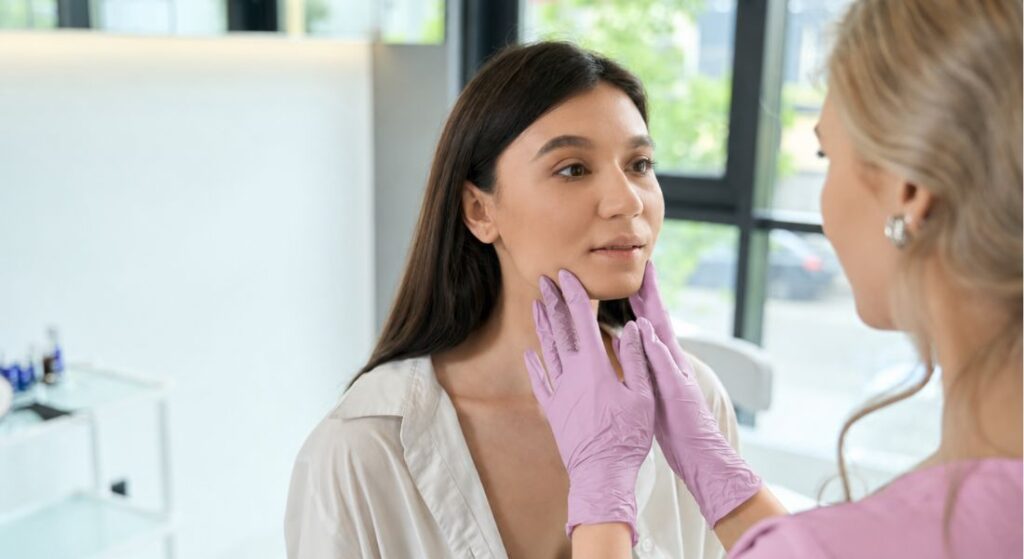
You may be a suitable candidate for CO₂ laser if your rosacea is well controlled and you have a stable skin concern, such as confirmed stable scarring, a localised textural irregularity or phymatous thickening. Your practitioner should also assess your general health, healing ability and any history of pigmentation changes, as these factors can influence your recovery and overall results.
You should be prepared to follow the recommended aftercare instructions carefully because your skin needs time to heal after treatment. It is also important to have realistic expectations. CO₂ laser can improve texture and contour, but it cannot guarantee perfectly smooth skin or treat every feature of rosacea. In some cases, you may achieve the best outcome with a combination of treatments rather than CO₂ laser alone.
Who May Not Be Suitable?
Treatment is usually postponed if you have an active rosacea flare, skin infection, open wound or active cold sore. Because CO₂ laser resurfacing is normally elective and pregnancy-specific safety evidence is limited, it is usually delayed until after pregnancy unless there is a clear medical reason to proceed. Tell your practitioner if you take isotretinoin or have used it recently, as timing depends on whether the planned treatment is fractional or fully ablative. Fully ablative resurfacing is not recommended during systemic isotretinoin treatment because evidence is insufficient. A history of abnormal scarring, poor wound healing or pigmentary change also requires individual assessment.
CO₂ laser may also not be the best option if your main concern is persistent redness or flushing, as vascular lasers or medical treatments are often more suitable. Your practitioner should assess your skin carefully and explain whether CO₂ laser is appropriate for you. You should also have realistic expectations, as the treatment can improve texture but cannot guarantee completely smooth, poreless or redness-free skin.
What Is Recovery Likely to Involve?
Your recovery will depend on the type and depth of your CO₂ laser treatment. After the procedure, you may experience redness, swelling and a warm or stinging sensation. As your skin heals, it may become dry, rough or flaky. If you have a more intensive treatment, such as rhinophyma removal, you may also notice oozing or crusting, and you will need to follow your aftercare instructions carefully.
Although the surface of your skin may heal within days or weeks, redness can last longer, especially if you have rosacea-prone skin. You should allow enough time for recovery before important events and protect your skin from the sun once your practitioner advises it is safe to do so. Careful aftercare and sun protection are important for supporting healing and reducing the risk of pigmentation changes.
What Risks Should You Consider?
After CO₂ laser treatment, you can expect temporary redness, swelling, tenderness and sensitivity while your skin heals. However, you should also be aware of possible complications, including infection, prolonged redness, pigment changes and, in rare cases, scarring. If you notice increasing pain, swelling, pus or redness that becomes worse instead of improving, you should contact your practitioner promptly.
Your personal risk depends on factors such as your skin tone, healing ability, treatment depth and how well you follow the aftercare plan. Although most people recover without serious problems, no procedure is completely risk-free. Your practitioner should explain the possible complications and help you decide whether the expected improvement justifies the recovery and potential risks.
How Can the Risk of a Rosacea Flare Be Reduced?
1. Control Active Symptoms: Follow your prescribed rosacea treatment and tell your practitioner if you develop increased redness, burning, swelling or inflammatory spots.
2. Use Gentle Skincare: Avoid introducing strong acids, scrubs, retinoids or unfamiliar products unless your practitioner advises you to use them.
3. Limit Common Triggers: Try to avoid excessive heat, strong sunlight and intense exercise while your treated skin is healing.
4. Report Unexpected Changes: Contact your clinic promptly if you develop worsening pain, heat, discharge, increasing redness or other signs of infection.
Rosacea-prone skin may remain temporarily red and sensitive after CO₂ laser treatment, even when healing normally. Following personalised aftercare advice and reporting unusual symptoms early can help reduce the risk of a significant flare or complication.
How Can You Decide Whether Treatment Is Worthwhile?
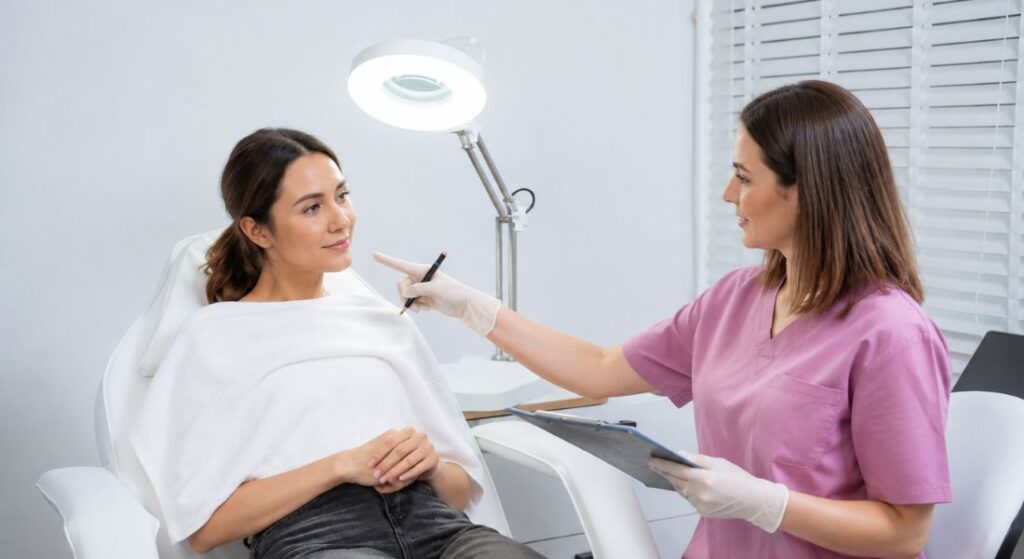
Start by identifying exactly what you want to improve. Dryness, facial redness, indented scars and rhinophyma are different concerns, and each may require a different treatment. You should ask your practitioner which feature the CO₂ laser is targeting and why it is the most suitable option for your skin.
Before deciding, discuss the expected level of improvement, the number of sessions you may need and what recovery is likely to involve. You should also ask about alternatives that match the confirmed diagnosis, such as vascular laser or IPL for redness, medical treatment for active rosacea, or other scar treatments when confirmed scarring is present.
Myth vs Fact
| Myth | Fact |
| Rosacea usually leaves deep facial scars. | Typical rosacea does not usually cause the indented scars associated with acne. |
| Rough skin always needs resurfacing. | Dryness and barrier impairment may improve with skincare and inflammation control. |
| CO₂ laser closes enlarged pores permanently. | It may make selected pores less noticeable but cannot remove them. |
| Fractional CO₂ and rhinophyma removal are the same procedure. | They involve different treatment patterns, depths and recovery. |
| CO₂ laser can remove rosacea redness and texture together. | Vascular redness usually needs a different treatment approach. |
| Stronger treatment always produces a better result. | Greater depth can increase redness, pigmentation, delayed healing and scarring risks. |
Key Takeaways
1. Rosacea does not usually cause the deep indented scars associated with acne.
2. Dryness and temporary roughness may reflect skin-barrier dysfunction rather than permanent damage.
3. Fractional CO₂ may improve selected confirmed scars or structural irregularities.
4. Evidence for acne-scar treatment is not specific to rosacea-prone skin.
5. Fully ablative CO₂ is more established for substantial rhinophyma.
6. CO₂ laser does not directly treat persistent flushing or visible blood vessels.
7. Fractional and fully ablative treatments are not interchangeable.
8. Enlarged-looking pores cannot be permanently removed.
9. Rosacea should be reasonably stable before elective resurfacing.
10. Suspicious rhinophyma tissue may require biopsy or histological examination.
11. Redness, pigment changes, infection, delayed healing and scarring are possible.
12. Worsening pain, heat, discharge or delayed healing requires prompt clinical review.
Frequently Asked Questions
1. Can CO₂ laser improve skin texture after rosacea?
Yes, CO₂ laser can improve certain types of uneven skin texture once your rosacea is well controlled. It is most effective for structural concerns such as thickened skin, surface irregularities or selected scars rather than ongoing redness or active inflammation.
2. Does rosacea usually leave permanent scars?
Most people with rosacea do not develop the deep, indented scars commonly seen after severe acne. If you have noticeable pits or depressions, your clinician may assess whether they are related to acne, previous procedures or another cause before recommending treatment.
3. Is CO₂ laser suitable for active rosacea?
CO₂ laser is generally not recommended during an active rosacea flare because inflamed skin may heal less predictably. Your practitioner will usually aim to stabilise your rosacea first before considering resurfacing treatment.
4. Can CO₂ laser reduce enlarged pores caused by rosacea?
It may reduce the appearance of enlarged pores by improving the surrounding skin texture, particularly when thickened tissue is present. However, it cannot permanently remove pores or guarantee completely smooth skin.
5. Will CO₂ laser also get rid of facial redness?
Not usually. CO₂ laser is designed to improve skin texture rather than treat blood vessels, so vascular lasers or intense pulsed light (IPL) are generally more suitable for persistent redness and visible facial vessels.
6. How many CO₂ laser sessions are usually needed?
The number of sessions depends on the diagnosis and treatment depth. Rhinophyma reduction may sometimes be completed in one procedure, whereas fractional treatment for scars or texture may require more than one session. Further treatment should be scheduled only after your skin has healed and the response has been reviewed.
7. What is the recovery like after CO₂ laser treatment?
You can expect redness, swelling and sensitivity during the early healing period, with recovery varying according to the depth of treatment. Your practitioner will provide detailed aftercare instructions to support healing and reduce the risk of complications.
8. Can CO₂ laser treat rhinophyma?
Yes. CO₂ laser is a well-established treatment for rhinophyma because it can carefully remove excess tissue, reshape the nose and improve its overall contour while helping to control bleeding during the procedure.
9. What are the risks of CO₂ laser for rosacea-prone skin?
Possible risks include infection, prolonged redness, pigment changes, delayed healing and scarring. Choosing an experienced practitioner and following the recommended aftercare can help reduce these risks.
10. How do you know if CO₂ laser is the right option for you?
The decision depends on the exact skin concern you want to treat. A consultation should identify whether your main issue is scarring, thickened skin, uneven texture or redness so that the most appropriate treatment can be recommended.
Final Thoughts: Restoring Skin Texture After Rosacea Treatment
Once your rosacea is under good control, you may still notice uneven skin texture, thickened areas or surface irregularities that affect your confidence. CO₂ laser can improve selected structural skin changes, particularly phymatous rosacea and certain types of scarring, but it is not designed to treat every feature of rosacea. The best results come from carefully matching the treatment to your specific skin concerns and ensuring that your skin is stable before the procedure.
If you’re considering C02 laser treatment in London, contact the London Medical & Aesthetic Clinic to arrange a consultation and discuss whether it may be suitable for your skin concern.
References:
1. Szwach, J. et al. (2026) ‘Laser-based therapies in rosacea: a comprehensive review of mechanisms, clinical efficacy, and future directions’, Journal of Clinical Medicine, 15(5), article 1771. Available at: https://www.mdpi.com/2077-0383/15/5/1771
2. Chauhan, R., Loewenstein, S.N. and Hassanein, A.H. (2020) ‘Rhinophyma: prevalence, severity, impact and management’, Clinical, Cosmetic and Investigational Dermatology, 13, pp. 537–551. Available at: https://pmc.ncbi.nlm.nih.gov/articles/PMC7429105/
3. Madan, V., Ferguson, J.E. and August, P.J. (2009) ‘Carbon dioxide laser treatment of rhinophyma: a review of 124 patients’, British Journal of Dermatology, 161(4), pp. 814–818. Available at: https://pubmed.ncbi.nlm.nih.gov/19624541/
4. Liu, F. et al. (2024) ‘Efficacy and safety of CO₂ fractional laser versus Er:YAG fractional laser in the treatment of atrophic acne scar: a meta-analysis and systematic review’, Journal of Cosmetic Dermatology, 23(9), pp. 2768–2778. Available at: https://pubmed.ncbi.nlm.nih.gov/38733085/
5. Kang, B.Y. et al. (2025) ‘Consensus statement on the prevention and management of complications of fully ablative laser resurfacing of the face’, Lasers in Surgery and Medicine, 57(6), pp. 477–489. Available at: https://pubmed.ncbi.nlm.nih.gov/40495549/