



If you’re considering Sculptra, you’ve probably heard that it “stimulates collagen” rather than filling the skin instantly. While that phrase is often repeated, very few explanations actually describe what’s happening beneath the surface in a way that makes sense.
Understanding how Sculptra works biologically can be reassuring. It explains why results develop gradually, why outcomes look natural, and why the treatment behaves very differently from traditional dermal fillers.
In this article, I’ll walk you through the science behind Sculptra in clear, human terms. You’ll learn how collagen production is triggered, what happens in the skin over time, and why patience plays such an important role in achieving long-lasting, natural results.
Why Collagen Matters So Much to Facial Ageing
Collagen is one of the key structural proteins in your skin. It provides strength, firmness, and elasticity, allowing skin to bounce back after movement or expression. When collagen levels are healthy, the skin appears smooth, tight, and resilient.
As we age, collagen production naturally slows. From the mid-20s onwards, the body generates less collagen each year, and existing collagen fibres begin to weaken and fragment.
This gradual reduction affects more than just the surface. Loss of collagen leads to sagging, hollowing, and thinning of the skin, which contributes to an overall aged appearance.
Importantly, facial ageing is not solely about wrinkles. It’s also about the decline in underlying structural support that collagen provides, affecting how the skin drapes and moves over facial muscles and bones.
What Makes Sculptra Different From Traditional Fillers
Traditional dermal fillers work by physically adding volume beneath the skin. They fill space immediately, which is why results are visible straight away. While this approach can be very effective for specific lines or contouring, it doesn’t address the underlying loss of collagen that occurs with ageing.
Sculptra works in a completely different way. Rather than acting as a space-filling gel, it stimulates your body to gradually produce its own collagen over time. The improvement develops slowly as the skin rebuilds strength and support from within.
Because of this, Sculptra supports the skin structurally instead of simply occupying space. The result is a more natural, long-term improvement in firmness and volume, rather than a surface-level enhancement alone.
What Is Poly-L-Lactic Acid?
The active ingredient in Sculptra is poly-L-lactic acid, often referred to as PLLA. It is a biocompatible and biodegradable substance that has been used safely in medical applications for many decades, including dissolvable sutures.
PLLA does not behave like a traditional dermal filler. Rather than adding instant volume, it works as a collagen stimulator by triggering a controlled biological response within the skin.
Once injected, the PLLA particles begin to dissolve slowly over time. As this happens, they stimulate the surrounding tissue to produce new collagen, strengthening the skin’s underlying structure.
The PLLA itself is eventually absorbed by the body, but the collagen it stimulates remains. This is what leads to gradual, natural-looking improvement in skin firmness, support, and overall facial quality.
How the Body Responds to Sculptra Injections

When Sculptra is injected, it works by engaging your body’s own regenerative processes rather than creating instant volume. The treatment relies on a controlled biological response that gradually strengthens the skin from within. Understanding this process helps explain why Sculptra results look natural and develop over time.
Recognition of PLLA particles: The poly-L-lactic acid (PLLA) particles in Sculptra are recognised by the body as a safe, foreign substance. This does not trigger an aggressive reaction, but rather a mild and controlled response.
Activation of a healing response: The body initiates a low-level inflammatory process, which is a normal and necessary part of tissue repair and regeneration. This response is subtle and does not cause visible inflammation long term.
Stimulation of fibroblasts: Fibroblasts, the cells responsible for collagen production, are activated around the injection sites. These cells begin producing new collagen fibres to strengthen the skin’s supporting framework.
Gradual collagen formation: Collagen is laid down slowly over weeks and months. This gradual build-up prevents sudden changes in facial appearance and allows results to integrate naturally with existing tissue.
Even distribution and integration: As the PLLA particles are absorbed, the newly formed collagen remains, providing long-term support without creating lumps or focal bulk when the treatment is performed correctly.
Because this process is slow, controlled, and biologically driven, Sculptra enhances the skin without overwhelming it. The result is progressive improvement in firmness, structure, and quality that looks natural precisely because it develops at the body’s own pace.
What Happens to the Product Itself?
One of the most important aspects of Sculptra to understand is that the product itself does not remain in the skin permanently. Unlike traditional fillers that stay in place until they break down, Sculptra’s active component is designed to be temporary.
After injection, the poly-L-lactic acid (PLLA) particles gradually break down into lactic acid. This is a substance your body naturally produces during everyday processes such as exercise, so it is safely metabolised over weeks to months.
As the PLLA dissolves, it triggers your skin to produce new collagen around the treated areas. This collagen becomes the true source of volume, support, and firmness rather than the injectable itself.
What ultimately remains is your own collagen, not the product. This is why Sculptra results can last significantly longer than traditional fillers and why improvements feel natural, integrated, and long-lasting.
Why Results Are Not Instant
It’s common for patients to feel concerned when they don’t see immediate results after Sculptra treatment. This reaction is completely normal, but the lack of instant change is expected with this type of injectable.
Sculptra isn’t designed to create immediate volume. Instead, it works by stimulating collagen production, a biological process that naturally takes time. Your skin needs several weeks to begin rebuilding its underlying structure.
As collagen gradually forms, improvements develop in a slow and controlled way. Changes appear progressively rather than all at once, which helps the face adapt naturally.
This gradual progression is actually one of Sculptra’s greatest strengths. It preserves natural expression and avoids the sudden, artificial-looking results that can occur with instant volume-based treatments.
How Collagen Builds Over Time
Collagen production after Sculptra treatment is a gradual, structured process rather than a single event. Instead of creating instant change, the treatment encourages the skin to rebuild its own support system step by step. This staged approach is what allows results to look natural and continue improving over time.
Early activation phase (first few weeks): Shortly after treatment, fibroblasts in the treated areas become more active. These cells begin responding to the presence of the PLLA particles by preparing the skin for collagen production.
Initial collagen formation: New collagen fibres start forming slowly around the injection sites. At this stage, changes may be subtle, with early improvements in skin texture or firmness rather than visible volume.
Collagen maturation and strengthening: Over the following months, the newly formed collagen fibres mature and become more organised. This strengthens the skin’s internal framework, leading to improved firmness, thickness, and support.
Progressive structural improvement: As collagen continues to build, the skin becomes better supported from within. This can improve overall facial balance and reduce the appearance of sagging without altering natural movement or expression.
Ongoing results after treatment completion: Collagen production does not stop immediately after the final session. Many patients notice continued improvement for several months as the skin responds fully to the treatment.
Because collagen builds gradually, the results from Sculptra unfold over time rather than appearing all at once. This slow, biological process allows the skin to strengthen naturally, creating subtle yet long-lasting improvements that evolve in line with your body’s own regenerative rhythm.
Why Multiple Sessions Are Usually Recommended
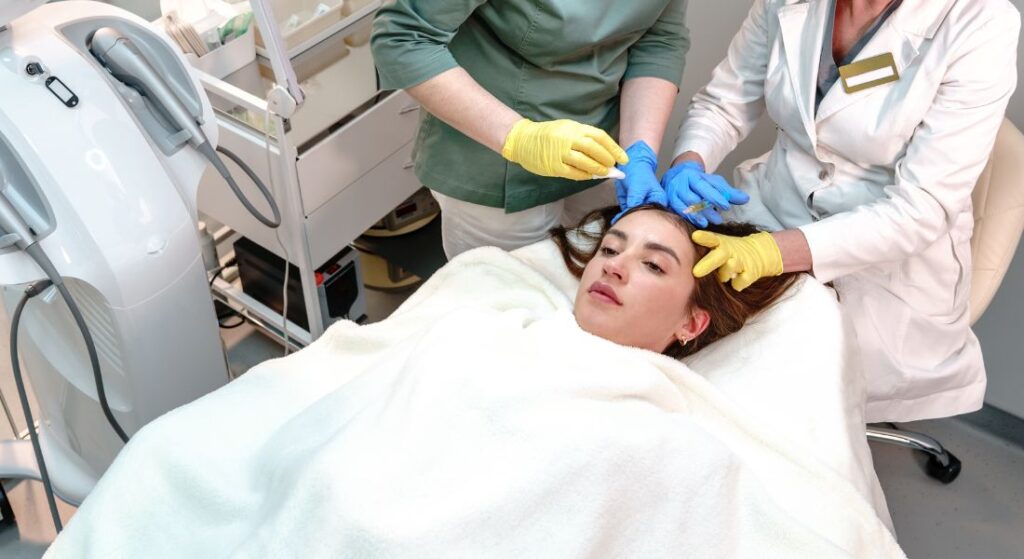
Sculptra is most often delivered as a course of treatments rather than a single session. This allows collagen stimulation to build gradually, supporting natural tissue regeneration without overwhelming the skin. Spacing sessions gives the practitioner time to assess how your skin responds before adding more product. Dosage and placement can be adjusted if needed, helping to maintain balance and symmetry.
This staged approach also reduces the risk of uneven collagen formation or overcorrection. By allowing the skin to adapt between sessions, results develop in a smoother and more controlled way. Overall, multiple sessions lead to more predictable, natural-looking outcomes that evolve gradually, enhancing facial support while preserving normal expression.
How Placement Affects Collagen Stimulation
Where Sculptra is placed is just as important as the amount used. The product is injected into precise layers of the skin where collagen stimulation can occur safely and effectively.
Correct placement allows for even distribution and controlled collagen formation, reducing the risk of lumps, uneven texture, or irregular results. This is one of the main reasons practitioner experience is so critical when using Sculptra.
When Sculptra is placed properly, collagen develops evenly beneath the skin. The face gains improved support and firmness without any change to natural movement or expression.
Why Sculptra Feels Subtle Rather Than Dramatic
Sculptra is designed to improve the face from the inside out rather than create immediate, visible volume. Instead of reshaping individual features, it focuses on restoring the skin’s underlying support system, which naturally weakens with age. This foundational approach is why the results tend to feel refined rather than obvious.
It works on structure, not surface shape: Sculptra rebuilds collagen deep within the skin, strengthening the framework that supports the face. Because it doesn’t add instant bulk at the surface, facial features remain unchanged while overall support improves.
Changes develop gradually over time: Improvements appear slowly as new collagen forms and matures. This gradual progression allows the face to adapt naturally, avoiding sudden or dramatic shifts in appearance.
Results enhance skin quality rather than volume: Patients often notice firmer, smoother, and more resilient skin rather than fuller cheeks or sharper contours. The focus is on improved texture and support, not visible filling.
Expressions and facial movement remain natural: Because Sculptra does not interfere with facial muscles or add weight to the skin, expressions stay the same. The face continues to move naturally, which contributes to the subtlety of the results.
Others notice improvement without noticing treatment: Friends and colleagues often comment that someone looks refreshed, healthier, or well rested. The absence of obvious “work done” is one of the defining characteristics of Sculptra.
Sculptra’s subtlety is intentional. By restoring what has gradually been lost rather than introducing something new, it creates changes that blend seamlessly with your natural features. The result is a fresher, more supported appearance that evolves quietly over time, without dramatic or artificial-looking effects.
How Long Do Results Last?
Because Sculptra stimulates your own collagen, results tend to last longer than traditional fillers. Many patients see benefits lasting up to two years or more.
The longevity depends on factors such as age, skin quality, lifestyle, and how well the treatment course is planned.
While collagen will continue to break down naturally over time, the baseline improvement achieved with Sculptra can be maintained with occasional top-up treatments.
Is the Collagen Produced Natural?
Yes, the collagen produced after Sculptra treatment is entirely your own. Your body is not creating anything artificial or synthetic; it is simply being stimulated to restore collagen that has been lost over time.
Because this collagen is biologically natural, it integrates seamlessly with your existing facial structure. The skin continues to behave and move normally, maintaining natural expression while benefiting from improved support.
This biological compatibility is one of the main reasons Sculptra is often chosen by patients seeking subtle, long-term improvement rather than obvious or short-lived cosmetic changes.
How Sculptra Differs From Skin-Deep Treatments

Many anti-ageing treatments focus on improving how the skin looks on the surface. While these approaches can be helpful, they have limits when deeper structural changes are driving facial ageing. Sculptra is designed to work beneath the surface, targeting the underlying loss of collagen that topical and superficial treatments cannot reach.
Topical products work only on the outer layers – Skincare products support the skin barrier, hydration, and surface texture. They can improve smoothness and brightness but cannot penetrate deeply enough to replace collagen that has been lost over time.
Sculptra acts at a structural level – Rather than treating visible signs alone, Sculptra stimulates collagen production within the deeper layers of the skin. This helps rebuild the framework that supports facial shape and firmness.
It addresses the root cause of ageing changes – Facial ageing is driven largely by gradual collagen loss and weakening support. By encouraging the body to produce new collagen, Sculptra targets the cause of thinning, sagging, and volume loss, not just the symptoms.
Best suited for deeper, widespread concerns – Sculptra is particularly effective for patients experiencing overall facial laxity, volume depletion, or skin thinning. It is less about treating fine lines and more about restoring strength and resilience to the skin.
Complements rather than replaces skincare – Skin-deep treatments still play an important role in maintaining skin health. Sculptra works alongside them, providing deeper support while topical products optimise the skin’s surface.
In short, Sculptra fills a gap that skincare alone cannot. By working from within to restore collagen, it creates improvements in firmness and support that surface-level treatments are unable to achieve, leading to results that feel natural and long lasting.
Combining Sculptra With Other Treatments
Sculptra can be combined with other aesthetic treatments when appropriate, but careful timing and planning are essential. Each treatment needs to be positioned within an overall strategy rather than applied in isolation.
Collagen stimulation works best when it complements other interventions instead of competing with them. Overlapping treatments without a clear plan can disrupt how results develop and may compromise overall balance.
A tailored approach ensures that collagen builds in harmony with the rest of your face. When treatments are coordinated thoughtfully, outcomes look natural, proportionate, and well integrated over time.
FAQs:
1. What is Sculptra, and how does it differ from other dermal fillers?
Sculptra is an injectable treatment that works by stimulating your body to produce its own collagen over time rather than adding immediate volume like traditional dermal fillers. While most fillers create instant fullness beneath the skin, Sculptra enhances the skin’s underlying structure gradually. This approach supports natural-looking results and long-term improvement in firmness and volume, rather than just treating surface-level wrinkles or lines.
2. How does Sculptra stimulate collagen production?
The active ingredient in Sculptra, poly-L-lactic acid (PLLA), triggers a controlled biological response in the skin. After injection, the body recognises PLLA particles as safe, prompting fibroblasts the cells responsible for collagen production to increase activity. Over weeks and months, these fibroblasts gradually lay down new collagen fibres, strengthening the skin’s support system and improving overall firmness and texture.
3. Why do results take time to appear?
Results from Sculptra are not immediate because collagen production is a slow, natural process. After treatment, the body begins rebuilding its structural support gradually. Patients may notice subtle improvements in skin texture and firmness within the first few weeks, but full results typically appear progressively over several months, allowing the face to adapt naturally without sudden or artificial changes.
4. How long do Sculptra results last?
Because Sculptra stimulates your own collagen, results generally last longer than traditional dermal fillers. Many patients enjoy benefits for up to two years or more. While natural collagen continues to degrade over time, the structural improvements achieved with Sculptra provide a long-lasting foundation that can be maintained with occasional top-up treatments if desired.
5. Is the collagen produced by Sculptra natural?
Yes, the collagen generated after Sculptra treatment is completely your own. The body is simply being encouraged to replace lost collagen, so the new fibres integrate seamlessly with your existing tissue. This means your skin maintains natural expression and movement while gaining improved support and resilience, giving subtle, biologically harmonious results.
6. How many sessions are typically needed?
Sculptra is usually administered as a series of sessions rather than a single injection. Multiple treatments allow collagen stimulation to develop gradually, reducing the risk of uneven results or overcorrection. Spacing sessions also gives the practitioner the opportunity to monitor progress and adjust placement or dosage if needed, ensuring natural and balanced improvements over time.
7. Does placement of Sculptra affect outcomes?
Yes, precise placement is critical for effective and safe collagen stimulation. Sculptra is injected into specific layers of the skin where fibroblasts can respond optimally. Proper technique ensures even collagen formation and reduces the risk of lumps, uneven texture, or irregular results. Experienced practitioners can achieve consistent, subtle enhancements that support facial structure while preserving natural movement.
8. Can Sculptra be combined with other treatments?
Sculptra can be safely combined with other aesthetic interventions, but timing and strategy are important. Collagen stimulation works best when integrated into a holistic treatment plan rather than applied in isolation. Coordinating treatments ensures that the skin rebuilds evenly and that the results complement each other, maintaining proportion, balance, and a natural overall appearance.
9. Why does Sculptra feel more subtle than other treatments?
Sculptra focuses on restoring the skin’s underlying framework rather than instantly adding surface volume. Because it strengthens structure gradually, changes develop slowly and subtly. This approach improves skin quality, firmness, and resilience without altering facial features dramatically, allowing others to notice a refreshed, healthier look without obvious signs of cosmetic intervention.
10. Who is the ideal candidate for Sculptra?
Sculptra is particularly suited to individuals experiencing gradual facial ageing due to collagen loss, including sagging, thinning, or overall volume depletion. It is most effective for those seeking subtle, long-term improvement in skin firmness and structural support rather than immediate, dramatic enhancement. Patients looking for natural results that maintain facial expression often benefit the most from this treatment.
Final Thoughts: Achieving Natural Facial Rejuvenation with Sculptra
Sculptra provides a unique approach to facial rejuvenation by stimulating your body’s own collagen production rather than creating immediate volume. This gradual process helps restore underlying structural support, improve skin firmness, and enhance overall facial balance, all while maintaining natural expression and movement. Results develop progressively over several months, giving a subtle, refined improvement that integrates seamlessly with your features.
To achieve optimal outcomes, it’s important to follow your personalised treatment plan, attend scheduled sessions, and allow time for collagen to build naturally. At the London Medical & Aesthetic Clinic, your practitioner will tailor your Sculptra course to your skin’s needs, monitor progress, and adjust treatment as necessary to ensure balanced, long-lasting results. If you’re considering sculptra treatment in London, you can reach out to us at the London Medical & Aesthetic Clinic.
References:
1. Sundaram, H. & Voigts, B., 2011. Nonsurgical rejuvenation of the aging face with injectable poly‑L‑lactic acid for restoration of soft tissue volume. https://academic.oup.com/asj/article-abstract/31/1/95/274078
2. Fabi, S. et al., 2024. Effectiveness and safety of Sculptra Poly‑L‑lactic Acid injectable implant in the correction of cheek wrinkles. https://pubmed.ncbi.nlm.nih.gov/38206151/
3. de Oliveira Da Silva, R., Butcher, B.E. & de Miranda, R.M.P., 2025. Efficacy, durability, and safety of collagen biostimulators based on poly‑L‑lactic acid and calcium hydroxyapatite in the face: a systematic review. https://pubmed.ncbi.nlm.nih.gov/41184662/
4. de Veras, L.P. et al., 2024. Efficacy and Safety of Poly‑L‑Lactic Acid in Facial Aesthetics: A Systematic Review. Polymers, 16(18), 2564. https://www.mdpi.com/2073-4360/16/18/2564
5. Burgess, C.M., Narins, R.S. & Murphy, D.K., 2009. Injectable poly‑L‑lactic acid (PLLA) provides long‑lasting improvement in nasolabial fold wrinkles through stimulation of endogenous collagen production. https://www.sciencedirect.com/science/article/abs/pii/S0190962209009621