

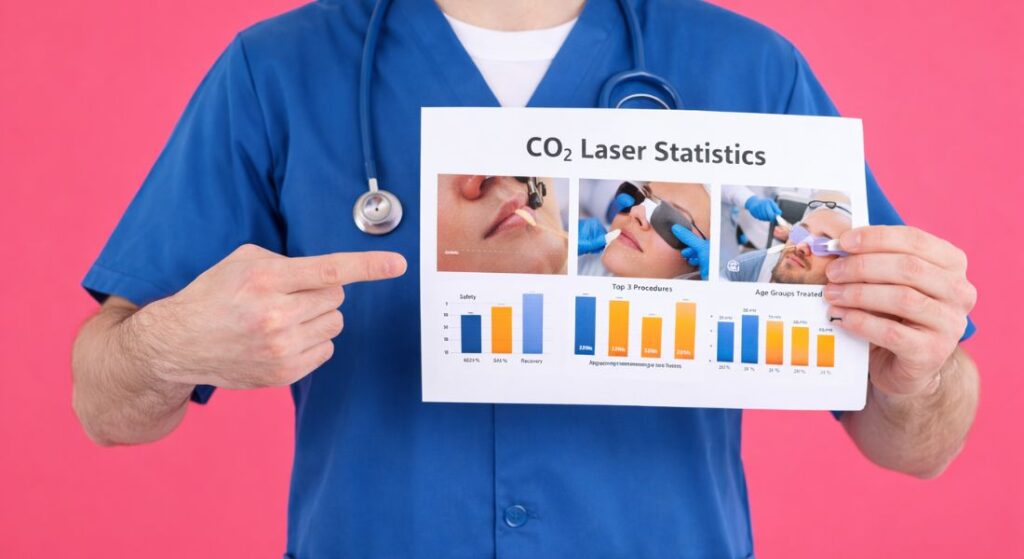
When you research skin resurfacing treatments, CO₂ laser is often described as one of the most powerful options available. However, power alone does not help you decide whether a treatment is right for you. What truly matters is data how often it works, how long recovery takes, and what risks are realistically involved.
In this article, we bring together key statistics related to CO₂ laser resurfacing, including wrinkle and texture improvement rates, downtime averages, complication frequencies, and long-term outcomes from clinical research. We explain what these numbers really mean so you can make informed decisions with clarity rather than assumptions. At London Medical & Aesthetic Clinic, we use statistics to educate, not to oversell results.
Why Statistics Matter More Than Marketing for CO₂ Laser
We often see CO₂ laser promoted through dramatic before-and-after images, but these usually highlight ideal outcomes. Statistics give a broader and more honest view by showing how treatments perform across many patients. This helps us understand typical results rather than exceptional cases.
By looking at averaged data, we gain insight into consistency and reliability. It becomes clear that skin response varies and is influenced by biology rather than promises. This perspective supports more realistic decision-making.
When we rely on statistics instead of marketing alone, expectations tend to be better aligned. That alignment reduces disappointment and improves overall satisfaction. Data reminds us that results are guided by healing processes, not guarantees.
How CO₂ Laser Outcomes Are Measured in Clinical Studies
We do not assess CO₂ laser success based only on visual change. Clinical studies measure wrinkle depth, skin texture scores, and microscopic tissue changes. Patient-reported satisfaction is also included to capture lived experience.
These measurements are collected over months rather than days. This timeline reflects the extended healing and collagen remodelling phase after treatment. Short-term assessment would miss much of the true effect.
By using multiple outcome measures, studies provide a more complete picture. We can better understand both surface improvement and deeper structural change. This approach improves the accuracy of reported results.
Wrinkle Reduction Statistics: What the Data Shows
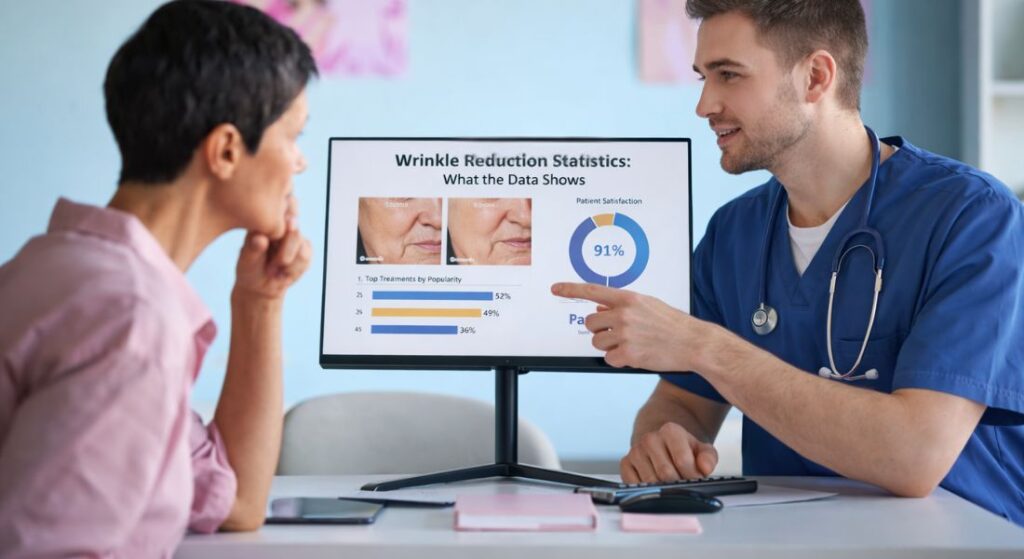
Clinical research consistently shows moderate to significant wrinkle improvement in most patients. Reported reductions commonly range between 40–70%, depending on wrinkle depth and treatment intensity. Deeper wrinkles tend to respond more noticeably than fine lines alone.
Importantly, results continue to evolve for several months. This gradual change reflects ongoing collagen formation rather than instant correction. Improvement is therefore progressive rather than immediate.
| Outcome Measure | Reported Clinical Range | What This Means for You |
| Average wrinkle reduction | 40–70% | Depends on wrinkle depth and treatment intensity |
| Fine lines response | 30–50% improvement | Subtle but visible smoothing |
| Deep wrinkles response | 50–70% improvement | More noticeable structural change |
| Time to peak improvement | 3–6 months | Collagen remodelling phase |
| Sustained improvement at 12 months | 70–85% | Results remain above baseline |
Clinical context: Wrinkle reduction is progressive, not instant. Statistics show that improvement reflects biological repair rather than surface filling.
These statistics explain why patience is required after treatment. We see that wrinkle reduction is a biological process that unfolds over time. Understanding this helps set realistic expectations from the outset.
Skin Texture and Surface Smoothness Improvements
Texture improvement is one of the strongest statistically supported outcomes of CO₂ laser treatment. Studies report visible smoothing in a large majority of patients, often between 70–90%. Changes in pores, roughness, and uneven tone frequently occur together.
These improvements are not purely cosmetic. They reflect structural changes within both the epidermis and dermis. Skin becomes more uniform because tissue architecture is altered.
By focusing on texture rather than isolated features, we better appreciate the overall effect. Smoother skin quality often contributes more to perceived improvement than wrinkle reduction alone. This explains high satisfaction rates in many studies.
Pigmentation and Sun Damage Response Rates
CO₂ laser shows strong effectiveness for sun-damaged skin. Clinical data demonstrates significant improvement in pigmentation irregularities, particularly superficial changes. This makes it a valuable option for photoageing concerns.
Deeper pigment issues may respond less predictably. In such cases, combination approaches are sometimes required. Statistics support careful selection rather than universal application.
By understanding response rates, we can guide treatment choices more safely. Pigment outcomes depend on depth, skin type, and aftercare. Data helps us manage these variables responsibly.
Collagen Remodelling: What the Evidence Shows
CO₂ laser resurfacing works by triggering biological repair rather than creating a surface-only effect. The most important changes happen beneath the skin, where collagen is rebuilt over time. Understanding this process helps explain both the timing and durability of results.
Here’s what the evidence shows:
1. Measurable Increases in Collagen Density – Histological studies confirm increases in collagen density commonly in the range of 20–40% compared to baseline. These changes are objectively measured rather than visually assumed.
2. New Collagen Forms Over Several Months – Collagen production continues for approximately 3–6 months after treatment. This ongoing activity underpins gradual, long-term improvement rather than immediate change.
3. Remodelling Explains Durable Results – Because the skin is structurally rebuilt, results tend to last. The improvement comes from strengthened tissue rather than a temporary surface effect.
4. Delayed Improvement Reflects Regeneration – The absence of instant results is expected and intentional. Skin quality improves progressively as collagen fibres mature and reorganise.
By recognising collagen remodelling as a biological process, we can explain realistic timelines more clearly. Results reflect regeneration from within rather than surface change alone. This foundation is what supports lasting improvement in skin strength, texture, and resilience.
Downtime Statistics: Average Recovery Timelines
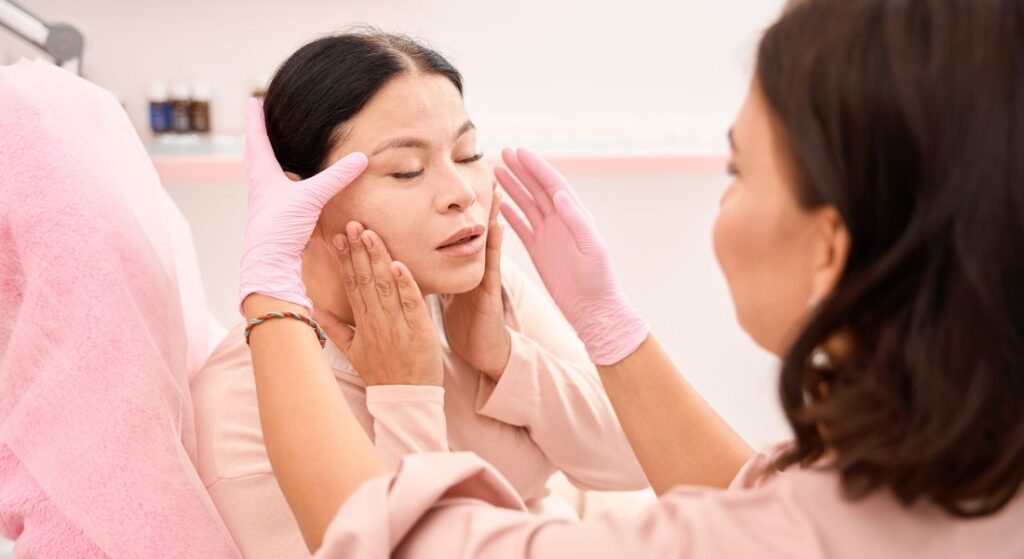
Recovery time varies depending on treatment depth. Fully ablative CO₂ laser typically involves 7–14 days of visible healing, including crusting and peeling. Redness may persist beyond this initial period, often for several additional weeks.
| Recovery Phase | Fully Ablative CO₂ | Fractional CO₂ |
| Crusting / peeling | 7–14 days | 5–7 days |
| Redness persistence | 4–8 weeks | 2–4 weeks |
| Re-epithelialisation | 7–10 days | 5–7 days |
| Collagen remodelling | 3–6 months | 3–6 months |
| Final skin settling | Up to 6 months | Up to 6 months |
Why this matters: Downtime varies by depth. Data helps you choose the right intensity based on recovery tolerance.
Fractional approaches generally reduce downtime. Statistics show faster recovery with less aggressive protocols, with visible healing commonly occurring within 5–7 days. This trade-off influences treatment choice.
By reviewing downtime data, we can plan recovery more realistically. Understanding averages helps us prepare for variation. Healing is individual, but patterns are predictable.
Return-to-Work and Social Downtime Data
Recovery after CO₂ laser treatment is predictable, but it is not identical for everyone. Understanding typical timelines helps reduce uncertainty and allows practical planning around work and social commitments. Clear data supports calmer recovery expectations.
Here’s what recovery data shows:
1. Return to Daily Activities Is Usually Within 10–14 Days – Most patients resume normal daily routines within 10–14 days following standard CO₂ laser treatment. This reflects functional recovery rather than complete skin normalisation.
2. Social Downtime May Last Longer Due to Redness – Residual redness can persist for several weeks, particularly after deeper or higher-intensity treatments. This is a cosmetic consideration rather than a medical limitation.
3. Make-Up Is Often Possible After Re-Epithelialisation – Once the skin has re-epithelialised commonly by 7-10 days make-up can usually be applied. This often shortens perceived downtime even if redness remains.
4. Timelines Represent Averages, Not Fixed Rules – Recovery varies based on treatment depth, skin type, and healing response. These figures provide guidance, not guarantees.
By discussing these timelines openly, expectations become clearer and more manageable. With realistic planning, we can align treatment with work and social needs more comfortably. This clarity reduces stress and supports a smoother recovery experience.
| Activity Milestone | Typical Timeframe | Practical Meaning |
| Resume basic daily activities | 7–10 days | Functional recovery |
| Return to desk-based work | 10–14 days | Depending on redness tolerance |
| Make-up use permitted | 7–10 days | After re-epithelialisation |
| Social confidence return | 2–4 weeks | Redness gradually fades |
| Complete cosmetic recovery | 6–8 weeks | Skin tone normalises |
Clinical insight: Medical recovery and social readiness are different. Statistics help you plan both realistically.
Pain and Discomfort Reporting in Studies
CO₂ laser is associated with moderate procedural discomfort, with patient-reported pain scores typically falling in the mild-to-moderate range when modern anaesthesia techniques are used. Most patients describe discomfort as manageable.
Post-procedure sensitivity usually settles within 3–5 days. Studies consistently show rapid improvement after the initial phase, and pain rarely persists beyond the first one to two weeks.
Clear explanation improves tolerance. When we know what to expect, discomfort feels more controlled. Data supports reassurance rather than fear.
Complication Rates: What the Statistics Actually Show
Serious complications after CO₂ laser are uncommon, with reported rates typically below 1–2% in experienced hands. Reported risks include infection, prolonged redness, and scarring.
Most complications are temporary and manageable. Permanent adverse outcomes are rare, particularly when protocols and aftercare guidelines are followed correctly. Technique and monitoring play a key role.
| Complication Type | Reported Frequency | Clinical Interpretation |
| Overall complication rate | <5% | Mostly temporary |
| Prolonged erythema | 2–5% | Resolves with time |
| Infection | <1–2% | Rare with proper care |
| Scarring | <1% | Usually linked to aftercare |
| Permanent adverse outcomes | Very rare | Uncommon in modern practice |
Why we share this: Risk exists, but serious complications are uncommon when protocols and aftercare are followed.
By reviewing complication data honestly, we support informed consent. Statistics help us balance benefit and risk. This transparency builds trust and confidence.
Hyperpigmentation Risk Statistics
We recognise post-inflammatory hyperpigmentation as a known risk after CO₂ laser treatment. Statistics show that risk varies depending on skin type, baseline pigmentation, and sun exposure, with reported incidence ranging from 5–10% in lighter skin types to 15–30% in darker skin tones. Darker skin tones are consistently shown to have higher susceptibility.
Our understanding of this risk allows us to plan proactively. Pre-treatment preparation and structured aftercare protocols have been shown to reduce incidence rates significantly, often to single-digit percentages. Sun avoidance and protection play a central role in prevention.
When data is applied correctly, risk becomes manageable rather than alarming. We use statistics to guide safer protocols. This ensures outcomes remain predictable and controlled.
Infection and Scarring Data
We see low infection rates when established clinical protocols are followed, with modern studies reporting infection rates below 1–2%. Scarring is rare and most often linked to improper aftercare rather than the laser itself. Contemporary data shows lower risks than earlier reports suggested.
| Risk Factor | Reported Rate | Risk Modifier |
| Infection | <1–2% | Reduced with sterile technique |
| Hypertrophic scarring | <1% | Linked to delayed healing |
| Atrophic scarring | Rare | Usually technique-related |
| Poor aftercare contribution | Major risk factor | Sun exposure, picking |
| Improvement over last decade | Significant | Due to protocol refinement |
Clinical meaning: Modern techniques and structured aftercare have markedly reduced infection and scarring risk.
Advances in technique and post-treatment care have improved safety outcomes. Longitudinal studies demonstrate a steady decline in complication rates over the past decade, particularly in experienced hands. Skilled handling and monitoring make a measurable difference.
By understanding these statistics, we can reassure patients realistically. Risk is present but limited when managed properly. Data supports confidence, not complacency.
Long-Term Outcome Data Beyond One Year
Long-term studies consistently show sustained improvement at 12–24 months, with measurable benefits in texture, tone, and wrinkle reduction remaining above baseline. Even as collagen naturally declines, skin quality often remains improved.
Results are not permanent, as ageing continues. However, follow-up data shows gradual change rather than sudden loss, and improvement does not disappear completely. The skin tends to age from a higher-quality baseline.
We use this data to discuss maintenance thoughtfully. Ongoing care may be considered, not because results fail, but because biology evolves. Statistics support long-term planning.
Fractional vs Fully Ablative CO₂ Laser Statistics
Fractional CO₂ laser treatments are associated with shorter downtime, with visible recovery typically occurring within 5-7 days. Fully ablative treatments, by contrast, deliver more dramatic results but involve longer recovery, often 10–14 days or more. Statistics clearly show this trade-off.
Choice depends on goals, tolerance, and lifestyle factors. Comparative outcome data shows higher intensity improvement with fully ablative treatments, balanced against increased downtime. Neither approach is universally superior.
| Outcome Metric | Fractional CO₂ | Fully Ablative CO₂ |
| Wrinkle improvement | 30–50% | 50–70% |
| Texture improvement | 60–80% | 70–90% |
| Downtime duration | 5–7 days | 10–14+ days |
| Risk profile | Lower | Moderate |
| Suitability | Milder ageing | Advanced ageing |
Clinical takeaway: Neither approach is superior overall. Statistics support personalised selection based on goals and downtime tolerance.
By reviewing outcomes comparatively, we can personalise treatment plans. Statistics support flexibility rather than rigid recommendations. This improves safety and satisfaction.
Patient Satisfaction Statistics Over Time
Patient satisfaction with treatments that work through regeneration is best understood over time, not immediately after the procedure. Long-term data gives a more accurate picture of how patients truly feel once healing has completed and results have settled. This perspective helps frame success more realistically.
Here’s what satisfaction data shows:
1. Long-Term Satisfaction Rates Remain High
Studies commonly report patient satisfaction rates between 80–90% at long-term follow-up. These figures reflect outcomes once healing and collagen development are complete.
2. Satisfaction Often Increases Over Time
Rather than peaking early, satisfaction frequently rises as recovery progresses. As redness fades and skin quality improves, confidence in the result tends to grow.
3. Delayed Appreciation Is a Recognised Pattern
Studies tracking patients over 6–12 months show increasing contentment as collagen matures. Results feel more natural and integrated with facial features over time.
4. Long-Term Confidence Matters More Than Immediate Reaction
Initial excitement is not always the best measure of success. Lasting comfort, confidence, and acceptance of the result are more meaningful indicators.
We use satisfaction data to set expectations honestly and responsibly. By focusing on long-term outcomes rather than immediate impressions, we support decisions grounded in realism. Consistent, lasting contentment is the true measure of success.
Age and Skin Type Differences in Outcomes

Younger patients often heal more quickly following CO₂ laser treatment, with shorter re-epithelialisation times and faster resolution of redness commonly observed within 7–10 days. Older patients still achieve meaningful improvement, though timelines may be longer, with healing and collagen remodelling extending over several additional weeks. Statistics consistently show variability rather than exclusion.
Skin type influences risk profiles more than benefit. Outcome data shows comparable improvement across age groups, while complication risk varies by skin type rather than age alone. Outcomes remain achievable with appropriate planning and protocol adjustment.
By acknowledging these differences, we avoid one-size-fits-all thinking. Data helps us tailor care safely. Personalisation remains essential.
Real-World Data Versus Clinical Trials
Clinical trials operate under strict and controlled conditions, often involving standardised protocols and defined patient groups. Real-world data reflects broader variation across patients, techniques, and recovery, frequently drawing from hundreds to thousands of treated cases.
| Data Source | Sample Size | What It Reflects |
| Clinical trials | 50–300 patients | Controlled conditions |
| Follow-up duration | 6–24 months | Standardised outcomes |
| Real-world datasets | Hundreds to thousands | Everyday clinical practice |
| Technique variation | Low in trials | Higher in real-world |
| Outcome trend consistency | High | Strengthens reliability |
Why both matter: When outcomes align across trials and real-world use, confidence in safety and effectiveness increases.
When trends align between trials and real-world use, confidence increases. CO₂ laser shows consistent patterns in wrinkle reduction, texture improvement, and satisfaction across both settings, supporting reliability in everyday practice.
We rely on both data sources to guide recommendations. Together, they create a more complete picture. Consistency strengthens trust.
What CO₂ Laser Statistics Cannot Guarantee
Statistics cannot predict individual healing responses. Even when average improvements are reported, individual results may fall above or below expected ranges. They do not guarantee wrinkle elimination or perfect symmetry.
Data describes probability rather than certainty. Outcome figures reflect likelihood, not precision, and understanding these limits prevents unrealistic expectations. Transparency helps patients engage more confidently with treatment decisions.
We use data to inform, not to promise. When limitations are acknowledged, trust grows. Honest discussion supports better experiences.
Ethical Use of CO₂ Laser Statistics in Practice
Statistics are an important part of patient education, but only when they are used responsibly. Numbers should help you understand what a treatment can realistically offer, not create pressure or unrealistic expectations. Clear explanation and honest context are essential.
Here’s how CO₂ laser statistics should be used in practice:
1. Statistics Should Support Education, Not Persuasion – Data works best when it explains trends and possibilities rather than encouraging decisions. We use numbers to inform understanding, not to influence choice.
2. Context Matters More Than Isolated Percentages – Most published outcomes reflect population-level averages, not individual guarantees. Without explanation, statistics can be misleading, which is why context is always provided.
3. Understanding Is Prioritised Over Claims – At London Medical & Aesthetic Clinic, data is used to guide meaningful discussion rather than promote outcomes. The focus remains on clarity, not comparison.
4. Transparency Supports Patient Autonomy – Explaining both benefits and limitations allows patients to make decisions that feel informed and confident. Honest data presentation respects autonomy and individual choice.
By grounding discussions in evidence rather than exaggeration, realistic expectations are built from the start. Trust develops through honesty, not promises. Education remains central to care, ensuring decisions are based on understanding rather than assumption.
| Ethical Principle | How Data Is Used | Why It Matters |
| Use of averages | Outcomes shown as ranges | Prevents false certainty |
| Long-term focus | ≥12 months data prioritised | Reflects real durability |
| No guarantees | No “perfect result” claims | Supports informed consent |
| Contextual explanation | Numbers explained in plain language | Avoids misinterpretation |
| Education-first approach | Data guides discussion, not sales | Builds trust |
Our approach: Statistics are used to educate you, not persuade you. Honest data supports confident, autonomous decisions.
How Data Should Guide Your Treatment Decision
Data supports CO₂ laser as a powerful resurfacing option for significant skin ageing and texture concerns, with measurable improvements commonly reported over 3–6 months and durability extending beyond 12 months. It is not a light or casual treatment. Commitment to recovery is required.
Understanding the statistics helps align goals with reality. When expectations match biological timelines, satisfaction improves. Results feel earned rather than assumed.
We use data to support confident, informed decisions. Evidence guides suitability and planning. This leads to safer outcomes and long-term satisfaction.
FAQs:
1. What do CO₂ laser statistics actually tell us about effectiveness?
CO₂ laser statistics show average levels of wrinkle reduction, texture improvement, and skin renewal across large patient groups. They reflect how consistently the treatment performs rather than highlighting exceptional results. These figures help patients understand typical improvement rather than expecting perfection.
2. How much wrinkle improvement is realistically seen with CO₂ laser treatment?
Clinical data commonly reports wrinkle reduction in the range of 40–70%, depending on wrinkle depth and treatment intensity. Deeper wrinkles tend to show more noticeable improvement than fine lines alone. Results develop gradually rather than appearing immediately.
3. How long does it take to see final results according to clinical data?
Most studies show that visible improvement continues to develop for three to six months after treatment. This timeline reflects collagen remodelling rather than surface healing alone. Early changes are not the final outcome, which is why patience is essential.
4. What do statistics say about recovery time after CO₂ laser resurfacing?
Fully ablative CO₂ laser typically involves 7–14 days of visible healing, with redness persisting for several weeks. Fractional CO₂ laser usually shortens downtime to around 5–7 days. These timelines represent averages rather than fixed rules.
5. When do most patients return to work or social activities after CO₂ laser?
Clinical recovery data shows most patients resume desk-based work within 10–14 days. Social confidence may take longer due to lingering redness rather than medical limitation. Makeup is often possible once re-epithelialisation is complete.
6. How safe is CO₂ laser based on complication statistics?
Large studies report low rates of serious complications when CO₂ laser is performed correctly. Most side effects are temporary, such as redness or swelling, while permanent complications are rare. Proper technique and aftercare significantly reduce risk.
7. What is the risk of pigmentation problems according to the data?
Post-inflammatory hyperpigmentation rates vary by skin type, with higher risk reported in darker skin tones. Clinical data shows that structured pre-treatment and aftercare can significantly reduce this risk. Sun protection plays a critical role in prevention.
8. How durable are CO₂ laser results based on long-term studies?
Follow-up data shows improvements in texture and wrinkles often remain visible at 12–24 months. Results are not permanent, but skin usually ages from a higher-quality baseline. Improvement fades gradually rather than disappearing suddenly.
9. How does fractional CO₂ laser compare statistically to fully ablative treatment?
Fractional CO₂ laser offers shorter downtime with moderate improvement, while fully ablative CO₂ provides stronger results with longer recovery. Statistics show neither approach is universally better. Choice depends on goals, skin condition, and recovery tolerance.
10. What are the limitations of CO₂ laser statistics for individual patients?
Statistics cannot predict individual healing speed, symmetry, or exact improvement. They describe probability rather than certainty and reflect averages across populations. Understanding these limits helps prevent unrealistic expectations and supports informed decision-making.
Final Thoughts: Using CO₂ Laser Data to Make Confident Decisions
When you look beyond marketing and focus on clinical statistics, CO₂ laser resurfacing becomes much easier to assess realistically. The data shows meaningful improvement in wrinkles, texture, and skin quality, balanced against clearly defined recovery timelines and manageable risks when treatment is performed correctly. Understanding these figures helps you see CO₂ laser not as a quick fix, but as a structured, regenerative treatment that works through healing and collagen remodelling over time.
If you’re looking for C02 laser treatment in London, you can get in touch with us at London Medical & Aesthetic Clinic. We use statistics to guide honest conversations, assess suitability carefully, and help you decide with clarity, so expectations stay realistic and outcomes feel informed, safe, and well-planned.
References
1. Clementi, A., et al. (2025) ‘Sequential fractional CO₂ and 1540/1570 nm lasers in facial rejuvenation: clinical efficacy and safety’, Journal of Clinical Medicine, 14(11), 3867. https://www.mdpi.com/2077-0383/14/11/3867
2. Hsiao, P.F. (2013) ‘Efficacy and safety of a single treatment using a 10,600-nm fractional CO₂ laser for acne scars’, Journal of Cosmetic Laser Therapy, 15(4), pp.241–249. https://www.sciencedirect.com/science/article/pii/S1027811712000948
3. Alexiades-Armenakas, M.R. (2008) ‘Nonablative, fractional, and ablative laser resurfacing for photoaging and scarring’, Dermatologic Clinics, 26(6), pp.555–577. https://www.sciencedirect.com/science/article/abs/pii/S0190962208000832
4. Glogau, R.G. (1997) ‘Long-term effectiveness and side effects of CO₂ laser resurfacing for photoaged facial skin’, Journal of the American Academy of Dermatology, 36(4), pp.569–576. https://pubmed.ncbi.nlm.nih.gov/10071310/
5. Tierney, E.P. and Hanke, C.W. (2003) ‘Outcomes of fractional CO₂ laser application in aesthetic surgery: a retrospective review’, Dermatologic Surgery, 29(12), pp.1158–1166. https://pubmed.ncbi.nlm.nih.gov/21131460/